Global Cotton Market Size, Share, Trends & Growth Forecast Report, Segmented By Product (Lint & Cottonseed), Application (Textiles, Medical & Surgical, Feed, Consumer Goods), Equipment Type (Ginning, Spinning), Operation (Automatic, Semi-Automatic), and By Region (North America, Europe, Asia Pacific, Latin America, and Middle East & Africa), Industry Analysis From 2026 to 2034
Global Cotton Market Size
The global cotton market was valued at USD 42.92 billion in 2025 and is anticipated to reach USD 44.10 billion in 2026 from USD 54.74 billion by 2034, growing at a CAGR of 2.74% from 2026 to 2034.
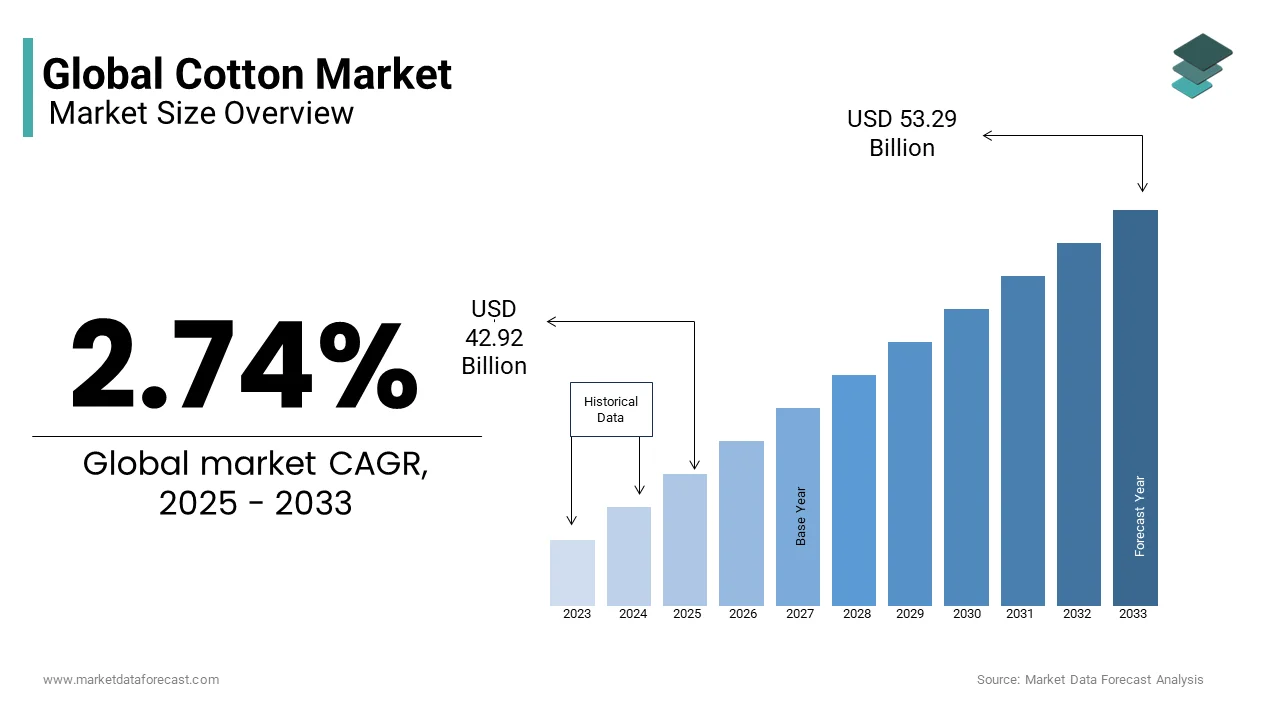
Since the eighteenth century, cotton has been an important aspect of industrial development. It also has a significant impact on the textile sector. It's a high-yielding cash crop that's mass-produced all over the world. Cotton is a major contributor to the worldwide textile mills and clothing manufacturing industries. Cotton is also a highly political crop due to its significance in the global exchange of many developing countries. Cotton may be found in practically every tropical and subtropical region on the planet. Cotton is an attractive crop for arid and semi-arid areas because it is salt and drought-tolerant.
Cotton is the most commonly used natural fiber in textiles, accounting for one-third of all fibers produced globally. It may be used to create a variety of fabrics that are robust, water-absorbent, and comfortable. It is well-renowned for its versatility, performance, and comfort. Its applications, however, are not limited to textiles. Cotton plants produce lint and seeds, which are used to make fiber, edible oil, and animal feed. More specifically, fiber is derived from cotton lint, with 64 percent of the fiber produced going to clothes, 28 percent to home furnishings, and 8% to industrial uses. Cotton seeds are crushed to produce cholesterol-free oil, which is used in cooking, cosmetics, medicines, and personal care goods. Other industrial applications, including polymers and rubber, cotton seeds, are also used to make high-protein meals for animals and fowl. "Cotton is the most widely lucrative non-food crop in the world," according to the World Wildlife Fund.
MARKET DRIVERS
Strong Global Production and Export Activity Supporting Cotton Market Expansion
VSS-compliant cotton accounted for 14.1% of the market in 2016, compared to only 1% in 2009. Cotton, which was theoretically VSS-compliant, accounted for 0.8 percent of the market. The increasing demand for cotton products worldwide, due to the wide applications and usage of cotton in various industries, contributes significantly to global market growth. The growing utilization of cotton in apparel manufacturing, home furnishings, and the manufacturing of industrial products is driving the market growth rate. The cotton market is considered a crucial component of the world economy due to its vast impact on the textile, clothing, medical, and other branches of manufacturing industries that boost the global market growth. The expanding textile industry is having a substantial positive impact on the cotton market expansion, as the textile industry is the major buyer of cotton and uses the cotton to produce various products like textile apparel, home textiles, and industrial textiles. The rising disposable incomes of the people, particularly in emerging countries, are expected to boost the demand for cotton products, expanding market revenue. The major countries like the United States, China, India, Pakistan, and Brazil are the largest cotton producers, with each country focusing on different types and qualities of the crop. For Instance, according to the US Department of Agriculture (USDA), the United States was the leading exporter of cotton worldwide in 2021 and 2022, where the cotton industry had an export volume of about 3.2 million metric tons. Brazil has the second-largest exporting share, with an export volume of 1.72 million metric tons, followed by India and Australia.
Innovation and Sustainability Driving Growth Opportunities in the Cotton Market
The escalating demand for cotton and its expected increase in the coming years due to rapid urbanization, population growth, substantial economic development, and the enlarging use of cotton in end-use industries will provide growth opportunities to the global cotton market. The growing technological advancements in the agricultural industry, particularly the increasing adoption of genetically engineered cotton and the growing investments in R&D activities, are driving productivity growth. Scientists are endeavoring to develop new cotton variants that enhance fiber quality and produce higher yields, which is estimated to boost the market growth rate significantly during the forecast period. The rising demand for organic cotton among people due to increasing interest in eco-friendly alternatives also augments the market growth rate.
MARKET RESTRAINTS
Supply Chain Shocks, Market Volatility, and Labor Issues Hindering the Global Cotton Market
Every step in the worldwide cotton–textile supply chain has been impacted by the pandemic. Many factories and businesses have shuttered as a result of public health instructions, causing many Western apparel designers to cancel or suspend existing orders. As a result, cotton farms and textile industries in many countries are projected to suffer. Several factors, notably the consequences of cotton stockpiling programs and the high sensitivity of cotton output to flooding, have already caused major price volatility in the sector. Despite the greater input prices and the impact on farmer debt levels, many farmers have become reliant on these seeds. Furthermore, cotton plantations have been linked to several societal ills, including low worker wages and documented incidences of slave labor.
MARKET CHALLENGES
Environmental, Regulatory, and Market Risks Facing the Global Cotton Industry
The rising demand for synthetic fibers is expected to create a decline in the demand for cotton products due to the lower production costs and ease of use of synthetic products, which acts as a challenge for the market players in expanding the market revenue. The continuous change in consumer preferences will negatively impact the market growth, as the market needs to adjust accordingly to guarantee precision and applicability. The increasing demand for sustainability in the market is estimated to be costly, and restricting access to small-scale farmers hinders market growth. The unpredictability of varying prices will be challenging for market expansion due to variations in weather conditions and worldwide demand. The stringent regulations regarding the quality and trade of cotton will be complex and time-consuming, leading to fluctuations in the cotton products. This is expected to limit the market growth rate. Climate change is a significant threat to the global cotton market growth, as adverse weather conditions like heatwaves, floods, droughts, and rising global water scarcity negatively impact the cotton market growth. For Instance, according to the non-profit Better Cotton Initiative, in 2022, severe flooding in Pakistan damaged around 40% of the year’s cotton harvest.
REPORT COVERAGE
| REPORT METRIC | DETAILS |
| Market Size Available | 2025 to 2034 |
| Base Year | 2025 |
| Forecast Period | 2026 to 2034 |
| CAGR | 5.40% |
| Segments Covered | By product, Application, Equipment, Operation, and Region. |
|
Various Analyses Covered | Global, Regional, and Country Level Analysis; Segment-Level Analysis, DROC; PESTLE Analysis; Porter’s Five Forces Analysis; Competitive Landscape; Analyst Overview of Investment Opportunities |
| Regions Covered | North America, Europe, APAC, Latin America, Middle East & Africa |
|
Market Leaders Profiled | UnifiInc.c, Weiqiao Textile Company Limited, Lu Thai Textile Co. Ltd., Gokak Mills, Vardhman Group, Damodar Group, Banswara Syntex Limited, Shri Vallabh Pittie Group, Oswal Group |
SEGMENTAL ANALYSIS
By Product Insights
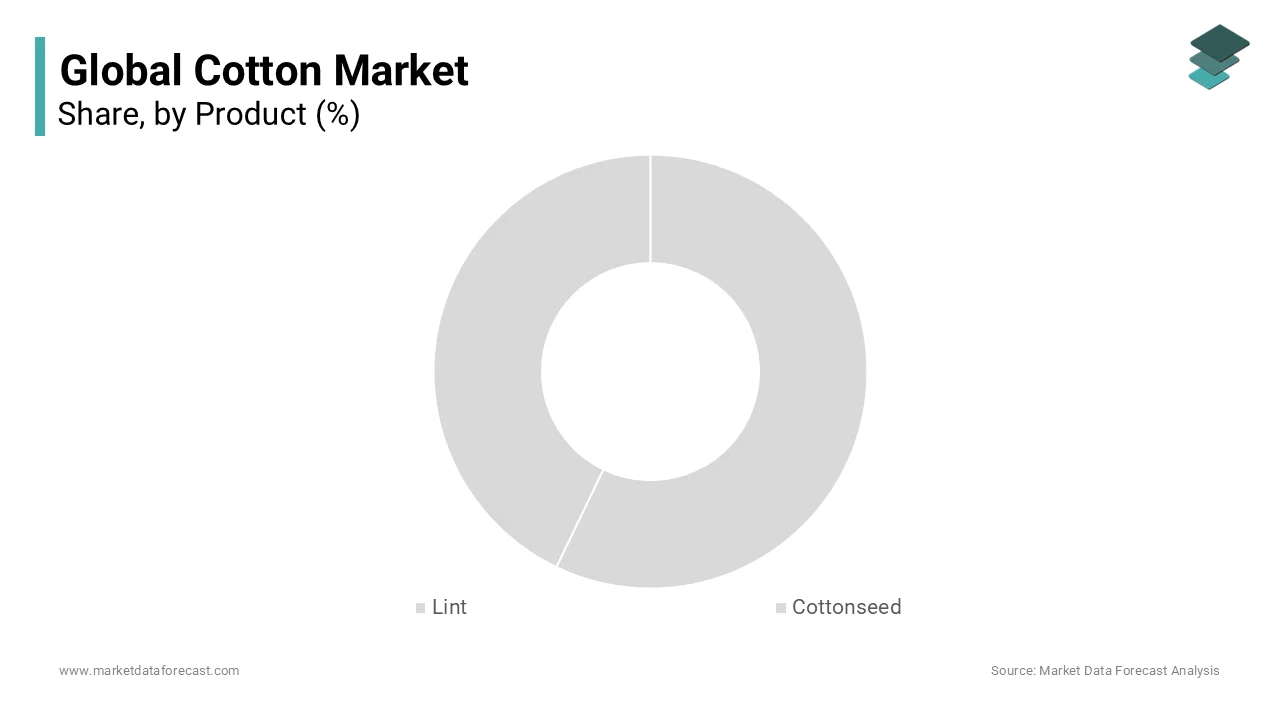
In the forecast period, the lint sector is expected to account for the highest proportion of the cotton processing market. The fiber extracted from cotton seeds during the ginning process is known as lint. The rise of urbanization and changes in consumer lifestyles have resulted in increased demand for textiles, which is expected to fuel the lint segment's expansion even more. Furthermore, rising consumer awareness of product quality is expected to boost the cotton processing market in the future years.
By Application Insights
The cotton processing market is divided into textiles, medicinal & surgical, feed, consumer goods, and others based on application. From 2025 to 2033, the textiles category is expected to be the fastest-growing segment in the cotton processing market. This is attributable to rising per capita income and shifting customer preferences, which are propelling market expansion. Furthermore, increased government investments and policy backing have driven the rise of the textile sector in nations like India and China.
By Equipment Type Insights
Over the forecast period, the spinning segment is expected to be the leading market in the cotton equipment processing market. This is owing to rising yarn usage in the textile, medicinal, and consumer products industries. Consumer expectations are rising, which is stimulating technological advancements that will result in higher-quality items. Consumer preferences are evolving, and technology improvements are propelling the market forward.
By Operation Insights
Over the forecast period, the automatic sector of the cotton processing ginning equipment market is expected to develop at the fastest rate. This is owing to machine makers' adoption of new technologies to increase mill productivity. Automatic equipment has cut labor costs and enhanced ginning mill profit margins. As a result, the automatic category is expected to increase even more in the coming years.
REGIONAL ANALYSIS
North America Market Analysis
Over the forecast period, in terms of cotton production and export, the United States is a prominent player in the global market. Approximately 20.0 million bales of cotton were produced in the United States in 2019-2020, accounting for nearly USD 7.0 million of the total value. The United States is the world's biggest cotton exporter, accounting for 37.8% of all worldwide cotton exports (2019). It helps to support the global textile industry while also allowing home farmers to market their crops through global trade. The export levels of the United States have increased dramatically since 2016. This is due to high-quality crop production paired with low levels of production from other growers. In addition, the United States is a major exporter of cotton items.
Asia Pacific Market Analysis
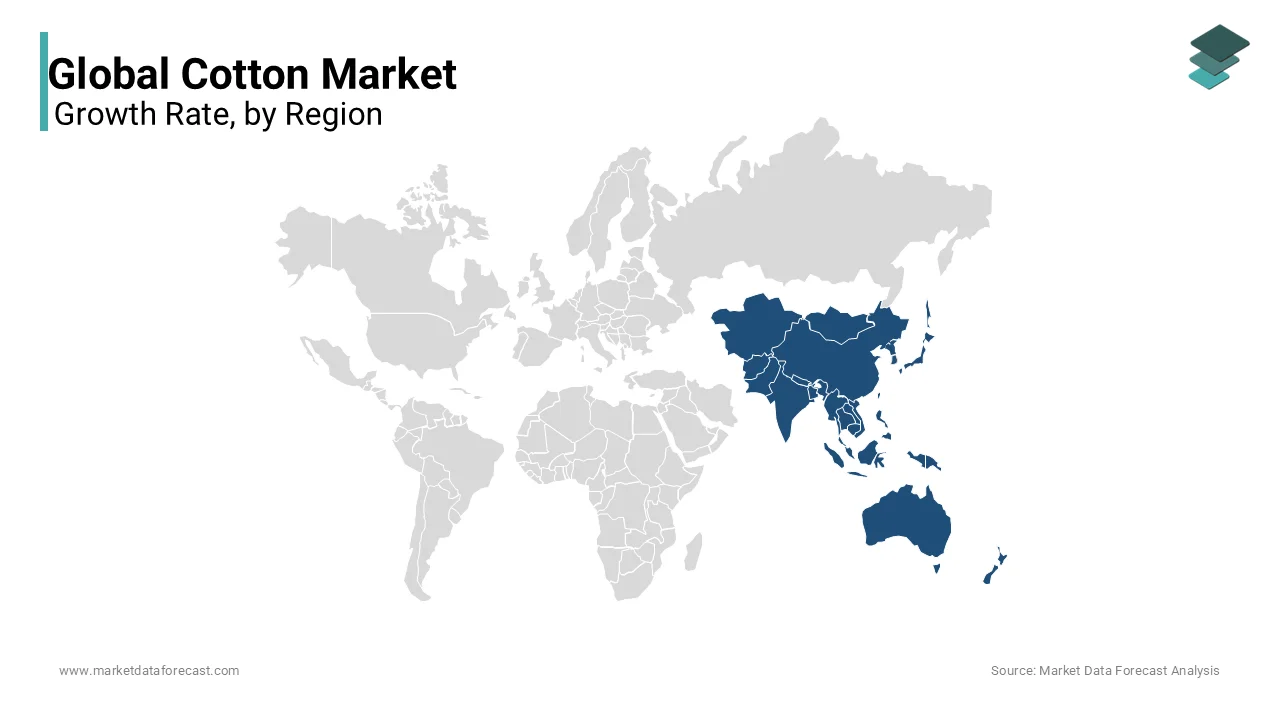
China and India combined accounted for 50.9 percent of global cotton production, with the United States coming in second. Due to the dropping price trend in the international market, global cotton production is predicted to expand at a slower rate than consumption over the forecast period. Because of the country's underdeveloped textile sector, the majority of cotton produced in the United States is exported. Although Asia dominates global cotton production, the majority of the cotton produced is consumed locally. China has the greatest market share, accounting for 29.0 percent of global cotton output and roughly 49.0 percent of milled cotton consumed. Similarly, the textile sector dominates in India, as it utilizes the majority of the cotton produced in the country.
Middle East And Africa Market Analysis
Over the next decade, Bangladesh and Vietnam are likely to be the leading importers. Both countries are expected to boost their imports by more than 43% by 2029. They will account for more than 40% of global imports when combined. Cotton is a significant export crop for Sub-Saharan Africa, which presently accounts for 15% of world exports (with West Africa accounting for about 75% of production and shipments). The top-producing countries, Burkina Faso, Benin, Mali, and Côte d'Ivoire, have seen their volumes increase as a result of increased land area and government backing.
COMPETITIVE LANDSCAPE
The global cotton market is fiercely competitive, driven by price efficiency, sustainability credentials, technological adoption, and supply chain agility. Major players like Lu Thai, Vardhman, and Weiqiao dominate through vertical integration, enabling end-to-end control from raw cotton to finished fabric. Competition intensifies as brands demand traceability, eco-certifications, and rapid sampling capabilities. Emerging economies challenge incumbents with lower labor costs, but leaders counter with automation, green manufacturing, and digital platforms for real-time collaboration. Regional players compete in niche segments, such as organic cotton, premium shirting, or technical textiles. Environmental regulations and consumer pressure push firms toward circular practices and water stewardship.
KEY MARKET PLAYERS
Some of the market players dominate the global cotton market.
- Unifi Inc
- Weiqiao Textile Company Limited
- Lu Thai Textile Co. Ltd.
- Gokak Mills
- Vardhman Group
- Damodar Group
- Banswara Syntex Limited
- Shri Vallabh Pittie Group
- Oswal Group
Top Players in the Market
- Lu Thai Textile is a global leader in premium cotton fabric manufacturing, supplying high-quality shirting materials to international apparel brands and retailers. Headquartered in China, the company integrates spinning, weaving, dyeing, and finishing under one roof, ensuring end-to-end quality control. Recently, Lu Thai has invested in sustainable cotton sourcing, adopting Better Cotton Initiative (BCI) standards and water-efficient dyeing technologies. It has expanded its digital design capabilities and launched traceable fabric collections to meet demand for transparency. Strategic collaborations with global fashion houses and the adoption of automation have reinforced its position as a reliable, innovation-driven cotton textile supplier worldwide.
- Vardhman Group, based in India, is a fully integrated cotton textile powerhouse with capabilities spanning yarn, fabric, and processed garments. It serves global markets with a reputation for consistency, scale, and compliance with international sustainability benchmarks. The group recently upgraded its manufacturing units with energy-efficient machinery and expanded organic and recycled cotton product lines. It has also strengthened backward integration by securing long-term cotton procurement partnerships with farming cooperatives. Digital transformation in supply chain management and ESG reporting has enhanced customer trust. Vardhman’s emphasis on innovation, vertical integration, and responsible sourcing continues to solidify its global relevance in the cotton value chain.
- Weiqiao Textile, part of China’s Shandong-based Binzhou Group, is among the world’s largest cotton yarn and denim fabric producers. Its vertically integrated operations ensure cost efficiency and rapid response to global demand fluctuations. Recently, Weiqiao has prioritized green manufacturing, reducing water and carbon footprints through advanced effluent treatment and renewable energy adoption. It has also increased the use of sustainable cotton and launched eco-denim collections for global fast-fashion and premium brands. Strategic investments in automation and R&D for functional cotton textiles have enhanced product differentiation.
Top Strategies Used By Key Market Participants
Key cotton market players prioritize vertical integration to control quality and costs across spinning, weaving, and finishing. Sustainability is central to adopting BCI, organic, and recycled cotton while reducing water and energy use. Digital transformation enhances supply chain transparency and fast order fulfillment. Strategic partnerships with global brands secure long-term contracts. Investment in automation and R&D drives innovation in performance fabrics. Geographic diversification mitigates regional risks. Compliance with international ESG and labor standards builds buyer confidence. Companies also engage directly with cotton farmers to ensure traceability and ethical sourcing, which is strengthening brand reputation and resilience in a volatile, eco-conscious global textile market.
RECENT MARKET NEWS
- The Indian government has eliminated the 5% basic customs charge on cotton imports to boost domestic supplies of the fiber, which has been severely hampered in the country's textiles and garments value chain.
- According to the Spinners Association (Gujarat), or SAG, an investment of Rs 3,500 crore would be made in Gujarat over the next year and a half, with 7 lakh new spindles installed to improve the state's spinning capacity.
MARKET SEGMENTATION
This research report on the global cotton market is segmented and sub-segmented into the following categories.
By Product
- Lint
- Cottonseed
By Application
- Textiles
- Medical & Surgical
- Feed
- Consumer goods
By Equipment Type
- Spinning
- Ginning
By Operation
- Automatic
- Semi-Automatic
By Region
- North America
- Europe
- Asia Pacific
- Latin America
- Middle East And Africa
Frequently Asked Questions
What is cotton mainly used for?
Cotton is primarily used in textile and apparel manufacturing, along with home furnishings, medical supplies, and industrial fabrics.
What is driving growth in the global cotton market?
Rising demand for natural fibers, growth of the textile industry, and preference for breathable and sustainable fabrics.
Which countries are the largest cotton producers?
India, China, the United States, Brazil, and Pakistan are among the top global cotton producers.
Why is cotton important for the textile industry?
Cotton offers comfort, durability, moisture absorption, and versatility, making it ideal for clothing and home textiles.
What types of cotton are commonly traded?
Upland cotton dominates global trade, while premium varieties like Egyptian and Pima cotton serve high-end markets.
How does sustainability impact the cotton market?
There is growing demand for organic cotton, better water management, and reduced pesticide use across supply chains.
What challenges does the cotton market face?
Climate variability, water scarcity, pest pressure, price volatility, and competition from synthetic fibers.
How is technology influencing cotton farming?
Precision agriculture, improved seed varieties, digital crop monitoring, and mechanized harvesting improve productivity.
Is cotton used outside the apparel sector?
Yes, cotton is used in medical textiles, hygiene products, upholstery, paper, and oilseed by-products.
What is the future outlook for the global cotton market?
The market is expected to grow steadily, supported by sustainable fashion trends and rising textile consumption in emerging economies.
Related Reports
Access the study in MULTIPLE FORMATS
Purchase options starting from
$ 2500
Didn’t find what you’re looking for?
TALK TO OUR ANALYST TEAM
Need something within your budget?
NO WORRIES! WE GOT YOU COVERED!
Call us on: +1 888 702 9696 (U.S Toll Free)
Write to us: sales@marketdataforecast.com