Europe Actuator Market Size, Share, Trends & Growth Forecast Report, Segmented By Actuator Type (Electric Actuators, Pneumatic Actuators, Hydraulic Actuators, Mechanical Actuators), Application, End Use Industry, And Country (UK, France, Spain, Germany, Italy, Russia, Sweden, Denmark, Switzerland, Netherlands, Turkey, Czech Republic & Rest Of Europe) - Industry Analysis From (2026 To 2034)
Europe Actuator Market Report Summary
The Europe actuator market was valued at USD 25.26 billion in 2025 and is projected to reach USD 48.37 billion by 2034, growing from USD 27.15 billion in 2026 at a CAGR of 7.49% during the forecast period. Market growth is driven by increasing adoption of automation technologies across industrial manufacturing, energy, automotive, and process industries. Actuators play a critical role in motion control systems and smart manufacturing processes, making them essential components in Industry 4.0 applications. Rising investments in robotics, industrial automation, and advanced control systems are further accelerating the growth of the Europe actuator market.
Key Market Trends
- Growing adoption of electric actuators in automation systems
- Increasing investment in smart manufacturing technologies
- Rising demand for actuators in robotics and industrial machinery
- Expansion of Industry 4.0 initiatives across Europe
- Integration of IoT-enabled and energy-efficient actuator systems
Segmental Insights
- Based on actuator type, the electric actuators segment dominated the Europe actuator market in 2025, supported by energy efficiency, precision control, and low maintenance requirements
- Based on application, the industrial automation segment led the market in 2025 by capturing the largest share, driven by increasing demand for automated production processes
- Based on end-use industry, the manufacturing segment held the majority share in 2025, supported by widespread adoption of automation technologies across production facilities
Competitive Landscape
The Europe actuator market is highly competitive, with companies focusing on advanced motion control technologies, digital integration, and energy-efficient solutions. Market participants are investing in R&D to develop smart actuators compatible with IoT and automation platforms.
Prominent players in the Europe actuator market include Siemens AG, ABB Ltd, Schneider Electric SE, Emerson Electric Co, Rockwell Automation Inc, Bosch Rexroth AG, SMC Corporation, Parker Hannifin Corporation, Honeywell International Inc, Rotork plc, Festo SE & Co. KG, Moog Inc, Mitsubishi Electric Corporation, Johnson Electric Holdings Limited, and AUMA Riester GmbH & Co. KG.
Europe Actuator Market Size
The Europe actuator market size was calculated to be USD 25.26 billion in 2025 and is anticipated to be worth USD 48.37 billion by 2034, from USD 27.15 billion in 2026, growing at a CAGR of 7.49% during the forecast period.

An actuator is an electromechanical device that converts energy, typically electrical, pneumatic, or hydraulic, into controlled motion to operate valves, dampers, robotic joints, or other mechanical systems. In Europe, the actuator market serves as a critical enabler of industrial automation, building management, energy infrastructure, and process control, where precision, reliability, and compliance with safety standards are paramount. The European actuator ecosystem is distinguished by its integration with digital factory architectures, stringent functional safety mandates, and the continent’s strategic push toward energy efficiency and decarbonization. European industrial production remains a core economic driver, with widespread adoption of automated systems across manufacturing sectors and a consistent reliance on mechanical components to manage fluid flow and motion. Recent European legislation modernizes safety requirements for industrial machinery to address digital risks and ensures that safety-related control components are designed to meet rigorous functional safety standards based on individual risk assessments. Furthermore, the Energy Efficiency Directive mandates intelligent actuation in HVAC and pumping systems to minimize parasitic energy loss. This regulatory and technological context positions actuators not as commodity components but as essential instruments of operational safety, resource conservation, and industrial modernization.
MARKET DRIVERS
Stringent Industrial Safety and Machinery Regulations Drive Adoption of Certified Actuators
The region’s comprehensive regulatory framework for machinery safety has become the primary enabler for high-integrity actuator deployment across manufacturing, chemical, and energy sectors, which drives the growth of the Europe actuator market. The updated European Machinery Regulation, which replaces the existing directive in 2027, strengthens requirements for safety-related control systems and requires rigorous risk assessment for automated machinery components. European safety agencies emphasize stricter safety requirements for actuators in hazardous industries to improve safety during power loss, with a strong focus on fail-safe positions in chemical applications. Following the adoption of the new Machinery Regulation, German industry stakeholders are increasingly prioritizing safety-certified components for machinery upgrades to enhance overall safety performance. Similarly, Regulatory enforcement in France continues to target the modernization of older machinery, particularly focusing on the upgrade of legacy systems to meet modern safety and monitoring standards. These legally binding measures create a recurring demand stream independent of economic cycles, ensuring sustained procurement of certified electric and electro-hydraulic actuators across high-risk industries.
Integration of Smart Actuators in Building Automation and Energy Management Systems
The convergence of smart building technologies and EU energy efficiency mandates is propelling the expansion of the Europe actuator market. This is accelerating demand for intelligent actuators in HVAC, shading, and ventilation systems across commercial and public infrastructure. Modern electric actuators now embed position sensors, temperature compensation, and communication protocols like BACnet or Modbus, enabling real-time integration with building management platforms. European non-residential construction is increasingly prioritizing advanced building automation components that modulate airflow and temperature based on real-time environmental data and room usage. Updated European Union energy directives mandate that larger non-residential buildings must integrate sophisticated automation and control systems to optimize energy performance. Major Swedish residential developments are successfully lowering thermal energy consumption by employing intelligent control systems that preemptively adjust building systems in response to external climate conditions. Companies like AUMA and Rotork have responded with IP67-rated actuators featuring cybersecurity modules compliant with IEC 62443. This fusion of regulatory compliance, energy savings, and occupant comfort elevates actuators from passive components to active nodes in the smart built environment.
MARKET RESTRAINTS
High Cost and Complexity of Functional Safety Certification Deter SME Adoption
Small and medium enterprises across Europe struggle to adopt certified safety actuators due to prohibitive certification costs and technical complexity, which hampers the growth of the Europe actuator market. This is despite clear regulatory mandates. Achieving safety performance level compliance for integrated actuator systems involves significant costs related to design, documentation, and testing, which can create a substantial financial burden for smaller manufacturers. A significant portion of small-to-medium enterprises within the metalworking and food processing sectors are struggling to upgrade machinery to comply with updated European safety regulations, primarily due to a shortage of in-house expertise. Moreover, the rigorous requirements for functional safety compliance often lead to long project timelines, which can delay the deployment of machinery and deter companies from updating older equipment. While EU funding programs exist, they rarely cover component-level compliance. Consequently, SMEs must rely on vendor support that is often bundled with premium-priced actuator models. Without simplified conformity pathways or subsidized certification hubs, this structural barrier will continue to slow the penetration of safety-critical actuators. This is particularly true in the vast SME segment that constitutes over 99 percent of European businesses.
Fragmented Communication Protocols Limit Interoperability in Legacy Installations
The proliferation of industrial communication standards creates significant integration issues for actuator deployment in the region’s aging industrial base, which hinders the expansion of the Europe actuator market. This issue is driven by the coexistence of legacy control systems with modern digital architectures. Modern industrial facilities are rapidly transitioning to Ethernet-based communication for new equipment, while a significant portion of older manufacturing infrastructure continues to rely on established, though declining, serial-based fieldbus technologies. Many industrial upgrade projects require additional bridging hardware or specialized software to ensure compatibility between legacy equipment and modern networks, which often contributes significantly to the overall labor and integration costs of the project. In Poland and Italy, chemical plants reported extended downtime during actuator upgrades due to incompatible signal mapping between old PLCs and new smart actuators. Despite promotion by the European Committee for Standardization as a standard framework, complete adoption of OPC UA is not expected for several years. System integration challenges will continue to hinder modernization and drive up long-term costs until versatile, backward-compatible actuators are standardized, particularly for cost-conscious industries.
MARKET OPPORTUNITIES
Expansion of Green Hydrogen and Carbon Capture Infrastructure Creates High-Value Niche
The region’s aggressive decarbonization roadmap is generating unprecedented demand for specialized actuators engineered for extreme purity, high pressure, and cryogenic conditions in emerging clean energy sectors, which provides new opportunities for the Europe actuator market. The European Hydrogen Backbone is advancing plans for a large-scale, cross-border hydrogen network requiring specialized, high-integrity, and corrosion-resistant valve technologies. The Clean Hydrogen Partnership continues to fund projects that demand rigorous safety standards for hydrogen components, accelerating the adoption of specialized, high-pressure-compatible valve technology. Simultaneously, carbon capture, utilization, and storage projects like Norway’s Northern Lights demand cryogenic actuators rated for liquid CO₂ at minus 50 degrees Celsius and 150 bar pressures. Additionally, the European Commission’s Innovation Fund is significantly financing large-scale CCUS projects, which directly stimulate procurement for carbon capture and storage infrastructure. Companies like AUMA and Bernard Controls have already qualified explosion-proof electric actuators with double-sealed gearboxes for these applications. This policy-led industrial transformation opens a high-margin niche where European engineering excellence in materials science and safety certification offers a decisive competitive advantage over generic suppliers.
Growth of Predictive Maintenance and Digital Twin Integration in Industrial Plants
The regional manufacturers are increasingly embedding smart actuators into predictive maintenance ecosystems to enhance asset reliability and reduce unplanned downtime, which creates fresh prospects for the expansion of the Europe actuator market. Modern electric actuators now feature embedded torque, position, and temperature sensors that feed real-time data into digital twin platforms for anomaly detection and remaining-life estimation. European chemical and pharmaceutical industries are increasingly adopting digital communication protocols for actuators to enable advanced diagnostic capabilities in modern production facilities. Industrial facilities are exploring the use of actuator torque data and machine learning algorithms to monitor valve health and schedule preventive maintenance during planned outages. The European Union provides substantial financial support through the Horizon Europe program for research into artificial intelligence and data-driven technologies to enhance industrial competitiveness and operational efficiency. Companies like Rotork and EMG have launched cloud-based analytics suites that visualize actuator health across entire facilities. This shift from reactive to predictive operations transforms actuators from mechanical devices into intelligent data sources, creating recurring revenue streams through software subscriptions and service contracts beyond initial hardware sales.
MARKET CHALLENGES
Intensifying Competition from Low-Cost Asian Manufacturers Undermines Price Leadership
The regional actuator suppliers face mounting pressure from Chinese and Korean exporters, who are offering functionally comparable products at lower prices, which limits the growth of the Europe actuator market. This pressure is particularly acute in standard-duty applications. Studies indicate a significant rise in low-torque electrical motion components entering the European market from Asian, primarily Chinese, manufacturing hubs. These imports often meet minimum CE marking requirements through third-party testing yet lack the material traceability, sealing quality, and cybersecurity features expected in European industrial environments. Industrial reliability assessments also suggest that locally produced, specialized actuators often demonstrate higher durability in harsh continuous-duty applications compared to budget-oriented imports. However, tight capital budgets in Southern and Eastern Europe drive procurement officers toward upfront cost savings despite lifecycle risks. This dynamic compresses margins for domestic manufacturers who must justify premiums through added-value services like local inventory, rapid response teams, and digital integration, advantages increasingly undervalued in tender-based purchasing decisions dominated by initial price comparisons.
Shortage of Skilled Automation Engineers Constrains System Integration and Optimization
A critical workforce deficit in application engineering, safety validation, and digital integration expertise is essential for maximizing system performance, and compliance confronts the expansion of the Europe actuator market. The European Union faces a significant, verified gap between the high demand for automation engineers and the limited number of qualified graduates produced annually. This gap is exacerbated by the retirement of experienced technicians with deep knowledge of legacy control logic and mechanical linkages. According to reports from the German Electrical and Electronic Manufacturers Association (ZVEI), shortages of skilled workers have caused substantial delays in the commissioning and servicing of industrial automation components. In Spain and Greece, many integrators resort to generic parameter sets rather than application-specific tuning, resulting in suboptimal response times and premature gear wear. Digital configuration tools, though useful, are no substitute for practical, hands-on validation of SIL, torque, and network integration. Failing to improve vocational prestige and coordinate reskilling initiatives, this talent gap will prevent expected improvements in safety and efficiency while allowing regions with stable, skilled labor to gain the upper hand.
REPORT COVERAGE
| REPORT METRIC | DETAILS |
| Market Size Available | 2025 to 2034 |
| Base Year | 2025 |
| Forecast Period | 2026 to 2034 |
| CAGR | 7.49% |
| Segments Covered | By Actuator Type, Application, End Use Industry, And Region |
| Various Analyses Covered | Global, Regional & Country Level Analysis; Segment-Level Analysis; DROC, PESTLE Analysis; Porter’s Five Forces Analysis; Competitive Landscape; Analyst Overview of Investment Opportunities |
| Regions Covered | UK, France, Spain, Germany, Italy, Russia, Sweden, Denmark, Switzerland, Netherlands, Turkey, and the Czech Republic |
| Market Leaders Profiled | Siemens AG, ABB Ltd., Schneider Electric SE, Emerson Electric Co., Rockwell Automation Inc., Bosch Rexroth AG, SMC Corporation, Parker Hannifin Corporation, Honeywell International Inc., Rotork plc, Festo SE & Co. KG, Moog Inc., Mitsubishi Electric Corporation, Johnson Electric Holdings Limited, AUMA Riester GmbH & Co. KG |
SEGMENTAL ANALYSIS
By Actuator Type Insights
The electric actuators segment led the Europe actuator market in 2025. The leading position of the segment is attributed to its precision, energy efficiency, ease of integration with digital control systems, and compliance with functional safety mandates. Unlike pneumatic or hydraulic alternatives, electric actuators offer programmable speed, position feedback, and seamless communication with PLCs and industrial networks, critical attributes in modern automation. The updated European Union legislation for industrial machinery introduces stricter safety and cybersecurity requirements for control systems, emphasizing that safety functions must remain effective even in the event of software updates or external digital interference. Industrial sectors such as chemical processing, power generation, and HVAC are increasingly adopting electric actuators for valve and damper control to leverage their capabilities for remote diagnostics and integration into predictive maintenance frameworks. Furthermore, as per Eurostat, EU industrial electricity prices have stabilized due to renewable integration, reducing operational cost concerns that once favored pneumatics. This regulatory alignment, combined with digitalization trends and declining motor costs, solidifies electric actuators as the backbone of Europe’s motion control infrastructure.
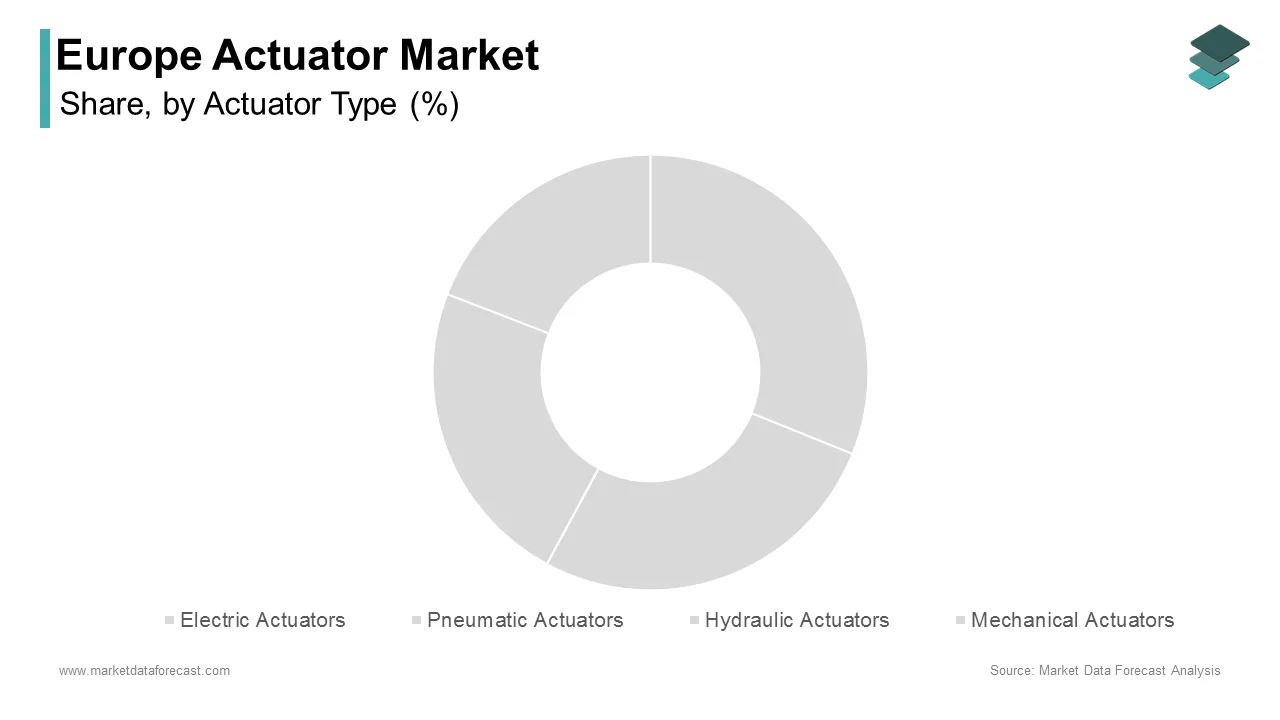
The electric actuators segment is also the fastest growing, with a projected CAGR of 8.9% from 2026 to 2034 due to Europe’s dual push toward industrial decarbonization and smart manufacturing. Electric actuators, consuming power only during movement, have shown potential for lower energy consumption in intermittent applications compared to continuously pressurized pneumatic systems, according to industrial efficiency reports. The European Commission’s Energy Efficiency Directive mandates intelligent actuation in all new industrial pumping and HVAC systems, directly favoring electric solutions. In aerospace, Airbus’ Hamburg facility is integrating servo-electric actuators and other advanced technologies to increase assembly line efficiency and reduce energy usage in aircraft manufacturing. Additionally, the rise of collaborative robotics in food packaging and pharmaceuticals demands quiet, spark-free motion, exclusively delivered by electric variants. Companies like AUMA and Rotork have responded with IP68-rated models featuring OPC UA cybersecurity modules compliant with IEC 62443. This convergence of sustainability, safety, and digital readiness creates a structural growth vector unmatched by fluid-powered alternatives.
By Application Insights
The industrial automation segment held the majority share of the European actuator market in 2025. The supremacy of the segment is driven by extensive adoption across manufacturing, process control, and material handling, where precise, repeatable motion is essential. Actuators serve as the final control element in automated valves, robotic arms, conveyor gates, and safety interlocks, systems fundamental to modern production lines. European manufacturing is heavily investing in advanced industrial automation systems and digital technologies to enhance efficiency, productivity, and safety in production processes. The upcoming EU Machinery Regulation will significantly impact safety requirements and digital security for industrial machinery, prompting manufacturers to modernize equipment and update safety certifications. The German Engineering Federation reports that electric automation technologies, including advanced actuators, are increasingly central to the modernization of industrial machinery and valve control systems. Volvo's Torslanda electric vehicle production facility utilizes advanced, high-precision, smart robotic solutions for the automated assembly and handling of battery modules. This breadth of application, depth of regulation, and scale of industrial investment ensure industrial automation remains the primary engine of actuator demand across Europe.
The aerospace application segment is predicted to witness the highest CAGR of 9.4% during the forecast period, owing to next-generation aircraft electrification and European defense modernization programs. Modern commercial and military aircraft increasingly replace hydraulic systems with “more electric” architectures to reduce weight, maintenance, and fuel consumption. The Franco-German Future Combat Air System program is, in line with wider industry trends towards more electric aircraft, developing advanced actuation systems that utilize electrical rather than hydraulic power for various systems to improve safety and maintenance. Airbus's ZEROe project focuses on developing specialized, high-performance, and lightweight cryogenic tanks to manage liquid hydrogen at extremely low temperatures for fuel systems. These systems prioritize utilizing materials that meet strict requirements to ensure component integrity and fuel purity. Safran's LEAP engine program continues to experience strong demand and, following a significant rise in deliveries in previous years, the company is increasing manufacturing and maintenance capacity, including the use of advanced electric actuation technologies for engine components. The European Space Agency’s Themis reusable launcher program also mandates redundant electric actuators for thrust vector control. This convergence of civil aviation innovation, defense sovereignty, and space ambition creates a high-value niche where European engineering excellence in extreme-environment motion control offers a decisive competitive advantage.
By End Use Industry Insights
The manufacturing segment dominated the European actuator market in 2025. This covers automotive, machinery, electronics, and metal fabrication industries that rely on precise, high-cycle motion control. Actuators are embedded in robotic welding arms, press brakes, injection molding machines, and automated guided vehicles, systems central to Europe’s advanced manufacturing base. Driven by the need for clean, high-precision assembly in new European EV battery gigafactories, there is a strong industry trend towards adopting electric actuators for cell stacking and module production. The European Commission is prioritizing 'factory of the future' investments, with Horizon Europe providing substantial funding to advance smart production technologies and intelligent actuation. The implementation of the new Machinery Regulation is driving a widespread, accelerated upgrade of automation systems among German mid-sized manufacturers, increasing the requirement for certified safety actuators. This combination of regulatory pressure, electrification trends, and industrial policy ensures manufacturing remains the dominant end-use pillar.
The healthcare end-use segment is estimated to register the fastest CAGR of 10.1% over the forecast period. The swift expansion of the segment is fuelled by the proliferation of robotic surgery, laboratory automation, and smart hospital infrastructure. Medical devices require ultra-precise, silent, and sterilizable actuators for applications such as surgical arm articulation, drug dispensing, and patient bed adjustment. Modern robotic-assisted surgical platforms are increasingly being adopted in European hospitals, with newer generations of these high-risk medical devices now incorporating advanced haptic feedback technology and precision electric actuators to improve surgical outcomes and safety. Companies like Siemens Healthineers and Philips now embed linear actuators in MRI-compatible patient tables that adjust position without magnetic interference. European Union funding initiatives, such as the Digital Europe Programme, are accelerating the digital transformation of healthcare by supporting the integration of artificial intelligence and advanced digital infrastructure into clinical settings. Pharmaceutical manufacturers like Novo Nordisk maintain highly controlled production environments in their Danish facilities, utilizing specialized automation components designed to minimize particle contamination during the sterile handling of insulin vials. This fusion of medical innovation, public health investment, and stringent hygiene standards creates a resilient, high-growth channel distinct from traditional industrial markets.
REGIONAL ANALYSIS
Germany Actuator Market Analysis
Germany led the Europe actuator market and captured a share of 28.6% in 2025. This growth of the German market is supported by its position as the continent's premier manufacturing hub and the birthplace of Industry 4.0. The regional market features highly automated production lines, seamlessly integrating pneumatic, hydraulic, and electric actuators to meet strict precision and reliability standards. A primary driving factor is the massive automotive sector, which produced roughly 4.1 million vehicles in 2024 according to data from the German Association of the Automotive Industry, creating immense demand for robotic actuators used in welding, painting, and assembly processes. Furthermore, the national strategy to transition toward electric mobility has spurred investment in new battery manufacturing facilities that rely heavily on advanced linear actuators for cell stacking and module assembly. As per reports from the German Engineering Federation (VDMA), investments in factory automation remain a priority despite a subdued domestic economy. Actuator systems continue to represent a significant portion of this expenditure as manufacturers focus on efficiency. The presence of global leaders like Festo and Bosch Rexroth ensures continuous innovation in smart actuators equipped with IoT sensors for predictive maintenance. This convergence of industrial might, technological leadership, and aggressive automation adoption solidifies Germany's role as the dominant force shaping the regional actuator landscape.
Italy Actuator Market Analysis
Italy was the second-largest country in Europe, accounting for a 16.8% share in 2025. This position of the Italian market is attributed to its specialized dominance in packaging machinery, robotics, and high-end manufacturing equipment, where precise motion control is critical. A high concentration of small-to-medium enterprises dominates this sector, creating top-tier automation for food, beverage, and pharmaceutical manufacturing that relies on compact, fast actuators. Among these, a key growth aspect is the country's status as a global leader in packaging machine exports. Data from the Italian Packaging Machinery Manufacturers Association (UCIMA) indicates that the sector achieved record-breaking turnover, with exports serving as the primary driver of growth. Each unit produced contains a high density of sophisticated pneumatic and electric actuators. The resurgence of the domestic automotive industry, particularly in the luxury and supercar segments, has also driven demand for flexible automation cells utilizing collaborative robots equipped with advanced actuation systems. According to statistics from Confindustria, the adoption of collaborative robots in Italian factories grew by 22 percent in 2024, directly boosting the consumption of safe and responsive electric actuators. Furthermore, government incentives under the Transition 4.0 plan have accelerated the modernization of legacy manufacturing lines, prompting widespread replacement of old hydraulic systems with energy-efficient electric alternatives. This unique blend of export-oriented machinery building and domestic modernization ensures Italy remains a pivotal growth engine for the European actuator sector.
France Actuator Market Analysis
France maintains a noteworthy share of the Europe actuator market. It serves as a critical hub for aerospace, nuclear energy, and transportation applications that require extreme durability and safety certification. Regional market dynamics are strongly driven by government-led policies aimed at securing technical autonomy, resulting in high-volume acquisition of premium actuators for both commercial and defense applications. The robust aerospace industry, spearheaded by Airbus, relies on a high volume of flight control actuators to meet increasing single-aisle jet production demands. Data from the French Aerospace Industries Association reveals that the sector delivered over 700 commercial aircraft in 2024, generating sustained demand for electro-hydrostatic and electromechanical actuators that meet rigorous airworthiness standards. Additionally, the nuclear energy sector, which provides about 70 percent of the nation's electricity, requires specialized radiation-hardened actuators for valve control and reactor maintenance, creating a niche but high-value market segment. As per reports from the Directorate General of Armaments, defense spending increases have led to expanded production of armored vehicles and naval vessels, further boosting demand for heavy-duty hydraulic actuators. The government's France 2030 investment plan specifically allocates funds for robotics and advanced manufacturing, fostering innovation in smart actuation technologies. This combination of strategic industries and strong government support ensures France maintains an influential position in the high-end actuator market.
United Kingdom Actuator Market Analysis
The United Kingdom witnessed a consistent growth in the Europe actuator market. It is known for its leadership in aerospace, motorsport, and offshore energy sectors, where high-performance and lightweight actuation solutions are paramount. This market prioritizes research and development to deploy advanced electric and hybrid actuator systems in future platforms. A key driving factor is the thriving motorsport industry, centered around Formula One, which acts as a testbed for advanced actuator technologies that eventually trickle down to mainstream automotive and industrial applications. According to the Motorsport Industry Association, the UK motorsport sector generates massive annual revenue, with a significant portion dedicated to developing ultra-fast and precise electro-mechanical actuators. This high-performance engineering hub serves as a global benchmark for vehicle dynamics control. The offshore wind energy sector is another major driver, as the installation and maintenance of massive turbines require robust hydraulic and electric actuators capable of operating in harsh marine environments. According to data from RenewableUK, the country continues to add substantial new offshore wind capacity. These renewable energy developments necessitate the extensive use of actuators for precise pitch and yaw control in large-scale turbines. Furthermore, the National Health Service's modernization efforts have increased demand for medical actuators used in surgical robots and patient handling equipment. As per analysis from the High Value Manufacturing Catapult, the UK's strong ecosystem of universities and innovation centers continues to push the boundaries of actuator miniaturization and efficiency, securing its role as a technology leader.
Spain Actuator Market Analysis
Spain is predicted to expand during the forecast period for the Europe actuator market. Moreover, it functions as a rapidly growing manufacturing base for automotive and renewable energy projects that drive substantial demand for automated motion solutions. This region's market is characterized by substantial foreign direct investment (FDI) aimed at electric vehicle battery and solar panel production, heavily dependent on automated assembly powered by advanced actuator technology. A major driving factor is the country's emergence as a European hub for electric mobility, with major automakers investing billions to retool existing factories for EV production, a process that requires a complete overhaul of robotic cells and linear motion systems. National vehicle production has faced recent challenges, but ANFAC data highlights a significant surge in electric vehicle sales. Consequently, this shift toward electrified platforms is driving higher actuator consumption in the modern automotive market. The aggressive expansion of solar energy capacity under the National Integrated Energy and Climate Plan has also created a booming market for actuators used in solar tracking systems that optimize panel orientation throughout the day. According to the Spanish Photovoltaic Union (UNEF), Spain is adding record-breaking levels of new solar capacity annually. These projects rely on a vast number of reliable linear actuators to maximize energy capture through tracking technology. Furthermore, the modernization of water management infrastructure to combat drought has spurred demand for large-scale industrial actuators for valve control in irrigation and desalination plants. As per reports from the Spanish Ministry of Industry, these converging trends in green energy and advanced manufacturing position Spain as a dynamic and high-growth market for actuator technologies in Europe.
COMPETITION OVERVIEW
The Europe actuator market features a tiered competitive landscape where premium engineering firms dominate safety-critical and high-precision applications, while standard product segments face pressure from low-cost imports. At the top end, companies like AUMA Rotork and Bernard Controls compete on material science, functional safety certification, and digital integration, serving sectors where failure risks public safety or production continuity. Mid-tier European specialists focus on regional water, HVAC, and manufacturing markets, emphasizing local service, rapid delivery, and regulatory compliance. Meanwhile, Chinese and Korean manufacturers gain share in commodity pneumatic and basic electric actuators through aggressive pricing, albeit with lower lifecycle reliability. Competition is increasingly defined by alignment with EU decarbonization mandates, digital factory standards, and extreme environment performance rather than price alone. Differentiation arises through cybersecurity hardening, material traceability, and support for regulatory compliance, creating a nuanced environment where technical excellence and policy engagement jointly determine market success.
KEY MARKET PLAYERS
A few major players of the Europe actuator market include
- Siemens AG
- ABB Ltd
- Schneider Electric SE
- Emerson Electric Co
- Rockwell Automation Inc
- Bosch Rexroth AG
- SMC Corporation
- Parker Hannifin Corporation
- Honeywell International Inc
- Rotork plc
- Festo SE & Co. KG
- Moog Inc
- Mitsubishi Electric Corporation
- Johnson Electric Holdings Limited
- AUMA Riester GmbH & Co. KG
Top Strategies Used by the Key Market Participants
Key players in the Europe actuator market focus on compliance with the EU Machinery Regulation and functional safety standards by embedding certified position feedback fail-safe mechanisms and cybersecurity features into their products. They develop smart actuators with IoT connectivity, predictive diagnostics, and multi-protocol support to enhance interoperability in mixed vintage industrial environments. Companies invest in application-specific engineering for high-growth sectors like green hydrogen, aerospace, and healthcare, where extreme reliability is required. Strategic partnerships with energy majors, defense contractors, and public utilities secure long-term project pipelines. Additionally, manufacturers offer digital twin service,s remote commissioning, and training academies to address the shortage of skilled engineers and accelerate deployment across complex industrial ecosystems.
Leading Players in the Europe Actuator Market
- AUMA Riester GmbH & Co KG is a German engineering leader specializing in electric actuators for valves in critical infrastructure, including power generation, water treatment, and oil and gas. The company supplies high torque explosion-proof and fail-safe actuators compliant with ATEX SIL and ISO 13849 standards across Europe and globally. AUMA’s products are integral to nuclear plants in France, LNG terminals in Spain, and district heating networks in Scandinavia. It also expanded its digital twin service, allowing operators to simulate actuator performance under extreme conditions before deployment, reinforcing its role as a technology enabler beyond hardware supply.
- Rotork plc is a UK-based global specialist in flow control actuators with a strong European footprint in industrial automation, aerospace, and renewable energy sectors. The company offers electric, pneumatic, and hydraulic actuators known for precision, reliability, and digital integration. Rotork’s solutions are deployed in Airbus assembly lines, BASF chemical plants, and North Sea offshore platforms, where safety and uptime are non-negotiable. It also enhanced its Rotork Master software platform to support multi-protocol communication across legacy and modern control systems, strengthening interoperability in complex industrial environments.
- Bernard Controls SA is a French innovator in electric valve actuators serving nuclear energy, water management, and hydrogen infrastructure across Europe. The company excels in extreme environment applications, including cryogenic hydrogen valves and seismic-resistant nuclear plant actuators. Bernard’s products meet stringent RCC E and RCC M nuclear codes and are specified in projects like France’s Flamanville EPR reactor and Germany’s H2ercules green hydrogen pipeline. It also partnered with the European Space Agency to develop actuators for reusable launch vehicle fuel systems, demonstrating strategic alignment with Europe’s sovereignty goals in critical technologies.
MARKET SEGMENTATION
This research report on the Europe actuator market has been segmented and sub-segmented based on actuator type, application, end-use industry, & region.
By Actuator Type
- Electric Actuators
- Pneumatic Actuators
- Hydraulic Actuators
- Mechanical Actuators
By Application
- Industrial Automation
- Automotive
- Aerospace
- Consumer Electronics
By End Use
- Manufacturing
- Oil Gas
- Food Beverage
- Healthcare
By Region
- UK
- France
- Spain
- Germany
- Italy
- Russia
- Sweden
- Denmark
- Switzerland
- Netherlands
- Turkey
- Czech Republic
- Rest of Europe
Frequently Asked Questions
1. What is driving the growth of the Europe actuator market?
Market growth is driven by increasing industrial automation, rising adoption of electric vehicles, and the growing demand for energy-efficient motion control systems across various industries.
2. Which actuator type dominates the Europe actuator market?
The electric actuator segment dominates the market due to its high efficiency, precision control, and low maintenance requirements compared to hydraulic and pneumatic actuators.
3. What are the major types of actuators used in Europe?
Major types include electric actuators, pneumatic actuators, hydraulic actuators, and mechanical actuators used for various industrial applications
4. Which industries are the primary end users of actuators in Europe?
Key end-use industries include manufacturing, automotive, aerospace, healthcare, oil & gas, and food & beverage industries.
5. How does industrial automation impact the actuator market?
The increasing adoption of automation technologies in manufacturing facilities boosts the demand for actuators used in robotics and automated machinery.
6. Which application segment contributes significantly to market demand?
Industrial automation and automotive applications are among the major contributors to actuator demand in Europe
7. What trends are shaping the Europe actuator market?
Key trends include increasing adoption of electric actuators, integration of smart technologies, and growing use of actuators in renewable energy and EV systems.
8. What challenges are faced by the Europe actuator market?
High installation costs and complexity in system integration may restrain market growth.
9. What role do actuators play in the automotive industry?
Actuators are used in braking systems, steering systems, HVAC, power windows, and seat adjustment systems in modern vehicles.
10. What is the future outlook of the Europe actuator market?
The market is expected to witness steady growth due to increasing technological advancements and rising demand for automation across industries.
Related Reports
Access the study in MULTIPLE FORMATS
Purchase options starting from
$ 2000
Didn’t find what you’re looking for?
TALK TO OUR ANALYST TEAM
Need something within your budget?
NO WORRIES! WE GOT YOU COVERED!
Call us on: +1 888 702 9696 (U.S Toll Free)
Write to us: sales@marketdataforecast.com