Europe Advanced Materials Market Size, Share, Trends & Growth Forecast Report Segmented By Product Type (Polymers, Metal & Alloys, Glasses, Composites and Ceramics), Application, And Country (Uk, France, Spain, Germany, Italy, Russia, Sweden, Denmark, Switzerland, Netherlands, Turkey, Czech Republic & Rest Of Europe), Industry Analysis From 2026 To 2034
Europe Advanced Materials Market Report Summary
The Europe advanced materials market was valued at USD 22 billion in 2025 and is projected to reach USD 38.16 billion by 2034, growing from USD 23.39 billion in 2026 at a CAGR of 6.31% during the forecast period. Market growth is driven by increasing demand for high-performance materials across automotive, aerospace, construction, and electronics industries. Advanced materials such as polymers, composites, and specialty chemicals are gaining traction due to their lightweight properties, durability, and enhanced performance characteristics. The transition toward electric mobility, sustainable construction, and energy-efficient technologies is further accelerating the growth of the Europe advanced materials market.
Key Market Trends
- Growing demand for lightweight and high-strength materials in the automotive and aerospace sectors
- Increasing adoption of advanced polymers and composites
- Rising focus on sustainability and recyclable material solutions
- Expansion of advanced materials in renewable energy applications
- Strong integration of nanotechnology and smart materials
Segmental Insights
- Based on product type, the polymers segment dominated the Europe advanced materials market in 2025 by accounting for 33.9% of the regional market share, driven by extensive use in automotive, packaging, and construction applications.
- Based on application, the automotive segment led the market in 2025 by capturing 31.6% of the regional market share, supported by demand for lightweight components and fuel-efficient vehicle design.
Regional Insights
- Germany led the Europe advanced materials market in 2025 by holding 23.6% of the regional market share, supported by a strong industrial base and advanced manufacturing capabilities
- France ranked second with a 17.7% share in 2025, driven by demand from the aerospace and automotive industries.s
- United Kingdom is expected to account for a prominent share during the forecast period, supported by innovation in advanced manufacturing and materials science.e
- Italy is projected to witness healthy growth, driven by industrial expansion and demand from the automotive and construction sectors.
- Spain is anticipated to hold a notable share, supported by infrastructure development and renewable energy investments.
Competitive Landscape
- The Europe advanced materials market is highly competitive, with major companies focusing on innovation, sustainability, and high-performance material development. Market players are investing in research and development to create next-generation materials that meet evolving industrial and environmental requirements.
- Prominent players in the Europe advanced materials market include BASF SE, Arkema S.A, Solvay S.A, Evonik Industries AG, LANXESS AG, Covestro AG, Wacker Chemie AG, DSM-Firmenich, Saint-Gobain, and Hexcel Corporation.
Europe Advanced Materials Market Size
The Europe advanced materials market size was calculated to be USD 22 billion in 2025 and is anticipated to be worth USD 38.16 billion by 2034, from USD 23.39 billion in 2026, growing at a CAGR of 6.31% during the forecast period.

Advanced materials encompass a diverse array of engineered substances, including nanomaterials, biomaterials, smart materials, and high-performance composites that exhibit superior properties compared to conventional counterparts. These materials are fundamental to innovation across strategic sectors such as aerospace, automotive, healthcare, and renewable energy. The region is characterized by a robust research and development ecosystem driven by stringent regulatory frameworks and a strong commitment to sustainability. According to Eurostat, the European Union has shown a strong commitment to research and development activities, which indicates the continent's dedication to technological advancement. The transition towards a circular economy has accelerated the adoption of bio-based and recyclable advanced materials. As per the European Commission, the Green Deal initiative mandates significant reductions in carbon emissions, thereby fostering demand for lightweight and energy-efficient materials. The aerospace industry in Europe relies heavily on carbon fiber reinforced polymers to enhance fuel efficiency and reduce environmental impact. According to the European Aviation Safety Agency, new aircraft designs increasingly incorporate composite materials to meet rigorous safety and performance standards. Furthermore, the healthcare sector utilizes advanced biomaterials for implants and drug delivery systems, which are improving patient outcomes. The interplay between industrial innovation, regulatory compliance, and environmental sustainability defines the operational landscape. This market serves as a critical enabler for achieving Europe’s strategic autonomy and climate neutrality goals by providing the foundational technologies required for next-generation applications.
MARKET DRIVERS
Stringent Environmental Regulations and Sustainability Mandates
The implementation of rigorous environmental regulations and sustainability mandates is one of the major factors propelling the growth of the Europe advanced materials market. The European Union’s Green Deal and Circular Economy Action Plan impose strict requirements on material sourcing, production processes, and end-of-life management. According to the European Commission, these policies necessitate the adoption of materials that offer reduced carbon footprints, enhanced recyclability, and lower toxicity. Advanced materials such as bio-based polymers and lightweight composites enable industries to meet these regulatory standards while maintaining performance. As per the European Environment Agency, the industrial sector has been identified as a major contributor to greenhouse gas emissions, which has prompted a shift towards sustainable alternatives. The automotive industry, for instance, utilizes advanced high-strength steels and aluminium alloys to reduce vehicle weight and improve fuel efficiency, thereby lowering emissions. The construction sector also adopts innovative insulation materials and self-healing concrete to enhance energy efficiency and durability. Regulatory pressure drives investment in research and development for eco-friendly materials. Companies that fail to comply face substantial penalties and loss of market access. This regulatory framework creates a favorable environment for advanced materials that align with sustainability goals. The demand for transparent supply chains and certified sustainable materials further accelerates market growth. Consequently, manufacturers are compelled to innovate and integrate advanced materials into their product portfolios to remain competitive and compliant.
Rapid Advancements in Aerospace and Automotive Industries
The rapid advancements in the aerospace and automotive industries significantly drive the demand for advanced materials in Europe, which is further fuelling the expansion of the Europe advanced materials market. These sectors require materials that offer exceptional strength-to-weight ratios, corrosion resistance, and thermal stability to enhance performance and efficiency. According to the European Automobile Manufacturers Association, the transition to electric vehicles necessitates lightweight materials to offset battery weight and extend driving range. Advanced composites such as carbon fiber reinforced plastics and magnesium alloys are increasingly used in vehicle bodies and components. As per the European Aviation Safety Agency, the aerospace industry relies on titanium alloys and ceramic matrix composites for engine components and airframes to improve fuel efficiency and reduce emissions. The development of next-generation aircraft and urban air mobility solutions further boosts demand for innovative materials. Investment in research and development by major manufacturers leads to the creation of customized materials with tailored properties. The integration of smart materials that can monitor structural health and adapt to environmental changes adds value to these applications. Government support for clean mobility and aviation initiatives encourages the adoption of advanced materials. The competitive landscape drives continuous innovation as companies seek to differentiate their products through superior performance. This technological evolution ensures sustained growth in the advanced materials market. The synergy between material science and engineering advancements propels the industry forward.
MARKET RESTRAINTS
High Production Costs and Complex Manufacturing Processes
High production costs and complex manufacturing processes are impeding the growth of the Europe advanced materials market. The synthesis and processing of materials such as graphene, carbon nanotubes, and specialized alloys often require sophisticated equipment and precise control parameters. According to the European Chemical Industry Council, the capital expenditure for establishing advanced material production facilities is considerably higher than for conventional materials. These costs are passed on to downstream industries, which is limiting market penetration, especially in price-sensitive sectors. For instance, the cost of producing high-quality carbon fiber remains prohibitive for mass-market automotive applications despite its performance benefits. The complexity of manufacturing also leads to longer lead times and potential supply chain bottlenecks. Small and medium-sized enterprises often lack the financial resources and technical expertise to invest in advanced material technologies. The need for specialized labor and rigorous quality control further increases operational expenses. Economic fluctuations and inflationary pressures exacerbate these cost challenges, making it difficult for manufacturers to maintain profitability. The high initial investment required for research and development discourages new entrants. Consequently, the market remains dominated by large corporations with significant financial backing. This economic barrier slows down the democratization of advanced materials. Until production costs decrease through technological advancements and economies of scale, adoption will remain limited.
Regulatory Hurdles and Safety Concerns
Regulatory hurdles and safety concerns pose major restraints to the Europe advanced materials market, particularly for novel substances such as nanomaterials and biomaterials. The European Union’s REACH regulation imposes stringent requirements for the registration, evaluation, and authorization of chemicals, including advanced materials. According to the European Chemicals Agency, the lack of comprehensive data on the long term health and environmental impacts of nanomaterials creates uncertainty for manufacturers. As per the European Commission, the regulatory framework for novel materials is still evolving, which leads to delays in product approval and commercialization. Safety concerns regarding the toxicity of certain nanoparticles and their potential accumulation in biological systems hinder market acceptance. The medical device regulation also requires extensive clinical trials and documentation for biomaterials, increasing the time to market. Compliance with these regulations involves high costs and administrative burdens. The precautionary principle adopted by European regulators often results in restrictive measures until safety is unequivocally proven. This cautious approach limits the speed of innovation and market entry. Manufacturers must invest heavily in toxicological studies and risk assessments to meet regulatory standards. The uncertainty surrounding future regulatory changes adds to the business risk. These factors collectively restrain the growth of the advanced materials market. Overcoming these barriers requires collaborative efforts between industry and regulators.
MARKET OPPORTUNITIES
Integration of Smart Materials in Internet of Things Applications
The integration of smart materials in Internet of Things applications is a significant opportunity for the Europe advanced materials market. Smart materials such as piezoelectric ceramics, shape memory alloys, and electrochromic polymers can sense and respond to environmental stimuli, enabling innovative functionalities in connected devices. According to the European Commission, the Internet of Things is a key component of the digital transformation strategy and is expected to expand rapidly across Europe. These devices require materials that can harvest energy, store data, and perform sensing functions without external power sources. As per the European Technology Platform on Smart Systems Integration, smart materials enable the development of self-powered sensors and actuators for industrial monitoring, healthcare, and smart cities. The ability of these materials to change properties in response to temperature, light, or electrical fields opens new avenues for product design. For instance, self-healing coatings can extend the lifespan of infrastructure while reducing maintenance costs. The automotive sector utilizes smart materials for adaptive suspension systems and interactive interiors. The healthcare industry employs them for drug delivery systems and diagnostic tools. Investment in research and development focuses on enhancing the sensitivity and durability of smart materials. The convergence of material science and digital technology creates a fertile ground for innovation. This synergy drives demand for advanced materials that enable intelligent and responsive systems.
Expansion of Bio-Based and Biodegradable Materials
The expansion of bio-based and biodegradable materials offers a promising opportunity for the Europe advanced materials market due to the rising demand for sustainable alternatives to petroleum-based plastics. Materials derived from renewable resources such as polylactic acid, polyhydroxyalkanoates, and cellulose nanocrystals offer comparable performance with reduced environmental impact. According to European Bioplastics, the production capacity for bio-based plastics in Europe is expected to grow steadily, supported by policy incentives and consumer preference. As per the Joint Research Centre of the European Commission, bio-based materials contribute to the circular economy by reducing dependency on fossil fuels and lowering greenhouse gas emissions. The packaging industry is a major adopter, utilizing biodegradable films and containers to comply with single-use plastic regulations. The agricultural sector uses bio-based mulch films that decompose naturally, reducing waste. Advances in fermentation and enzymatic processes have improved the cost-effectiveness and quality of bio-based materials. The textile industry explores biobased fibers for sustainable fashion. Government grants and subsidies support the scaling up of production facilities. Collaborations between chemical companies and agricultural producers ensure a stable supply of raw materials. This trend aligns with corporate sustainability goals and regulatory mandates. The growing awareness of plastic pollution drives consumer demand for eco-friendly products. This shift creates a robust market for bio-based advanced materials.
MARKET CHALLENGES
Supply Chain Vulnerabilities and Raw Material Scarcity
Supply chain vulnerabilities and raw material scarcity are major challenges to the Europe advanced materials market. Many advanced materials rely on critical raw materials such as rare earth elements, lithium, and cobalt, which are predominantly sourced from outside Europe. According to the European Commission, the supply risk for many of these materials is considered high due to geopolitical tensions and concentrated production in a few countries. As per the European Raw Materials Alliance, disruptions in supply chains can lead to shortages and price volatility, affecting downstream industries. The dependence on imports exposes European manufacturers to trade restrictions and logistical bottlenecks. The extraction and processing of these materials often involve environmental and social governance issues, complicating procurement. The lack of domestic mining and refining capabilities limits Europe’s ability to secure stable supplies. Efforts to diversify supply sources and develop recycling technologies are ongoing but face technical and economic hurdles. The complexity of global supply chains makes them susceptible to shocks from natural disasters or political instability. Manufacturers must implement robust risk management strategies to mitigate these risks. However, these measures require significant investment and coordination. The uncertainty of supply affects production planning and customer confidence. Addressing this challenge requires strategic partnerships and investment in domestic capabilities.
Technical Complexity and Standardization Issues
Technical complexity and the lack of standardized testing methods pose significant challenges to the Europe advanced materials market. The unique properties of advanced materials, such as nanomaterials and composites, require specialized characterization techniques and performance metrics. According to the European Committee for Standardization, the absence of harmonized standards hinders the comparison of materials and impedes market acceptance. As per industry experts, variability in material properties due to manufacturing processes makes quality control difficult. The lack of standardized protocols for safety assessment and environmental impact evaluation creates uncertainty for regulators and consumers. This inconsistency complicates the certification process for new materials, delaying market entry. The interdisciplinary nature of advanced materials requires collaboration between chemists, physicists, and engineers, which can be challenging to coordinate. The rapid pace of innovation outpaces the development of standards, leading to a regulatory gap. Manufacturers face difficulties in demonstrating the reliability and durability of their products without established benchmarks. This lack of clarity discourages investment and adoption. Efforts to develop international standards are underway, but progress is slow. The industry must work closely with standardization bodies to establish clear guidelines. Until these issues are resolved, the market will face barriers to growth.
REPORT COVERAGE
| REPORT METRIC | DETAILS |
| Market Size Available | 2025 to 2034 |
| Base Year | 2025 |
| Forecast Period | 2026 to 2034 |
| CAGR | 6.31% |
| Segments Covered | By Product Type, Application, And Region |
| Various Analyses Covered | Global, Regional & Country Level Analysis; Segment-Level Analysis; DROC, PESTLE Analysis; Porter’s Five Forces Analysis; Competitive Landscape; Analyst Overview of Investment Opportunities |
| Regions Covered | UK, France, Spain, Germany, Italy, Russia, Sweden, Denmark, Switzerland, Netherlands, Turkey, and the Czech Republic |
| Market Leaders Profiled | BASF SE, Arkema S.A., Solvay S.A., Evonik Industries AG, LANXESS AG, Covestro AG, Wacker Chemie AG, DSM-Firmenich, Saint-Gobain, Hexcel Corporation |
SEGMENTAL ANALYSIS
By Product Type Insights
The polymers segment dominated the market by holding 33.9% of the European market share in 2025. The dominance of the polymers segment in the European market is attributed to the versatility and cost-effectiveness of advanced polymers such as engineering plastics and high-performance thermoplastics, which are essential across multiple industries. According to PlasticsEurope, the European plastics industry transforms a large volume of plastics annually, with a significant portion comprising advanced polymer grades used in automotive and packaging applications. The automotive sector extensively utilizes lightweight polymers to reduce vehicle mass and improve fuel efficiency, in compliance with stringent emission regulations. As per the European Automobile Manufacturers Association, modern vehicles contain substantial amounts of plastic materials, many of which are advanced polymers designed for durability and heat resistance. The packaging industry also drives demand through the adoption of barrier films and biodegradable polymers mandated by the European Union’s Single Use Plastics Directive. Advanced polymers offer superior mechanical properties, chemical resistance, and design flexibility compared to traditional materials. The ability to recycle and reuse certain polymer types aligns with circular economy goals, further boosting their adoption. Manufacturing processes such as injection molding allow for high-volume production at competitive costs. The continuous development of bio-based polymers adds to the segment's growth potential. These factors collectively ensure that polymers remain the backbone of the advanced materials market in Europe.
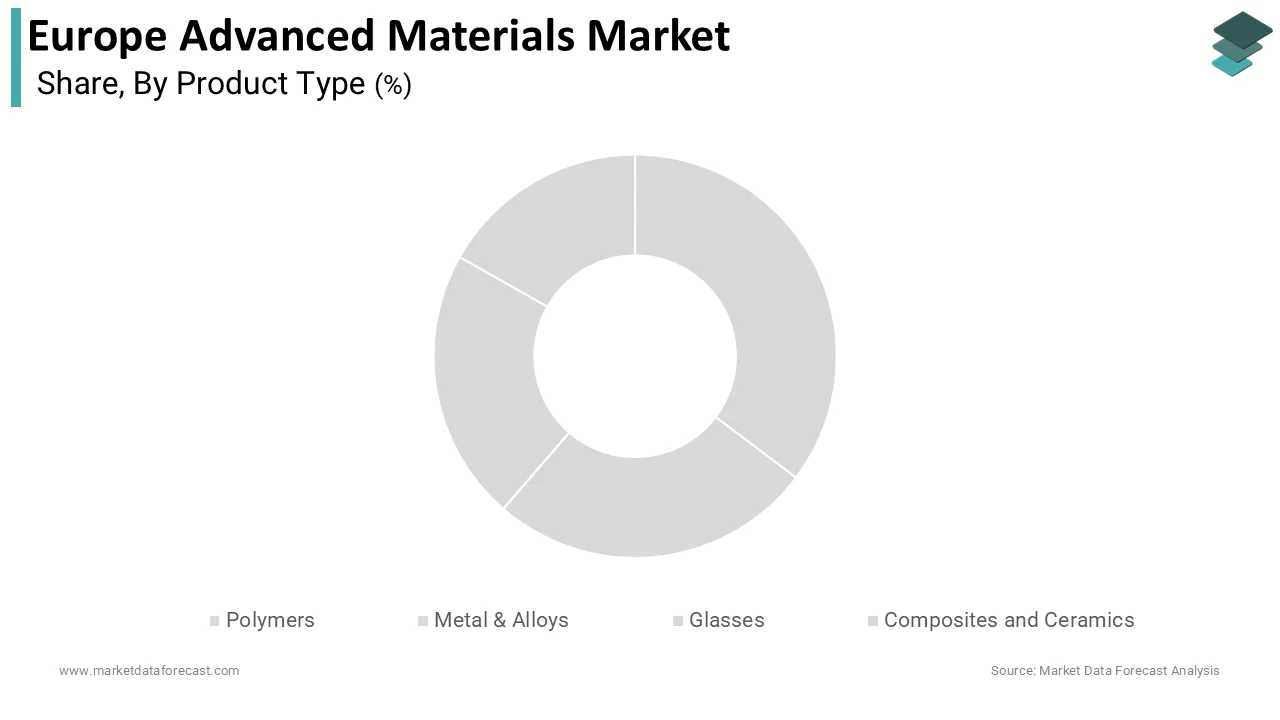
However, the composites segment is projected to register the highest CAGR of 8.4% over the forecast period, owing to the growing demand for lightweight and high-strength materials in the aerospace and renewable energy sectors. Carbon fiber reinforced polymers and glass fiber composites are critical for manufacturing aircraft components, wind turbine blades, and automotive parts. According to the European Composite Industry Association, the demand for composite materials in the wind energy sector has surged as Europe accelerates its transition to offshore wind power. As per WindEurope, new wind capacity installations require large volumes of durable and lightweight composite blades. The aerospace industry also contributes significantly, with manufacturers like Airbus integrating composites into next-generation aircraft to enhance fuel efficiency and reduce emissions. The European Aviation Safety Agency supports the use of advanced composites due to their proven safety and performance records. Automotive manufacturers are increasingly adopting composites for electric vehicle structures to offset battery weight. Government incentives for green technologies and infrastructure projects further drive adoption. The superior strength-to-weight ratio of composites makes them indispensable for high-performance applications. Continuous innovation in manufacturing techniques, such as automated fiber placement, reduces production costs. These dynamics ensure that composites outpace other segments in growth rate.
By Application Insights
The automotive segment led the market by capturing 31.6% of the European market share in 2025 due to the industry’s urgent need to reduce vehicle weight and improve energy efficiency to meet strict environmental regulations. Advanced materials such as high-strength steel, aluminum alloys, and carbon fiber composites are extensively used in vehicle bodies, chassis, and interior components. According to the European Automobile Manufacturers Association, passenger car production in Europe remains robust, with a growing shift towards electric vehicles that require lightweight structures to maximize range. As per the International Council on Clean Transportation, reducing vehicle mass significantly improves fuel efficiency, making advanced materials critical for compliance. The transition to electrification also drives demand for specialized materials in battery housings and thermal management systems. Advanced polymers and ceramics are used for insulation and protection of sensitive electronic components. The durability and corrosion resistance of these materials extend vehicle lifespan and reduce maintenance costs. Government subsidies for electric vehicle purchases further stimulate production and material demand. The automotive supply chain is well established for integrating advanced materials, ensuring consistent quality and availability. These factors collectively maintain the automotive sector as the primary consumer of advanced materials in Europe.
On the other hand, the electrical and electronics segment is identified as the fastest-growing application area and is estimated to witness a CAGR of 8.4% over the forecast period, owing to the proliferation of smart devices, 5G infrastructure, and the expansion of the semiconductor industry in Europe. Advanced materials such as silicon carbide, gallium nitride, and specialized conductive polymers are essential for high-performance electronic components. According to the European Semiconductor Industry Association, the demand for chips and electronic components is rising due to digitalization and the Internet of Things. As per the European Commission, the Digital Decade policy aims to strengthen Europe’s technological sovereignty, leading to increased investment in semiconductor fabrication facilities. These facilities require high-purity materials and advanced substrates for chip production. The rollout of 5G networks necessitates materials with low signal loss and high thermal conductivity for antennas and base stations. Consumer electronics such as smartphones and wearables also utilize advanced materials for flexible displays and durable casings. The miniaturization of electronic components drives innovation in nanomaterials and thin films. Government funding for research and development in electronics supports this growth. The integration of advanced materials enables faster, more efficient, and smaller electronic devices. This technological evolution ensures robust demand growth in the sector.
REGIONAL ANALYSIS
Germany Advanced Materials Market Analysis
Germany dominated the advanced materials market in Europe in 2025 with 23.6% of the European market share. The dominance of Germany in the European market is driven by the country’s strong industrial base, particularly in automotive and chemical manufacturing, which drives substantial demand for advanced materials. According to the German Federal Ministry for Economic Affairs and Climate Action, the manufacturing sector is a key pillar of the economy with significant investment in innovation and sustainability. Germany is home to major automobile manufacturers that utilize advanced polymers and composites for lightweight vehicle construction. As per the German Chemical Industry Association, the country is a global leader in chemical production, providing a steady supply of advanced polymer materials. The presence of renowned research institutions fosters innovation in material science. Germany’s commitment to Industry 4.0 integrates advanced materials into smart manufacturing processes. The government’s support for green technologies encourages the adoption of sustainable materials. The well-developed infrastructure facilitates efficient distribution and processing. The market status is characterized by high technological standards and strict regulatory compliance. Investment in research and development ensures continuous innovation. These factors collectively sustain Germany’s dominance in the regional market.
France Advanced Materials Market Analysis
France held the second largest share of the Europe advanced materials market in 2025 with 17.7% of the regional market share. The country’s robust aerospace and nuclear energy sectors are majorly propelling the French market expansion. According to the French Ministry of Economy, the aerospace industry is a strategic sector with major players like Airbus and Safran utilizing advanced composites and titanium alloys. As per the French Aerospace Industries Association, the sector invests heavily in research and development to maintain competitiveness. The nuclear energy industry also requires specialized materials for reactor components and fuel cycles. France’s commitment to energy transition drives demand for materials in renewable energy applications. The presence of leading chemical companies supports the production of advanced polymers. The government’s France 2030 investment plan prioritizes innovation in materials science. The market status is defined by strong industrial capabilities and government support. Regulatory frameworks promote sustainability and safety. France’s expertise in high-tech industries ensures steady demand for advanced materials. Collaboration between industry and academia fosters innovation. These elements maintain France’s significant market position.
United Kingdom Advanced Materials Market Analysis
The United Kingdom is anticipated to hold a prominent share of the Europe advanced materials market during the forecast period, owing to the country’s strong aerospace, pharmaceutical, and automotive industries, which drive consumption. According to the UK Office for National Statistics, the manufacturing sector remains a vital part of the economy with a focus on high-value-added products. The aerospace industry utilizes advanced composites for aircraft structures, supporting companies like BAE Systems and Rolls-Royce. As per the UK Automotive Council, the transition to electric vehicles increases demand for lightweight materials and battery components. The pharmaceutical sector relies on advanced biomaterials for drug delivery and medical devices. The UK’s exit from the European Union has led to new trade dynamics, but demand for essential materials remains robust. The government’s Industrial Strategy supports innovation in materials science. The market status is characterized by strong research capabilities and diverse industrial applications. Investment in green technologies drives the adoption of sustainable materials. The UK’s financial services facilitate international trade in materials. These factors sustain its position in the regional market.
Italy Advanced Materials Market Analysis
Italy is expected to exhibit a healthy CAGR in the Europe advanced materials market over the forecast period. The country’s automotive, aerospace, and machinery industries are the main drivers of market growth in Italy. According to the Italian National Institute of Statistics, the manufacturing sector contributes significantly to national GDP, with a focus on design and quality. Italy is home to major automotive manufacturersthato utilize advanced materials for high-performance vehicles. As per the Italian Aerospace Industries Association, the sector is growing with increased use of composites in aircraft components. The machinery industry requires durable and lightweight materials for equipment production. Italy’s strong chemical industry supports the production of advanced polymers. The government’s National Recovery and Resilience Plan includes investments in innovation and sustainability. The market status is defined by a mix of traditional craftsmanship and modern technology. Export-oriented manufacturing drives demand for competitive materials. Regulatory frameworks promote environmental protection. These factors support Italy’s strong market presence.
Spain Advanced Materials Market Analysis
Spain is anticipated to account for a notable share of the Europe advanced materials market over the forecast period. The country’s automotive and renewable energy sectors are driving the Spanish market expansion. According to the Spanish Ministry of Industry, Trade, and Tourism, the manufacturing sector is recovering with increased investment in modernization. Spain is a major producer of vehicles utilizing advanced materials for lightweighting. As per the Spanish Automotive Manufacturers Association, the industry is focusing on electric vehicle production, driving demand for battery materials and composites. The renewable energy sector, particularly wind power, requires large volumes of composite materials for turbine blades. Spain’s strategic location facilitates trade with North Africa and Latin America. The government’s support for industrial revitalization boosts activity. The market status is characterized by emerging growth potential and infrastructure development. Investment in green energy projects stimulates demand. The diversity of end-use applications provides stability. These factors contribute to Spain’s significant market share.
COMPETITION OVERVIEW
The Europe advanced materials market exhibits a moderately consolidated competitive landscape characterized by the presence of global chemical giants and specialized niche players. Competition is primarily driven by technological innovation, sustainability credentials, and application-specific performance rather than price alone. Major players leverage their extensive research and development capabilities to create proprietary materials with superior characteristics. The market sees intense rivalry in developing eco-friendly solutions, with companies investing significantly in bio-based alternatives and recycling technologies. New entrants face high barriers due to capital-intensive requirements and complex regulatory compliance needs. Strategic collaborations with end users in aerospace, automotive, and electronics sectors are common tactics to secure long term contracts. The shift towards circular economy practices has intensified competition in sustainable material segments. Companies differentiate themselves through technical expertise and customized solutions for specific applications. This dynamic environment fosters continuous improvement and innovation among participants striving to maintain competitive edges in a mature yet evolving market structure influenced by regulatory changes and sustainability trends.
KEY MARKET PLAYERS
A few major players of the Europe advanced materials market include
- BASF SE
- Arkema S.A
- Solvay S.A
- Evonik Industries AG
- LANXESS AG
- Covestro AG
- Wacker Chemie AG
- DSM-Firmenich
- Saint-Gobain
- Hexcel Corporation
Top Strategies Used by the Key Market Participants
Key players in the Europe advanced materials market predominantly focus on sustainability-driven innovation to develop bio-based and recyclable materials. Companies invest heavily in research and development to enhance material performance and reduce environmental footprints. Strategic partnerships with downstream industries ensure stable demand and collaborative product development. Participants prioritize circular economy initiatives by establishing recycling infrastructure and closed-loop systems. Expansion into high-growth sectors like electric vehicles and renewable energy offers new opportunities. Manufacturers leverage digital technologies for supply chain optimization and process efficiency. These strategies collectively strengthen market positions by improving competitiveness, ensuring regulatory compliance, and meeting evolving customer preferences in a dynamic industrial landscape.
Leading Players in the Market
- BASF SE is a global chemical leader with a significant footprint in the Europe advanced materials market, offering high-performance polymers and composites. The company supplies innovative solutions for the automotive, aerospace, and construction sectors, focusing on lightweighting and sustainability. BASF recently expanded its production capacity fobio-baseded plastics and recycled materials to align with circular economy goals. The company invests heavily in research and development to create next-generation materials with enhanced properties. These actions strengthen its position as a preferred supplier for eco-conscious industries. BASF collaborates with customers to develop customized material solutions that meet specific performance requirements. Its commitment to innovation and sustainability drives long-term growth. The company continues to optimize its supply chain for resilience and efficiency. BASF remains a key enabler of industrial transformation through advanced material technologies.
- Solvay SA is a science-based company specializing in advanced materials and specialty chemicals with strong operations in Europe. The company produces high-performance polymers, composites, and rare earth materials used in aerospace, automotive, and electronics industries. Solvay recently focused on accelerating its sustainable growth strategy by divesting non-core assets and investing in green technologies. The company launched new bio-based polymer grades and recycling initiatives to reduce environmental impact. These efforts enhance its competitiveness and appeal to sustainability-driven customers. Solvay partners with industry leaders to co-develop innovative material solutions. Its expertise in material science supports the transition to cleaner energy and mobility. The company continues to expand its portfolio of high-value-added products. Solvay’s strategic focus on sustainability and innovation strengthens its market leadership. It remains a vital partner for industries seeking advanced material solutions.
- Covestro AG is a leading provider of high-quality polymer materials with a strong presence in the Europe advanced materials market. The company specializes in polycarbonates, polyurethane,s and coatings used in construction, automotive,e and electronics sectors. Covestro recently accelerated its transition to a circular economy by increasing the use of renewable raw materials and recycled content. The company invested in new production facilities for bio-based polymers and chemical recycling technologies. These initiatives strengthen its position as a sustainable material supplier. Covestro collaborates with customers to develop innovative solutions for energy efficiency and lightweighting. Its focus on digitalization improves supply chain transparency and customer service. The company continues to drive innovation in material science to meet evolving market needs. Covestro’s commitment to sustainability and performance ensures long-term competitiveness. It remains a key player in shaping the future of advanced materials.
MARKET SEGMENTATION
This research report on the Europe advanced materials market has been segmented and sub-segmented based on product type, application & region.
By Product Type
- Polymers
- Metal & Alloys
- Glasses
- Composites and Ceramics
By Application
- Medical Devices
- Automotive
- Aerospace
- Electricals & Electronics
- Industrial
- Power
- Others
By Region
- UK
- France
- Spain
- Germany
- Italy
- Russia
- Sweden
- Denmark
- Switzerland
- Netherlands
- Turkey
- Czech Republic
- Rest of Europe
Frequently Asked Questions
1. What are the main types of advanced materials?
Key types include composites, ceramics, nanomaterials, biomaterials, and advanced polymers.
2. What industries use advanced materials the most?
Major industries include aerospace, automotive, electronics, healthcare, energy, and construction.
3. What factors are driving the Europe advanced materials market?
Increasing demand for lightweight materials, technological advancements, and growth in high-performance applications are key drivers.
4. What role do advanced materials play in the automotive industry?
They help reduce vehicle weight, improve fuel efficiency, and enhance safety and performance.
5. How are advanced materials used in aerospace applications?
They are used in aircraft structures, engines, and interiors to improve strength, reduce weight, and increase durability.
6. What is the role of nanomaterials in this market?
Nanomaterials provide enhanced strength, conductivity, and chemical resistance, enabling innovative applications.
7. How does sustainability impact the advanced materials market?
There is growing demand for recyclable, bio-based, and energy-efficient materials to meet environmental regulations.
8. What challenges does the market face?
High production costs, complex manufacturing processes, and regulatory hurdles are key challenges.
9. What opportunities exist in the market?
Opportunities include expansion in 3D printing, advanced composites, and medical applications.
10. What is the future outlook of the Europe advanced materials market?
The market is expected to grow steadily due to increasing demand across high-tech industries and ongoing technological advancements.
Related Reports
Access the study in MULTIPLE FORMATS
Purchase options starting from
$ 2000
Didn’t find what you’re looking for?
TALK TO OUR ANALYST TEAM
Need something within your budget?
NO WORRIES! WE GOT YOU COVERED!
Call us on: +1 888 702 9696 (U.S Toll Free)
Write to us: sales@marketdataforecast.com