Europe Advanced Process Control Market Size, Share, Trends & Growth Forecast Report, Segmented By Enterprise Size, Component, Technology, Solution, End-User and By Country (UK, France, Spain, Germany, Italy, Russia, Sweden, Denmark, Switzerland, Netherlands, Turkey, Czech Republic and Rest of Europe), Industry Analysis From (2026 to 2034)
Europe Advanced Process Control Market Size
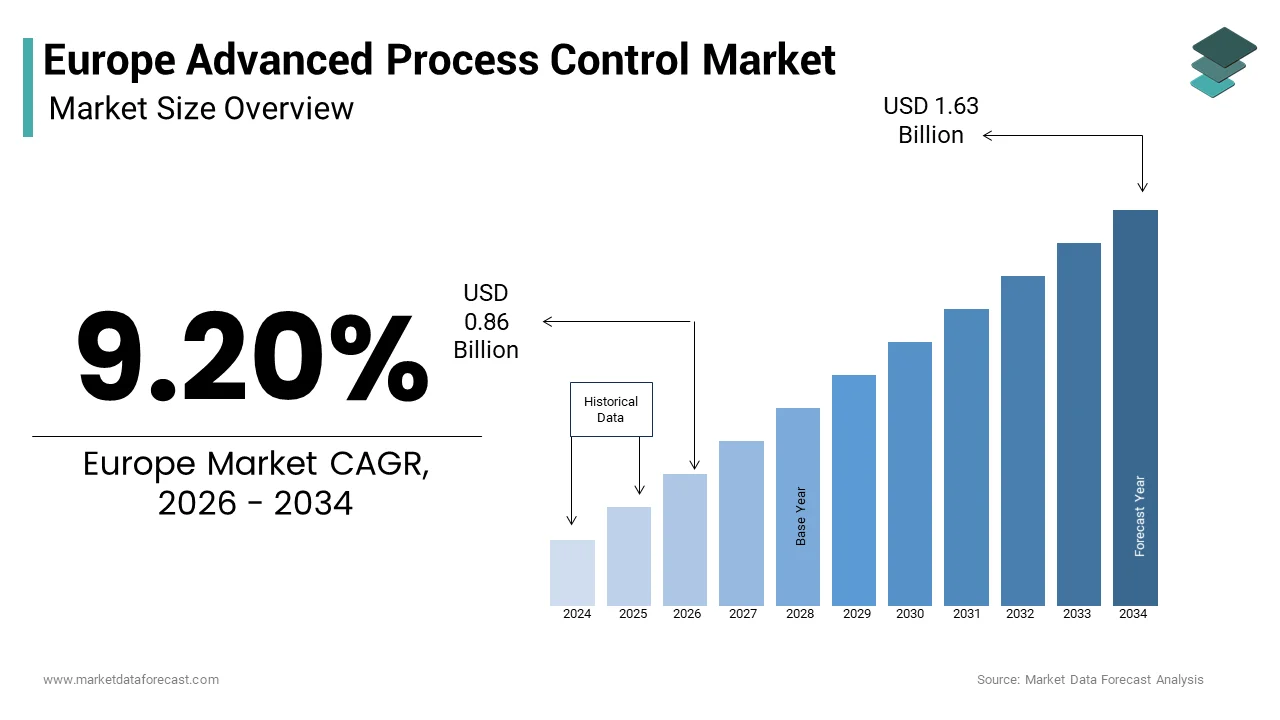
The Europe advanced process control market size was valued at USD 0.78 billion in 2025 and is anticipated to reach USD 0.86 billion in 2026 to reach USD 1.63 billion by 2034, growing at a CAGR of 9.20% during the forecast period from 2026 to 2034.
Current Market Introduction and Definition
The sophisticated layer of industrial automation software and algorithms designed to optimize complex manufacturing processes beyond the capabilities of standard proportional integral derivative controllers. The epicenter for high-value chemical, pharmaceutical, and refining industries where marginal gains in efficiency translate to significant economic advantages. According to Eurostat, the manufacturing sector accounts for approximately 15% of the European Union gross domestic product, creating a vast foundational demand for technologies that enhance productivity and reduce waste. As per the European Environment Agency, industrial activities are responsible for total greenhouse gas emissions in Europe, driving an urgent regulatory push for precise process management to minimize carbon footprints. The European Commission's Green Deal Industrial Plan further accelerates this transition by mandating stricter energy intensity targets for heavy industries. Data from the International Energy Agency indicates that digitalization in industrial sectors could reduce global energy consumption, a statistic that resonates deeply with European policymakers and plant operators alike.
MARKET DRIVERS
Stringent Environmental Regulations and Decarbonization Mandates
The implementation of rigorous environmental legislation and aggressive decarbonization targets across the European Union acts with the adoption of advanced process control systems is fuelling the growth of Europe advanced process control market. Industries such as chemicals, oil and gas, and power generation face immense pressure to reduce emissions and improve energy efficiency to comply with the EU Emissions Trading System and the Fit for 55 packages. According to the European Commission, the revised EU ETS aims to reduce greenhouse gas emissions by 62% by 2030 compared to 2005 levels, forcing industrial plants to optimize every unit of energy consumed. As per the International Energy Agency, advanced process control applications can reduce energy consumption in refineries by 3 to 5% and lower emissions proportionally, providing a direct pathway to regulatory compliance. The ability of these systems to continuously adjust operating parameters in real time ensures that plants run at optimal efficiency even as feedstock quality or environmental conditions fluctuate.
Rising Energy Costs and Operational Efficiency Demands
The sustained volatility and upward trajectory of energy prices for the deployment of advanced process control technologies aimed at maximizing operational efficiency and minimizing resource wastage is fuelling the growth of Europe advanced process control market. Following geopolitical shifts and supply chain disruptions, European industrial energy prices have reached historic highs, compelling manufacturers to seek immediate and tangible reductions in utility consumption. According to Eurostat, industrial electricity prices in the European Union surged in recent years, squeezing profit margins and necessitating rapid technological interventions to maintain competitiveness. Data from the Federation of German Industries indicates that manufacturers implementing advanced process control solutions have achieved energy savings ranging from 4 to 8% within the first year of deployment by offering a rapid return on investment. As per the European Bank for Reconstruction and Development, the correlation between high energy costs and the adoption of digital optimization tools has strengthened, with companies prioritizing projects that deliver immediate operational expenditure reductions. Advanced process control systems enable plants to operate closer to their constraint limits without violating safety protocols, thereby extracting maximum value from every kilowatt hour and barrel of feedstock.
MARKET RESTRAINTS
High Implementation Costs and Complex Integration Requirements
The substantial capital expenditure associated with acquiring, customizing, and integrating advanced process control solutions for small and medium-sized enterprises is limiting the growth of Europe advanced process control market. Deploying these systems often requires extensive engineering hours, specialized hardware upgrades, and prolonged shutdown periods for installation, creating a formidable financial barrier to entry. According to the European Small Business Alliance, nearly 60% of smaller manufacturing firms cite high upfront costs and uncertain return on investment timelines as the primary reasons for delaying digital transformation initiatives. Data from the International Society of Automation suggests that the total cost of ownership for advanced process control projects can exceed initial software licensing fees by 300% due to necessary infrastructure modifications and consultant fees. As per the European Manufacturing Technology Centre, the complexity of integrating modern control algorithms with legacy distributed control systems installed decades ago often leads to project delays and budget overruns, discouraging potential adopters. The need for highly skilled personnel to design and maintain these sophisticated models further escalates operational expenses, creating a skills gap that many organizations struggle to bridge. These financial and technical hurdles limit the penetration of advanced process control technologies to only the largest corporations with deep pockets by leaving a significant portion of the market underserved.
Shortage of Specialized Technical Talent and Expertise
The acute scarcity of engineers and data scientists possessing the specialized knowledge required to develop, deploy, and maintain advanced process control systems is limiting the growth of Europe advanced process control market. These systems rely on complex mathematical modeling and domain-specific expertise that are not typically covered in standard engineering curricula by creating in project execution. According to the European Centre for the Development of Vocational Training, the demand for digital skills in the manufacturing sector is outpacing supply by a margin of 2 to 1, with advanced process control being one of the most difficult roles to fill. Data from the European Engineering Industry Association indicates that 45% of industrial automation projects face delays due to the unavailability of qualified personnel capable of tuning model predictive control loops effectively. As per the Confederation of European Paper Industries, the aging workforce in traditional industries exacerbates the issue, as retiring experts take decades of tacit process knowledge with them, leaving younger engineers without adequate mentorship. The reliance on external consultants to fill this gap increases project costs and introduces risks related to knowledge transfer and long-term system sustainability.
MARKET OPPORTUNITIES
Integration of Artificial Intelligence and Machine Learning
The emergence of advanced process control with artificial intelligence and machine learning technologies to enhance predictive capabilities and adaptive optimization in European industrial plants is creating new opportunities for the growth of Europe advanced process control market. Traditional model-based approaches often struggle with non-linear dynamics and changing process conditions, whereas AI-driven algorithms can learn from vast historical datasets to predict deviations and adjust controls proactively. According to the European Commission's Digital Europe Programme, investment in AI for manufacturing is expected to grow significantly, with specific funding allocated to projects that combine physics-based models with data-driven insights. Data from the Internet of Things European Research Cluster suggests that hybrid models leveraging machine learning can improve prediction accuracy by up to 20% compared to conventional methods, enabling tighter control and higher yields. As per the Fraunhofer Institute, early adopters of AI-enhanced process control in the German chemical sector have reported reduced unplanned downtime and improved product consistency, validating the technology's potential. The ability of these systems to self-optimize over time reduces the burden on human operators and allows for the management of increasingly complex production networks. This technological evolution opens new avenues for service providers to offer value-added analytics and continuous improvement packages, expanding the market beyond initial software sales into recurring revenue streams.
Expansion into Renewable Energy and Bio-Processing Sectors
The rapid expansion of renewable energy production and bio-based manufacturing for the application of advanced process control technologies in emerging and highly dynamic sectors is another factor elevating the growth of Europe advanced process control market. As the continent shifts away from fossil fuels, the complexity of managing intermittent energy sources like wind and solar, along with variable biological feedstocks, requires sophisticated control strategies to ensure grid stability and process efficiency. According to the European Wind Energy Association, the integration of large-scale renewable capacity necessitates advanced forecasting and real-time balancing algorithms to handle fluctuations in power generation and demand. Data from the European Bioeconomy Alliance indicates that bio-refineries processing diverse organic materials face significant variability in feedstock composition, creating an ideal use case for model predictive control to maintain consistent output quality. The unique challenges posed by these new industries, such as batch variability and decentralized operations, drive demand for flexible and robust control solutions tailored to sustainable processes.
MARKET CHALLENGES
Cybersecurity Threats and Operational Technology Vulnerabilities
The increasing connectivity of industrial control systems exposes European manufacturing facilities to heightened cybersecurity risks, posing a significant challenge to the widespread adoption of advanced process control solutions. The cybersecurity threats and operational technology vulnerabilities is one of the challenges for the growth of Europe advanced process control market. As plants integrate more digital interfaces and remote access capabilities to support advanced algorithms, the attack surface for malicious actors expands, which is threatening critical infrastructure and public safety. Data from the European Network and Information Security Agency highlights that many legacy operational technology environments lack the inherent security features required to protect modern advanced process control applications, creating vulnerabilities that are difficult to patch without disrupting operations. As per the International Society of Automation, the convergence of information technology and operational technology networks often leads to gaps in security protocols, leaving critical control loops susceptible to manipulation or shutdown. The fear of catastrophic incidents resulting from cyber intrusions causes hesitation among plant managers to fully embrace cloud-connected or remotely managed control systems. Addressing these security concerns requires substantial investment in specialized industrial firewalls, encryption standards, and continuous monitoring, adding complexity and cost to implementation projects.
Resistance to Cultural Change and Organizational Inertia
The deeply ingrained operational cultures within established European industrial organizations often create resistance to the adoption of advanced process control technologies, hindering successful implementation and utilization. Operators and plant managers who have relied on manual intervention and traditional control methods for decades may view automated optimization tools with skepticism or fear job displacement. Data from the Chartered Management Institute suggests that without comprehensive change management strategies and extensive training programs, advanced control systems are frequently overridden by human operators who distrust algorithmic decisions during abnormal situations. As per the European Federation of Chemical Engineers, the lack of clear communication regarding the benefits of advanced process control for operator workload reduction rather than replacement fosters an environment of mistrust. This cultural inertia can result in projects failing to achieve their projected returns on investment, as the software remains idle or improperly configured due to human reluctance.
REPORT COVERAGE
| REPORT METRIC | DETAILS |
| Market Size Available | 2025 to 2034 |
| Base Year | 2025 |
| Forecast Period | 2026 to 2034 |
| CAGR | 9.20% |
| Segments Covered | By Enterprise Size, Component, Technology, Solution, End-User, and Country |
| Various Analyses Covered | Regional & Country Level Analysis, Segment-Level Analysis, DROC, PESTLE Analysis, Porter’s Five Forces Analysis, Competitive Landscape, Analyst Overview on Investment Opportunities |
| Countries Covered | UK, France, Spain, Germany, Italy, Russia, Sweden, Denmark, Switzerland, Netherlands, Turkey, Czech Republic, and the Rest of Europe |
| Market Leaders Profiled | ABB Ltd., Siemens AG, Emerson Electric Co., General Electric Company, Honeywell International Inc., Mitsubishi Electric Corporation, Panasonic Holdings Corporation, Rockwell Automation, Inc., SAP SE, Onto Innovation Inc. |
SEGMENTAL ANALYSIS
By Enterprise Size Insights
The large enterprises segment was the largest by holding a dominant share of the Europe advanced process control market in 2025 with the massive capital intensity and operational complexity inherent in the industries these entities dominate, such as oil refining, petrochemicals, and bulk pharmaceuticals, where even marginal efficiency gains translate to millions in savings. The primary factor fueling this domination is the availability of substantial financial resources required to fund the high upfront costs of licensing, customization, and integration associated with advanced process control solutions. According to the European Chemical Industry Council, the top 50 chemical companies in Europe account for over 60% of the region's total chemical output, creating a concentrated demand base for sophisticated optimization technologies. Data from the Federation of German Industries indicates that large industrial conglomerates invest nearly 3 times more in digital transformation initiatives compared to smaller counterparts by enabling them to deploy comprehensive model predictive control systems across multiple sites. Furthermore, the regulatory burden regarding emissions and safety falls heaviest on these major players, compelling them to adopt advanced controls to ensure compliance with EU directives. As per Eurostat, large enterprises employ the vast majority of engineers and data scientists in the manufacturing sector, providing the necessary internal expertise to manage these complex systems.
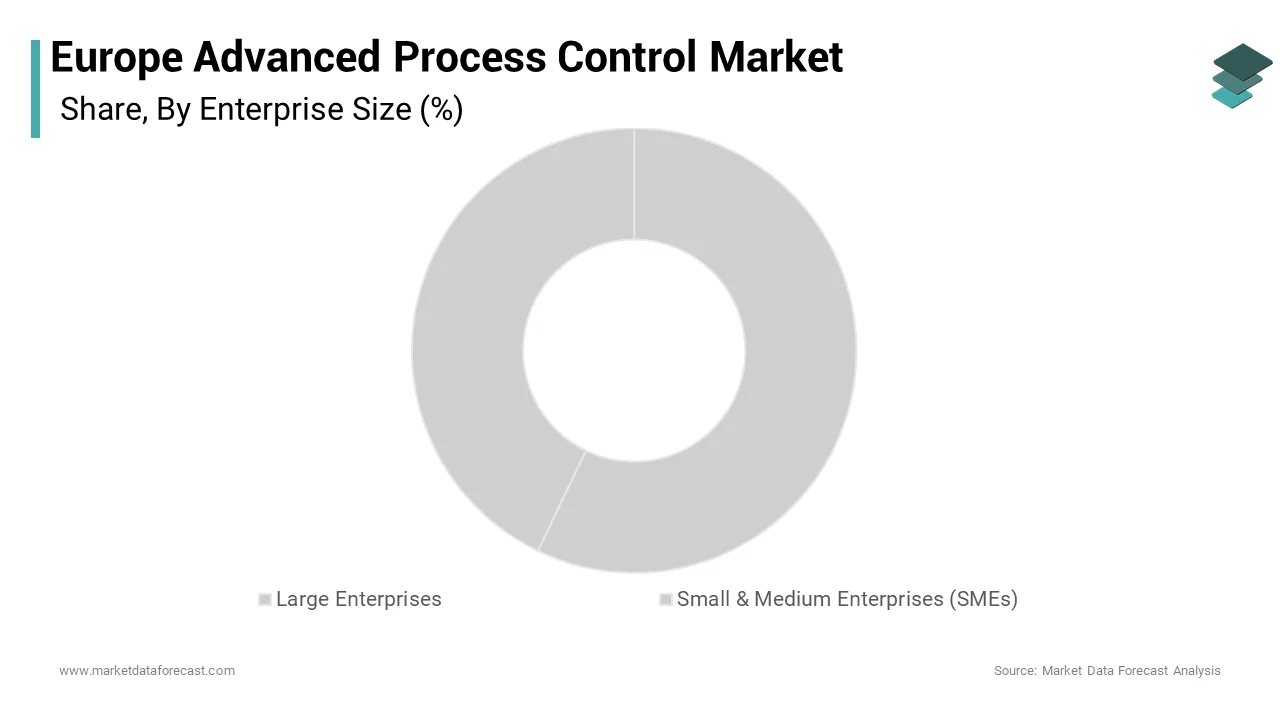
The small & medium enterprises segment is projected to witness a fastest CAGR of 9.2% in coming years with the democratization of automation technology through cloud-based software-as-a-service models and modular solutions that significantly lower the barrier to entry for smaller manufacturers. According to the European Commission, SMEs constitute 99% of all businesses in the EU, and recent initiatives like the Digital Innovation Hubs have provided subsidized access to advanced testing and deployment facilities for these firms. As per the Confederation of European Paper Industries, smaller mills are increasingly leveraging remote monitoring and simplified multivariable control to optimize production runs without needing large internal IT teams. The shift towards flexible manufacturing and the need for rapid adaptation to market changes also drive SMEs to adopt agile control strategies. This emergence of accessible technology, economic necessity, and government support positions SMEs as the most dynamic growth vector in the market landscape.
By Technology Insights
The multivariable model predictive control segment held 42.3% of the Europe advanced process control market in 2025 with its unique ability to handle complex, multi-variable processes with interacting constraints, which is characteristic of the continuous processing industries prevalent in Europe such as refining and petrochemicals. The superior economic performance MPC delivers by pushing operations closer to physical limits while maintaining stability, a capability that single-loop controllers cannot match. Data from the European Refiners Association indicates that over 80% of large-scale cracking units in the region now utilize MPC to manage the intricate balance between feedstock variability and product specifications. As per the European Chemical Industry Council, the stringent quality requirements for specialty chemicals necessitate the precise trajectory tracking that MPC offers, ensuring consistent product grades despite disturbances. The technology's capacity to explicitly handle constraints on inputs, outputs, and states makes it indispensable for safe and efficient operation in highly regulated environments. The proven track record of MPC in delivering tangible ROI in energy-intensive sectors cements its position as the backbone of advanced process control strategies across the continent.
The inferential control segment is anticipated to grow at a CAGR of 10.5% from the forecast period for real-time quality estimation in processes where online analyzers are either too expensive, too slow, or technically impossible to install. The advancement in data analytics and machine learning algorithms that allow inferential sensors to predict key quality variables with high accuracy using existing process data, thereby reducing reliance on laboratory sampling delays. As per the European Pharmaceutical Manufacturers Association, the shift towards continuous manufacturing in pharma relies heavily on inferential models to monitor quality attributes in real time, as mandated by regulatory bodies like the EMA. As per the Internet of Things European Research Cluster, the proliferation of low-cost IoT sensors provides the dense data streams necessary to train and maintain robust inferential models by making the technology more accessible and reliable. The ability to achieve tighter control loops and faster response times without the capital expenditure of hardware analyzers drives aggressive adoption rates.
By End Use Insights
The oil & gas segment was the largest by holding 35.4% of the Europe advanced process control market share in 2025 with the extreme complexity and high value of refining and petrochemical operations, where advanced process control is essential for maximizing yield, ensuring safety, and meeting strict environmental standards. The intense pressure on European refineries to optimize margins amidst fluctuating crude prices and shrinking demand for traditional fuels by necessitating every possible efficiency gain. According to the European Refiners Association, the average utilization rate of advanced process control in European refineries exceeds 90%, reflecting its status as a standard operational tool rather than an optional upgrade. As per the European Environment Agency, the rigorous emissions trading system forces operators to use MPC to minimize flaring and optimize fuel gas networks, making APC critical for regulatory survival. The high cost of downtime and the severe consequences of safety incidents in this sector further justify the substantial investment in robust control systems.
The pharmaceuticals segment is projected to witness a fastest CAGR of 11.8% from 2025 to 2033 with the global shift towards continuous manufacturing and the stringent regulatory push for Quality by Design principles, which rely heavily on real-time process monitoring and control. A major driving factor is the need to ensure absolute batch-to-batch consistency and purity in drug production, where advanced process control systems provide the precision and adaptability required to manage complex biological and chemical reactions. Data from the European Federation of Pharmaceutical Industries and Associations shows that investments in digitalization and smart manufacturing have increased driven by the need to reduce time-to-market and enhance supply chain resilience. As per the International Society for Pharmaceutical Engineering, the implementation of model predictive control in bioreactors and crystallization units has improved yield and reduced waste significantly, offering a strong economic incentive. The high value of pharmaceutical products means that even small improvements in efficiency translate to substantial financial gains, driving rapid adoption. This convergence of regulatory support, technological necessity, and economic benefit ensures that the pharmaceutical sector will lead market growth.
COUNTRY ANALYSIS
Germany Advanced Process Control Market Analysis
Germany was the largest contributor Europe advanced process control market by holding 26.3% of share in 2025 due to its status as the continent's industrial powerhouse and an automation technology. The presence of major global chemical conglomerates and engineering firms headquartered in the country, which serve as early adopters and developers of cutting-edge process optimization technologies is propelling the growth of market. According to the Federal Ministry for Economic Affairs and Climate Action, the German government has allocated billions in funding to support digital transformation in manufacturing, specifically targeting energy efficiency and resource productivity through advanced automation. Data from the VDMA (German Engineering Federation) indicates that the adoption rate of model predictive control in German processing industries is the highest in Europe, reflecting a culture of precision and continuous improvement.
France Advanced Process Control Market Analysis
France was positioned second by holding 19.2% of the Europe advanced process control market share in 2025. The strong state-led initiative to modernize industrial infrastructure and enhance energy sovereignty, which prioritizes the deployment of advanced optimization tools. The presence of global giants in the energy and cosmetics sectors, such as TotalEnergies and L'Oreal, which utilize advanced process control to maintain competitiveness and meet ambitious carbon neutrality goals. According to the French Ministry of Economy, the "France 2030" investment plan includes significant provisions for decarbonizing industry through digital technologies, spurring demand for energy management and process optimization systems. Data from the Union of Chemical Industries indicates that French refineries and chemical plants have aggressively upgraded their control architectures to handle diverse feedstocks and stricter environmental regulations. As per the French Nuclear Safety Authority, the complex dynamics of nuclear power generation require sophisticated control algorithms to ensure safety and efficiency, creating a specialized niche for high-end APC solutions.
United Kingdom Advanced Process Control Market Analysis
The United Kingdom advanced process control market growth is likely to grow with a strong heritage in oil and gas, life sciences, and specialty chemicals. The UK is marked by a focus on maximizing asset life and efficiency in mature North Sea fields and aging refinery infrastructure, where advanced control is vital for economic viability. The rigorous regulatory environment regarding safety and emissions, coupled with high energy costs, which forces operators to squeeze maximum value from existing assets through digital optimization. According to the Department for Energy Security and Net Zero, the UK's net-zero targets have accelerated the adoption of advanced process control in hydrogen production and carbon capture projects by creating new growth avenues. Data from the Chemical Industries Association reveals that UK chemical manufacturers are increasingly investing in inferential control and real-time optimization to mitigate the impact of volatile energy prices on production costs.
Italy Advanced Process Control Market Analysis
Italy advanced process control market growth is driven by the petrochemicals, pharmaceuticals, and food and beverage processing. The need to improve energy efficiency and reduce dependency on imported energy, prompting widespread upgrades of process control systems in energy-intensive industries is driving the growth of Europe advanced process control market. Data from Confindustria indicates that the Italian chemical and pharmaceutical clusters are actively implementing model predictive control to enhance product quality and reduce waste in line with EU sustainability mandates. As per the Italian Association of Chemical and Pharmaceutical Industries, the transition towards bio-based feedstocks in refineries requires flexible and advanced control strategies to manage variability, driving technology adoption. The focus on high-value niche products and the imperative for energy independence drive Italy's steady growth in the advanced process control sector.
Netherlands Advanced Process Control Market Analysis
The Netherlands advanced process control market growth is likely to grow with the status as a major logistics and refining hub with the Rotterdam port complex serving as a central node for European energy and chemical flows. The Dutch government's ambitious climate goals and the Port of Rotterdam's initiative to become a fully circular and carbon-neutral hub by 2050, which is necessitating advanced optimization of material and energy flows. According to the Netherlands Enterprise Agency, significant subsidies and tax incentives are available for industries implementing technologies that reduce CO2 emissions and improve resource efficiency by boosting APC adoption. Data from the Royal Netherlands Chemical Industry Association shows that the integration of hydrogen networks and carbon capture systems in the port area relies heavily on multivariable control to balance supply and demand dynamically. As per TNO, the Dutch organization for applied scientific research, collaborative projects between industry and knowledge institutions are pioneering next-generation control algorithms for sustainable chemistry.
COMPETITIVE LANDSCAPE
The competition in the Europe advanced process control market is characterized by intense rivalry among established multinational conglomerates and specialized software vendors who vie for dominance in high-value industrial sectors. The mix of full-suite automation providers offering integrated hardware and software solutions alongside niche players focusing on advanced algorithms and analytics. Differentiation frequently hinges on the depth of industry expertise, the robustness of cybersecurity features, and the ability to seamlessly integrate legacy systems with modern digital tools. Price sensitivity varies by sector with large oil and gas refineries willing to pay premiums for proven reliability while smaller manufacturers seek cost-effective modular options. Supply chain resilience and local support capabilities are also critical battlegrounds where companies strive to prove their commitment to European clients. The entry of tech giants offering general-purpose industrial internet platforms adds a new dimension to competition by challenging traditional automation leaders with agile data-centric solutions.
KEY MARKET PLAYERS
A few of the market players that are in the Europe advanced process control market are
- ABB Ltd.
- Siemens AG
- Emerson Electric Co.
- General Electric Company
- Honeywell International Inc.
- Mitsubishi Electric Corporation
- Panasonic Holdings Corporation
- Rockwell Automation, Inc.
- SAP SE
- Onto Innovation Inc.
Top Players In The Market
- Siemens AG operates as a global titan in industrial automation and digitalization with a profound influence on the Europe advanced process control market through its comprehensive Simatic PCS 7 and Process Optimization Suite. The company provides sophisticated model predictive control and real-time optimization solutions that enable complex industries to maximize efficiency and sustainability. Their contribution to the global market involves setting benchmarks for integrated engineering environments and cybersecurity in operational technology. Recently the company has strengthened its position by launching enhanced artificial intelligence capabilities within its process control platforms to enable autonomous optimization. They have also expanded their consulting services to help European manufacturers navigate the energy transition through advanced digital twins.
- ABB Ltd stands as a premier provider of robotics and industrial automation with a significant footprint in the Europe advanced process control market via its System 800xA platform. The company leverages decades of domain expertise to deliver robust multivariable control solutions tailored for oil and gas, chemicals, and power generation sectors. Their global involvement includes pioneering collaborative robots and digital services that integrate seamlessly with advanced process control architectures to enhance plant safety and productivity. In recent actions to bolster their European presence the group has introduced cloud-based analytics tools that allow remote monitoring and optimization of process units. They have also formed strategic alliances with energy companies to develop specific applications for hydrogen production and carbon capture utilization. These efforts demonstrate their commitment to driving the industrial decarbonization agenda while ensuring their control systems remain at the forefront of technological innovation.
- Emerson Electric Co. is a leading technology and engineering company that plays a critical role in the Europe advanced process control market through its DeltaV distributed control system and Plantweb digital ecosystem. The company specializes in delivering scalable advanced regulatory control and inferential sensing technologies that help operators manage complexity and variability in continuous processes. Their global market contribution is marked by extensive investments in wireless instrumentation and edge computing that facilitate data-driven decision-making in real time. They have also launched new training programs aimed at upskilling the European workforce in advanced automation techniques. These actions ensure that Emerson remains a trusted partner for industries seeking to improve agility and resilience in an increasingly volatile economic landscape.
Top Strategies Used By Key Market Participants
Key players in the Europe advanced process control market primarily employ strategies focused on integrating artificial intelligence and machine learning to enhance predictive capabilities and autonomous optimization. Companies are increasingly investing in cloud-based deployment models to offer scalable software-as-a-service solutions that reduce upfront costs for clients. Forming strategic partnerships with energy providers and engineering firms is another critical strategy used to develop industry-specific applications for the energy transition. Participants are also expanding their service portfolios to include comprehensive consulting and lifecycle management that ensures long-term system performance and adoption. Furthermore, firms are prioritizing cybersecurity enhancements to protect critical infrastructure from evolving digital threats while maintaining operational continuity. These combined approaches allow manufacturers to deliver holistic value propositions that address both immediate efficiency needs and long-term sustainability goals.
MARKET SEGMENTATION
By Enterprise Size
- Large Enterprises
- Small & Medium Enterprises (SMEs)
By Component
- Software
- Hardware
- Control Systems
- Computing Systems
- Interface, Display & Others
- Services
By Technology
- Advanced Regulatory Control (ARC)
- Multivariable Model Predictive control (MPC)
- Inferential control
- Sequential control
- Compressor control
By Solution
- Energy Management & Optimization
- Asset Performance Optimization
- Process Performance
- Operation Management
- Workforce Management & Others
By End Use
- Oil & Gas
- Chemicals
- Mining, Minerals, & Metals
- Pharmaceuticals
- Energy & Power
- Food & Beverages
- Paper, Pulp & Others
By Country
- UK
- Russia
- Germany
- Italy
- France
- Spain
- Sweden
- Denmark
- Poland
- Switzerland
- Netherlands
- Rest of Europe
Frequently Asked Questions
How does advanced process control improve industrial operations in Europe?
Advanced process control optimizes production processes by using real-time data and automated control systems.
What factors are driving the growth of the advanced process control market in Europe?
Increasing demand for efficiency, quality control, and reduced operational costs is boosting adoption.
Which industries commonly use advanced process control systems?
Industries such as oil and gas, chemicals, power generation, and manufacturing widely use these systems.
Why are companies adopting advanced process control solutions?
They help improve productivity, minimize waste, and maintain consistent product quality.
How does advanced process control support automation in industries?
It enables automated decision-making and precise control of complex industrial processes.
What technologies are integrated into advanced process control systems?
Data analytics, sensors, control algorithms, and industrial software platforms are commonly integrated.
What challenges affect the Europe advanced process control market?
High implementation costs and integration complexity can limit adoption.
How is digital transformation influencing process control solutions?
Digital technologies are enabling smarter, more adaptive, and data-driven control systems.
Which countries are leading in advanced process control adoption in Europe?
Germany, the United Kingdom, France, and Italy are key markets due to strong industrial sectors.
What future trend is expected in the Europe advanced process control market?
Increasing adoption of AI-driven and predictive control systems is expected to drive market growth.
Access the study in MULTIPLE FORMATS
Purchase options starting from
$ 2000
Didn’t find what you’re looking for?
TALK TO OUR ANALYST TEAM
Need something within your budget?
NO WORRIES! WE GOT YOU COVERED!
Call us on: +1 888 702 9696 (U.S Toll Free)
Write to us: sales@marketdataforecast.com