Europe Biomaterials Market Size, Share, Trends & Growth Forecast Report By Material Type, Application and Country (UK, France, Spain, Germany, Italy, Russia, Sweden, Denmark, Switzerland, Netherlands, Turkey, Czech Republic and Rest of Europe) - Industry Analysis (2025 to 2033)
Europe Biomaterials Market Size
The Europe Biomaterials Market was valued at USD 44 billion in 2024. The Europe Biomaterials Market is expected to have a 13.62% CAGR from 2024 to 2033 and be worth USD 138.63 billion by 2033 from USD 49.91 billion in 2025.

Biomaterials are engineered substances designed to interface with biological systems for medical applications, including implants, tissue engineering scaffolds, drug delivery systems, and wound care products. These materials, ranging from biodegradable polymers and ceramics to metallic alloys and natural hydrogels, are critical in restoring, augmenting, or replacing damaged tissues and organs. Biomaterials are widely used in European healthcare, supporting a large number of surgical procedures each year. The region’s advanced healthcare infrastructure and a strong emphasis on translational research support the integration of next-generation biomaterials. Institutions such as the Max Planck Institute and the French National Institute of Health and Medical Research (INSERM) are actively advancing bioactive coatings and smart responsive materials, reinforcing Europe’s role as a hub for biomedical innovation and regulatory excellence.
MARKET DRIVERS
Rising Prevalence of Chronic Diseases and Age-Related Degenerative Conditions
The escalating burden of chronic diseases such as osteoarthritis, cardiovascular disorders, and diabetes is significantly increasing the demand for implantable and regenerative biomaterials across Europe. Like, a high rate of all deaths in the European Region is attributable to non-communicable diseases, with musculoskeletal conditions affecting millions of people. The aging population exacerbates this trend; Europe’s aging population increases the need for implants and regenerative therapies. This demographic shift has led to a surge in joint replacements, with Surgical procedures such as joint replacements expanding, fueling biomaterials consumption. Biomaterials such as hydroxyapatite-coated implants and biodegradable polymer stents are increasingly used to enhance integration and reduce long-term complications, directly linking clinical demand to material innovation.
Expansion of Regenerative Medicine and Tissue Engineering Research
Europe has emerged as a global leader in regenerative medicine, driving demand for advanced biomaterials that support cell growth, differentiation, and structural regeneration. As per the European Tissue Engineering Society, over 400 active clinical trials involving biomaterial-based scaffolds were underway in 2023, particularly in skin, cartilage, and cardiac tissue regeneration. The EU allocated a substantial amount to regenerative therapies, supporting initiatives such as the RESTORE consortium, which develops 3D-bioprinted constructs using collagen and polylactic acid (PLA) matrices. In Sweden and the Netherlands, academic-industry collaborations have led to the commercialization of decellularized extracellular matrix (ECM) materials for wound healing and organ repair. Additionally, the European Medicines Agency (EMA) has approved many advanced therapy medicinal products (ATMPs) incorporating biomaterials, signaling regulatory maturity and accelerating clinical adoption.
MARKET RESTRAINTS
Stringent Regulatory Pathways and Lengthy Approval Timelines
The development and commercialization of biomaterials in Europe are hindered by rigorous regulatory requirements under the Medical Devices Regulation (MDR) (EU) 2017/745, which mandates extensive preclinical and clinical validation. CE marking under MDR has led to longer approval timelines and heightened scrutiny, impacting SMEs. This delay stems from heightened scrutiny by Notified Bodies, with a significant portion of regulatory submissions being rejected due to incomplete safety or compatibility data. In Europe, small and medium-sized enterprises (SMEs) in the biomaterials sector experienced project discontinuation or funding withdrawal due to regulatory bottlenecks. These challenges disproportionately affect innovators developing resorbable polymers or bioactive composites, slowing the translation of research into clinical practice.
High Costs of Biomaterial Development and Limited Reimbursement
The financial burden associated with biomaterial R&D, manufacturing, and clinical validation restricts market entry, particularly for novel or patient-specific solutions. Developing and commercializing biomaterials requires substantial financial investment, particularly for compliance and testing. Furthermore, inconsistent reimbursement policies across EU member states limit patient access and discourage adoption. Biomaterial development is expensive, and variable reimbursement across EU member states limits the adoption of advanced therapies. In Germany and France, hospitals often absorb the cost of advanced biomaterials, creating financial disincentives for widespread use. This economic barrier stifles innovation and restricts equitable access to cutting-edge therapies, particularly in Eastern and Southern Europe.
MARKET OPPORTUNITIES
Integration of 3D Printing and Patient-Specific Implant Design
The convergence of additive manufacturing and digital health is unlocking transformative potential in personalized biomaterial applications. In Europe, the use of 3D-printed patient-specific implants (PSIs) in craniofacial and orthopedic surgery has increased in recent years. These implants, fabricated from titanium alloys, PEEK, or bioceramics, are tailored to individual anatomies using CT and MRI data, improving surgical precision and osseointegration. Also, customized implants can reduce the need for revision surgeries and improve outcomes. Companies are expanding production facilities in Germany and Spain to meet rising demand. This shift toward customization enhances clinical outcomes and reduces long-term healthcare costs, positioning 3D printing as a cornerstone of next-generation biomaterial deployment.
Development of Smart and Stimuli-Responsive Biomaterials
A growing frontier lies in the creation of intelligent biomaterials capable of responding to physiological cues such as pH, temperature, or enzymatic activity. These materials enable targeted drug delivery, real-time monitoring, and dynamic tissue support. Like, numerous EU research groups are developing hydrogels for inflammation-responsive drug delivery. In cardiovascular applications, shape-memory polymer stents are being investigated in Europe for cardiovascular applications, with the potential to improve vessel compliance. Graphene Flagship research is advancing neural interfaces with improved signal detection. These innovations, supported by EU digital twin and AI initiatives, are paving the way for adaptive, real-time medical interventions that redefine the functionality of traditional biomaterials.
MARKERT CHALLENGES
Long-Term Biocompatibility and Degradation Byproduct Risks
Despite advances in material science, concerns persist regarding the long-term interaction of synthetic biomaterials with human tissues, particularly for biodegradable polymers and nanocomposites. Also, certain degradation byproducts of polylactic-co-glycolic acid (PLGA), a widely used resorbable polymer, have been linked to localized inflammatory responses and foreign body reactions in some implant cases. Additionally, the accumulation of wear particles from metallic implants, such as cobalt-chromium alloys, has raised concerns about systemic toxicity and osteolysis. The European Society for Biomaterials emphasizes that predictive in vitro models often fail to replicate long-term in vivo behavior, leading to unforeseen complications years after implantation. Ensuring sustained biocompatibility requires advanced monitoring and improved preclinical testing protocols.
Fragmented Supply Chain for High-Purity Raw Materials
The production of medical-grade biomaterials is constrained by a fragmented and geographically concentrated supply chain for critical raw inputs such as medical-grade polymers, bioactive ceramics, and recombinant proteins. Also, a large number of high-purity polylactic acid (PLA) and polyglycolic acid (PGA) used in Europe are imported from the United States and Asia, exposing manufacturers to geopolitical and logistical risks. Moreover, due to limited domestic refining capacity, tricalcium phosphate and hyaluronic acid are vulnerable. Additionally, disruptions during the pandemic revealed vulnerabilities in sterile processing and quality control, with supply chain disruptions can significantly delay manufacturing schedules. Establishing resilient, EU-based sourcing and purification infrastructure is essential to ensure consistent quality and supply security for advanced medical applications.
REPORT COVERAGE
| REPORT METRIC | DETAILS |
| Market Size Available | 2024 to 2033 |
| Base Year | 2024 |
| Forecast Period | 2025 to 2033 |
| Segments Covered | By Type, Application, and Country. |
| Various Analyses Covered | Global, Regional and Country-Level Analysis, Segment-Level Analysis, Drivers, Restraints, Opportunities, Challenges; PESTLE Analysis; Porter’s Five Forces Analysis, Competitive Landscape, Analyst Overview of Investment Opportunities |
| Countries Covered | UK, France, Spain, Germany, Italy, Russia, Sweden, Denmark, Switzerland, Netherlands, Turkey, Czech Republic, Rest of Europe |
| Market Leaders Profiled | DSM, Zimmer Biomet Holdings, Inc., Evonik Industries AG, Wright Medical Technology, Inc., Corbion N.V., Berkeley Advanced Biomaterials, Bayer AG, Carpenter Technology Corporation, Covalon Technologies Ltd., BASF SE, Invibio Ltd., Inc., CAM Bioceramics BV, Collagen Matrix, Inc. |
SEGMENTAL ANALYSIS
By Type Insights
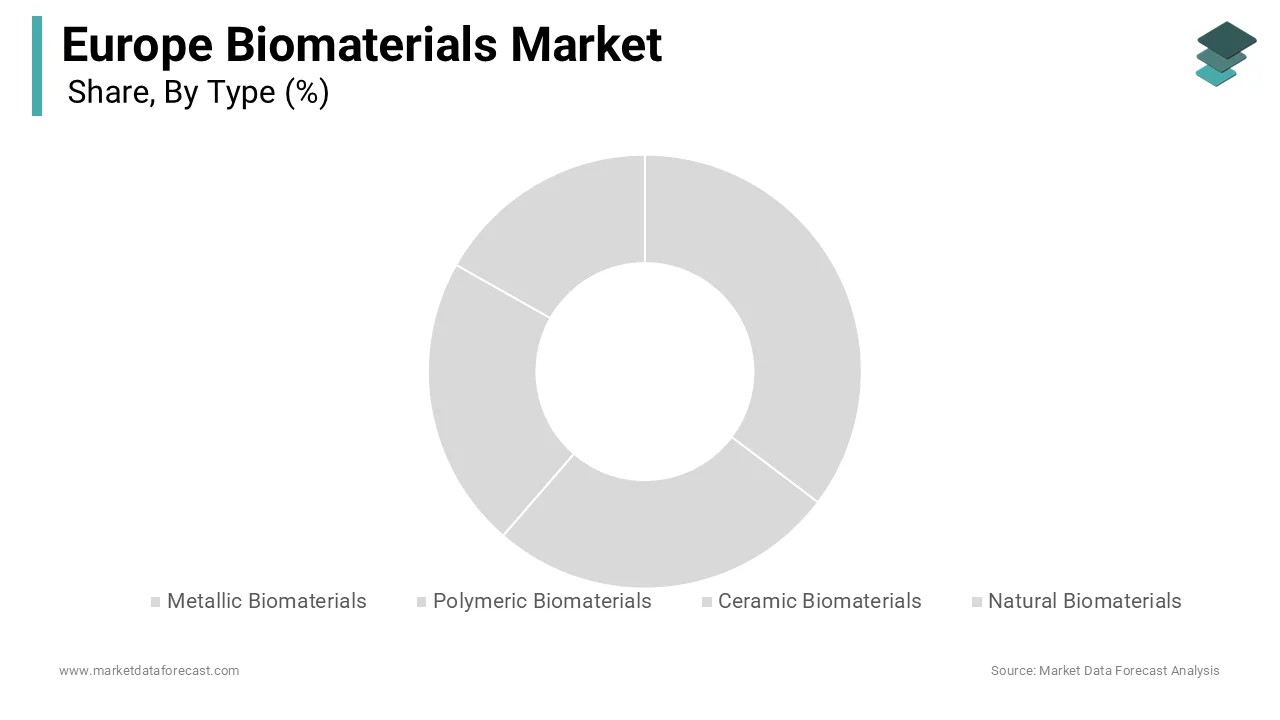
The polymeric biomaterials segment held the largest share of the Europe biomaterials markmarket9.1% in 2024. This dominance is primarily driven by their versatility in both temporary and permanent medical applications, including sutures, drug delivery systems, and tissue engineering scaffolds. Synthetic polymers such as polylactic acid (PLA), polyglycolic acid (PGA), and their copolymer PLGA are widely used due to their tunable degradation rates and biocompatibility. Like, Europe produces significant volumes of polymeric biomaterials, led by major manufacturing hubs. Additionally, the rise of minimally invasive procedures has increased demand for polymer-based stents and catheters, which offer flexibility and reduced thrombogenicity. Polymeric components are widely incorporated in approved biomaterial devices.
The natural biomaterials segment is expanding at a CAGR of 13.4% and is propelled by their inherent biocompatibility, low immunogenicity, and alignment with regenerative medicine principles. These materials, derived from collagen, hyaluronic acid, chitosan, and decellularized extracellular matrices, are increasingly used in wound healing, dermal fillers, and bioengineered tissues. Natural materials often perform better than synthetics in cell growth and tissue integration studies. Also, a significant number of chronic wounds are treated annually in the EU, with natural hydrogels and collagen dressings used in advanced cases. Furthermore, EU programs and regional initiatives are promoting sustainable and clinically advanced natural biomaterials. Countries like Sweden and the Netherlands are pioneering the use of plant-derived cellulose and marine-sourced chitosan, enhancing sustainability while meeting stringent biocompatibility standards.
By Application Insights
The orthopedic application segment dominated the market and commands an estimated 31.7% share of the Europe biomaterials market in 2024. This lead position is to theotoe high volume of joint replacement surgeries and spinal implants driven by an aging population and rising incidence of osteoarthritis. Moreover, a large number of hip and knee arthroplasties were performed in the EU, with demand projected to grow annually due to increasing obesity and sedentary lifestyles. Biomaterials such as titanium alloys, hydroxyapatite coatings, and ultra-high-molecular-weight polyethylene (UHMWPE) are critical in ensuring implant durability and osseointegration. Many primary joint implants now incorporate bioactive coatings to reduce loosening and revision rates. Additionally, the integration of 3D-printed porous titanium structures has improved bone ingrowth, reinforcing the orthopedic sector’s reliance on advanced materials.
The tissue engineering segment is growing at a CAGR of 15.2% which is driven by breakthroughs in stem cell research, 3D bioprinting, and scaffold design. In Europe, significant allocated to tissue engineering projects in recent years, supporting initiatives like ORGANOID and BIODESIGN. These programs focus on developing functional skin, cartilage, and vascularized liver constructs using biomaterial scaffolds seeded with autologous cells. In 2022, the European Medicines Agency approved Holoclar, the first tissue-engineered product for corneal regeneration, marking a regulatory milestone. Academic centers in Belgium and the UK have successfully implanted lab-grown trachea and bladder tissues using polycaprolactone (PCL) and collagen scaffolds. Numerous clinical trials involving biomaterial-based constructs were active in 2023, signaling robust translational momentum and positioning tissue engineering as the frontier of regenerative medicine.
COUNTRY LEVEL ANALYSIS
Germany Biomaterials Market Insights
Germany remained the leading country in the Europe biomaterials market by accounting for 26.6% in 2024. The country’s lead position is anchored in its world-class engineering, robust healthcare infrastructure, and strong integration of research and industry. Germany is home to leading biomaterial manufacturers such as B. Braun, CeramTec, and Heraeus, which produce advanced ceramics, metallic implants, and polymer-based devices for global distribution. The Fraunhofer Institute for Interfacial Engineering and Biotechnology (IGB) collaborates with clinics to develop bioresorbable stents and antimicrobial coatings. Additionally, the country performs High procedural volumes of orthopedic implant procedures, creating sustained demand. With stringent quality control and a focus on innovation, Germany serves as a benchmark for regulatory compliance and technological advancement in biomaterial deployment.
United Kingdom Biomaterials Market Insights
The UK is a key player in the regional biomaterials market and is distinguished by its excellence in academic research and translational medicine. Institutions such as Imperial College London, the University of Cambridge, and the Francis Crick Institute are at the forefront of developing smart hydrogels, nanocomposites, and bioengineered tissues. Also, a significant amount was invested in biomaterials-related projects, particularly in tissue engineering and drug delivery. Clinical adoption of advanced biomaterials is substantial across the healthcare system. The Medicines and Healthcare products Regulatory Agency (MHRA) has streamlined pathways for ATMPs, facilitating the approval of biomaterial-integrated therapies. This synergy between public research, healthcare delivery, and regulatory agility positions the UK as a pioneer in next-generation biomaterial innovation.
France Biomaterials Market Insights
France is another strong region in the Europe biomaterials market, which is characterized by a strong public healthcare system and a focus on high-value medical technologies. The country performs a high number of orthopedic and cardiovascular implants. French hospitals are early adopters of bioactive coatings and resorbable stents. The country hosts major biomaterial producers such as Corin and L’Oréal’s medical division, which develops collagen-based wound matrices. Additionally, the INSERM-led BIOMATHEUS initiative fosters collaboration between academia and industry to accelerate clinical translation. France’s commitment to evidence-based medicine and patient safety ensures rigorous evaluation of new materials, fostering trust and long-term clinical integration.
Italy Biomaterials Market Insights
Italy is a significant contributor to the European biomaterials market, with a healthcare system that emphasizes regional innovation and specialized medical centers. The country performs substantial orthopedic procedures annually, with high adoption of ceramic and hybrid biomaterials in joint replacements. Lombardy and Emilia-Romagna are hubs for medical device manufacturing, hosting companies like LimaCorporate, a pioneer in 3D-printed patient-specific implants. Also, national research initiatives contribute innovative biomaterials for clinical use. Additionally, Italy’s aging population, 24% over the age of 65, according to ISTAT, drives demand for durable, biocompatible materials. The integration of biomaterials into national reimbursement frameworks has improved access, supporting sustained growth in both public and private healthcare settings.
Spain Biomaterials Market Insights
Spain is emerging as a competitive player through growing investment in biomedical research and surgical innovation. It allocated a significant amount to biomaterials and regenerative medicine projects in recent years, supporting institutions like the Institute for Bioengineering of Catalonia (IBEC). The country performs a notable volume of orthopedic and dental implant procedures annually, with increasing use of titanium and zirconia-based materials. Hospitals in Barcelona and Madrid are participating in EU-funded trials on biodegradable cardiovascular stents and neural scaffolds. Additionally, Spain has strengthened its regulatory alignment with EMA standards, accelerating the approval of advanced wound care products. With a focus on innovation and cost-effective healthcare delivery, Spain is positioning itself as a rising force in the European biomaterials landscape.
KEY MARKET PLAYERS
Some of the major companies operating in the European biomaterials market profiled in this report are DSM, Zimmer Biomet Holdings, Inc., Evonik Industries AG, Wright Medical Technology, Inc., Corbion N.V., Berkeley Advanced Biomaterials, Bayer AG, Carpenter Technology Corporation, Covalon Technologies Ltd., BASF SE, Invibio Ltd., Inc., CAM Bioceramics BV, and Collagen Matrix, Inc.
TOP LEADING PLAYERS IN THE MARKET
Medtronic plc
Medtronic maintains a pivotal role in the European biomaterials landscape through its extensive portfolio of implantable devices incorporating advanced polymers, metallic alloys, and bioactive coatings. The company integrates biomaterials into cardiovascular stents, spinal implants, and insulin delivery systems, emphasizing long-term biocompatibility and performance. In recent years, Medtronic has intensified its focus on next-generation drug-eluting stents using biodegradable polymers such as poly-l-lactic acid (PLLA), which reduce inflammation and late thrombosis risks. Its Hugo robotic-assisted surgery platform incorporates biomaterial-compatible instrumentation, enhancing precision in tissue manipulation. The company collaborates with European research hospitals on real-world evidence studies to validate implant durability. Additionally, Medtronic has expanded its R&D centers in Galway, Ireland, and Tolochenaz, Switzerland, to accelerate localized innovation and regulatory alignment with EU MDR standards.
Johnson & Johnson (DePuy Synthes)
Johnson & Johnson, through its DePuy Synthes division, plays a transformative role in orthopedic biomaterials by pioneering bioactive coatings, 3D-printed porous titanium structures, and resorbable fixation devices. The company’s Trabecular Meta technology, composed of tantalum-based scaffolds, is widely used in hip and spine implants across Europe due to its exceptional osseointegration properties. The company actively partners with academic institutions such as Karolinska Institutet to study bone-implant interfaces and improve material performance. Additionally, J&J has invested in sustainable manufacturing processes, reducing solvent use in polymer processing. These initiatives reinforce its leadership in clinical efficacy and responsible innovation.
Smith & Nephew plc
Smith & Nephew is a key contributor to the European biomaterials market through its focus on advanced wound care, orthopedic implants, and sports medicine devices. The company’s portfolio includes antimicrobial dressings incorporating silver-impregnated hydrocolloids and collagen-based matrices for chronic wound management, widely adopted in NHS and EU hospital networks. Its EXOGEN bone healing system integrates piezoelectric biomaterials to stimulate fracture repair, supported by clinical data from trials in France and Italy. The company has strengthened its position through digital integration, launching a cloud-based platform for monitoring implant performance in real time. Its R&D hub in Hull, UK, collaborates with the University of Leeds on smart biomaterials that respond to mechanical stress, positioning the company at the forefront of adaptive medical technologies.
TOP STRATEGIES USED BY KEY MARKET PARTICIPANTS
Key players in the Europe biomaterials Market are deploying strategies such as investment in R&D for next-generation materials, strategic collaborations with academic and clinical institutions, compliance with EU MDR regulations, expansion of 3D printing and patient-specific implant capabilities, and integration of digital health platforms for post-implant monitoring. Companies are prioritizing biocompatibility, sustainability, and accelerated regulatory pathways through real-world evidence generation. Emphasis is placed on developing resorbable, bioactive, and stimuli-responsive materials to meet the demands of regenerative medicine. Vertical integration of material sourcing and manufacturing ensures quality control, while partnerships with public healthcare systems facilitate clinical adoption. Additionally, firms are enhancing supply chain resilience and investing in green production methods to align with EU environmental directives, ensuring long-term competitiveness in a highly regulated and innovation-driven sector.
COMPETITION OVERVIEW
The competition in the Europe Biomaterials Market is shaped by a convergence of technological innovation, regulatory rigor, and clinical validation, with multinational corporations and specialized SMEs vying for leadership across orthopedic, cardiovascular, and regenerative applications. While large firms dominate through integrated device portfolios and global scale, niche players are gaining traction with bioengineered scaffolds, smart hydrogels, and patient-specific solutions. Success hinges on navigating the EU Medical Devices Regulation, achieving reimbursement approval, and demonstrating long-term safety. Geographic clusters in Germany, the UK, and Scandinavia foster collaboration between industry, academia, and healthcare providers. Differentiation is increasingly based on material intelligence, sustainability, and digital integration, creating a dynamic, high-barrier environment where scientific excellence and regulatory agility determine market sustainability and growth potential.
MARKET SEGMENTATION
This research report on the European biomaterials market has been segmented and sub-segmented into the following categories
By Type
- Metallic Biomaterials
- Polymeric Biomaterials
- Ceramic Biomaterials
- Natural Biomaterials
By Application
- Orthopedic
- Cardiovascular
- Ophthalmology
- Dental
- Plastic Surgery
- Wound Healing
- Tissue Engineering
- Neurological / Central Nervous System
- Urinary
- Other Applications
By Country
- UK
- France
- Spain
- Germany
- Italy
- Russia
- Sweden
- Denmark
- Switzerland
- Netherlands
- Turkey
- Czech Republic
- Rest of Europe
Frequently Asked Questions
1. What factors are driving growth in the Europe Biomaterials Market?
Key drivers for the Europe Biomaterials Market are technological advancements, increased orthopedic surgeries, an aging population, and high medical technology investments, especially in Germany and the UK
2. Which material types are prominent in the Europe Biomaterials Market?
The Europe Biomaterials Market's most prominent types include polymer biomaterials, metallic biomaterials, ceramic biomaterials, and natural biomaterials, each used extensively in different medical applications.
3. Who are the leading players in the Europe Biomaterials Market?
Top companies in the Europe Biomaterials Market are DSM, Zimmer Biomet Holdings, Evonik Industries, Medtronic, BASF SE, and Corbion N.V.,
driving innovation and expanding regional market reach
4. What are the main medical applications in the Europe Biomaterials Market?
The Europe Biomaterials Market’s primary medical applications are orthopedic, cardiovascular, dental, tissue engineering, wound healing, and reconstructive surgeries, reflecting diverse healthcare needs.
5. How does biocompatibility impact the Europe Biomaterials Market?
Biocompatibility is central to the Europe Biomaterials Market, as only materials with proven safety and minimal side effects can be widely adopted for medical implants and devices.
6. What challenges does the Europe Biomaterials Market face? The Europe Biomaterials Market faces challenges such as strict regulatory frameworks, high R&D costs, adverse implant reactions, and manufacturing complexities, which can slow market expansion
xThe Europe Biomaterials Market faces challenges such as strict regulatory frameworks, high R&D costs, adverse implant reactions, and manufacturing complexities, which can slow market expansion
7. What is the role of government funding in the Europe Biomaterials Market?
Government grants and increased funding stimulate innovation, research, and new biomaterial product development in the Europe Biomaterials Market, fostering greater market adoption and growth.
8. Why is the orthopedic segment important for the Europe Biomaterials Market?
The orthopedic segment dominates the Europe Biomaterials Market due to increased joint replacements, fracture treatments, and rising cases of musculoskeletal disorders, driving demand for specialized biomaterials
9. Which technological innovations are shaping the Europe Biomaterials Market?
Technologies such as smart biomaterials, hydrogen scaffolding, decellularized dermal matrices, and nanotechnology influence advancements in the Europe Biomaterials Market and expand clinical applications.
Further innovation is expected as research investment increases
10. How do different countries contribute to the Europe Biomaterials Market?
Germany leads the Europe Biomaterials Market with high implant demand, while the UK and France witness strong growth due to healthcare investment and advanced infrastructure.
Italy and Spain are emerging as promising contributors to the region's expanding market
Related Reports
Access the study in MULTIPLE FORMATS
Purchase options starting from
$ 2000
Didn’t find what you’re looking for?
TALK TO OUR ANALYST TEAM
Need something within your budget?
NO WORRIES! WE GOT YOU COVERED!
Call us on: +1 888 702 9696 (U.S Toll Free)
Write to us: sales@marketdataforecast.com