Europe Call Center AI Market Size, Share, Trends & Growth Forecast Report, Segmented By Application, Deployment, Enterprise, Channel, Industry, And By Country (UK, France, Spain, Germany, Italy, Russia, Sweden, Denmark, Switzerland, Netherlands, Turkey, Czech Republic & Rest of Europe), Industry Analysis From 2026 to 2034
Europe Call Center AI Market Size
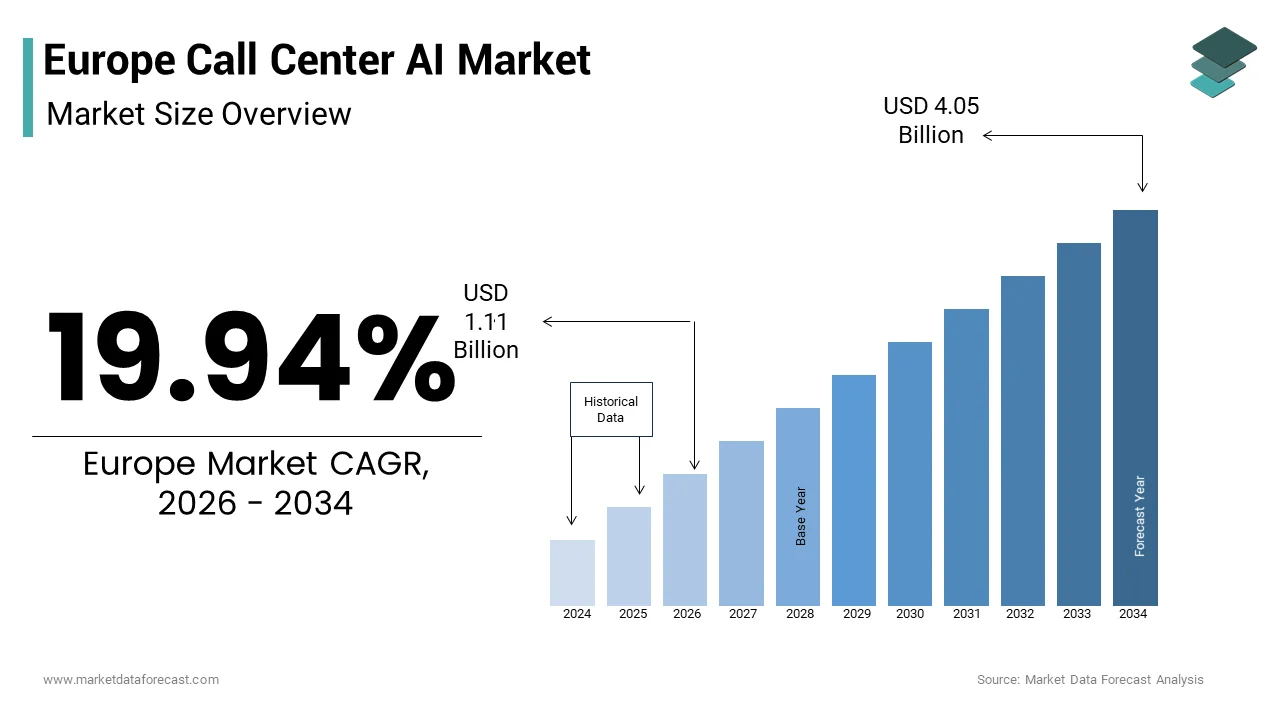
The Europe call center AI market size was valued at USD 0.92 billion in 2025 and is anticipated to reach USD 1.11 billion in 2026 to reach USD 4.05 billion by 2034, growing at a CAGR of 19.94% during the forecast period from 2026 to 2034.
Introduction to the Europe Call Center AI Market
Call center AI encompasses the integration of artificial intelligence technologies into customer contact operations to enhance efficiency, personalization, and automation. This sector includes solutions such as natural language processing, virtual agents, predictive analytics, and sentiment analysis tools that transform traditional voice interactions into intelligent digital experiences. The region is characterized by a strong emphasis on data privacy and multilingual support, which shapes the deployment of these technologies. According to Eurostat, 93% of households in the European Union had access to the internet in 2023, which is creating a robust digital foundation for AI-driven customer service channels. This high connectivity rate enables seamless omnichannel interactions where customers expect immediate and accurate responses across various platforms. Furthermore, according to the European Commission, approximately 70% of companies in the EU are actively investing in digital technologies to improve operational efficiency. The adoption of AI in call centers addresses the growing demand for 24/7 customer support while reducing the reliance on human agents for routine inquiries. According to the International Labour Organization, the service sector employs a significant portion of the European workforce and is driving the need for augmentation rather than replacement of human labor through AI. These technologies enable real-time translation and context-aware responses, which are crucial in a linguistically diverse region. The definition of this market extends beyond simple chatbots to include sophisticated systems that analyze customer intent and emotion. Such advancements allow businesses to proactively resolve issues and enhance customer satisfaction. The regulatory landscape, including the General Data Protection Regulation, influences how data is processed and stored, ensuring that AI implementations adhere to strict privacy standards. This environment fosters innovation while maintaining consumer trust in automated systems.
MARKET DRIVERS
Increasing Demand for Personalized Customer Experiences and Operational Efficiency
The rising expectation for personalized and efficient customer service is primarily driving the growth of the European call center AI market. Modern consumers demand instant resolution to their queries and tailored interactions that reflect their previous engagement history. According to a study by the European Consumer Organisation, over 60% of consumers expect companies to understand their individual needs and preferences. AI technologies enable call centers to analyze vast amounts of customer data in real time, allowing agents to provide customized recommendations and solutions. Natural language processing algorithms can interpret customer intent accurately, reducing the need for repetitive explanations and transfers. As per McKinsey & Company, organizations that leverage AI for customer service can reduce response times by up to 50% while improving satisfaction scores. The ability of AI to handle routine inquiries frees human agents to focus on complex and high-value interactions. This shift enhances overall operational efficiency and reduces costs associated with long handling times. Furthermore, AI-driven analytics help identify trends and pain points, enabling proactive service improvements. The competitive landscape in sectors such as banking, telecommunications, and retail drives companies to differentiate themselves through superior customer experiences. The integration of AI allows for scalable personalization that was previously unattainable with manual processes. Companies are increasingly viewing AI not just as a cost-saving tool but as a strategic asset for building customer loyalty. The continuous improvement of machine learning models ensures that personalization becomes more accurate over time. This driver sustains the momentum of AI adoption across various industries in Europe.
Labor Shortages and Rising Operational Costs in the Service Sector
Persistent labor shortages and escalating operational costs in the European service sector is further aiding the expansion of the European call center AI market. Many countries in Europe face demographic challenges, leading to a shrinking workforce and increased competition for skilled customer service representatives. According to Eurostat, the vacancy rate in the information and communication services sector has remained elevated and reaching 3% in the EU in 2023, which indicates difficulties in recruiting qualified personnel. AI solutions offer a viable alternative by automating repetitive tasks and handling high volumes of inquiries without the need for additional staff. Virtual agents and chatbots can operate continuously without breaks, ensuring consistent service availability during peak hours. As per the European Centre for the Development of Vocational Training, the cost of labor in Western Europe continues to rise and prompting companies to seek automation strategies to maintain profitability. By deploying AI technologies, organizations can optimize their workforce allocation and reduce overhead expenses related to training and retention. The ability of AI to scale instantly during demand surges provides flexibility that human teams cannot match. This capability is particularly valuable for seasonal businesses or those experiencing fluctuating call volumes. Moreover, AI reduces the burden on human agents by providing real-time assistance and knowledge base recommendations. This support improves agent productivity and job satisfaction by minimizing stressful and mundane tasks. The economic imperative to control costs while maintaining service quality makes AI an attractive investment. Companies are recognizing that automation is essential for sustainable growth in a tight labor market. This financial driver accelerates the integration of AI into existing call center infrastructures.
MARKET RESTRAINTS
Stringent Data Privacy Regulations and Compliance Complexities
The rigorous data protection laws in Europe, particularly the General Data Protection Regulation is hampering the expansion of the European call center AI market. These regulations require explicit consent for data collection and processing, limiting the ability of AI systems to access and utilize customer information freely. According to the European Data Protection Board, non-compliance with GDPR can result in fines of up to 4% of global annual turnover, creating substantial financial risks for organizations. AI models often require large datasets for training and optimization, which conflicts with the principle of data minimization mandated by privacy laws. As per a survey by the International Association of Privacy Professionals, 56% of companies struggle to balance innovation with compliance, leading to delayed AI deployments. The requirement for transparency in automated decision-making further complicates the use of "black box" AI algorithms. Customers have the right to know how their data is used and to request explanations for AI-driven outcomes. This necessitates the development of explainable AI systems, which can be technically challenging and costly. Additionally, cross-border data transfers within and outside the EU are subject to strict restrictions, affecting multinational call center operations. The complexity of ensuring compliance across different member states, with varying interpretations of the law, adds to the administrative burden. Organizations must invest heavily in legal expertise and compliance infrastructure to navigate this landscape. This regulatory uncertainty can deter smaller companies from adopting AI solutions. The fear of reputational damage from privacy breaches also inhibits aggressive AI adoption. Consequently, compliance remains a major restraint on market growth.
High Implementation Costs and Integration Challenges with Legacy Systems
The substantial financial investment required for implementing AI solutions and integrating them with legacy infrastructure is another significant restraint for many European organizations and hindering the regional market expansion. Upgrading outdated call center systems to support advanced AI technologies involves considerable upfront costs, including software licensing, hardware upgrades, and customization. According to the European Investment Bank, small and medium-sized enterprises often lack the capital reserves necessary for such digital transformations, with 33% identifying costs as a major barrier. The complexity of integrating AI with existing customer relationship management and enterprise resource planning systems can lead to prolonged implementation timelines and unexpected expenses. As per Gartner, 80% of organizations underestimate the technical debt associated with legacy systems, resulting in budget overruns and project delays. The need for specialized skills to manage and maintain AI platforms further increases operational costs. There is a shortage of data scientists and AI engineers in Europe, which drives up salaries and recruitment expenses. Additionally, the risk of disruption to ongoing operations during the transition phase discourages some companies from pursuing AI initiatives. The return on investment for AI projects may not be immediately visible, causing hesitation among decision-makers. Maintenance and updates for AI models require continuous investment to ensure accuracy and relevance. For companies with limited IT budgets, these costs can be prohibitive. The fragmentation of the European market means that solutions often need to be adapted for different languages and regulatory environments, increasing complexity. This financial and technical barrier limits the widespread adoption of AI in call centers, particularly among smaller players.
MARKET OPPORTUNITIES
Expansion of Multilingual Support and Real-Time Translation Capabilities
The linguistic diversity of Europe provides a significant opportunity for the European call center AI market. With over 24 official languages in the European Union, call centers struggle to provide consistent service across different regions. AI-powered natural language processing and machine translation technologies can bridge this gap by enabling seamless communication between agents and customers speaking different languages. According to the European Commission, the demand for cross-border services is increasing as the digital single market expands. AI systems can instantly translate voice and text interactions, allowing agents to serve a broader customer base without needing fluency in multiple languages. As per Statista, the number of online shoppers purchasing from other EU countries reached 33% of the population in 2023, driving the need for multilingual customer support. This capability enhances customer satisfaction by removing language barriers and reducing misunderstandings. It also allows companies to centralize their call center operations while still providing localized service. The development of dialect-specific models further improves accuracy and cultural relevance. AI can also analyze sentiment in different languages, providing deeper insights into customer emotions. This technology enables businesses to expand into new markets with lower entry barriers. The ability to offer 24/7 support in multiple languages creates a competitive advantage. Providers who invest in robust multilingual AI solutions can capture a larger share of the European market. This opportunity aligns with the EU’s goal of fostering digital inclusion and accessibility. The continuous improvement of translation algorithms ensures higher quality interactions. This trend drives innovation and differentiation in the call center AI sector.
Integration of Predictive Analytics for Proactive Customer Engagement
The integration of predictive analytics into call center operations offers a substantial opportunity for the European call center AI market. AI algorithms can analyze historical data to predict customer behavior, preferences, and potential issues before they occur. According to the European Business Review, companies that use predictive analytics report 10% to 15% higher customer retention rates and increased sales. In the context of call centers, this technology enables proactive outreach, such as notifying customers about potential service disruptions or offering personalized promotions. As per Forrester Research, proactive customer service can reduce call volumes by up to 20% by resolving issues before customers reach out. Predictive models can also identify customers at risk of churning, allowing agents to intervene with targeted retention strategies. This approach transforms call centers from reactive cost centers into proactive revenue generators. The ability to anticipate customer needs enhances the overall experience and builds loyalty. AI can optimize routing by predicting the best agent for each customer based on personality and issue type. This matching improves first-call resolution rates and satisfaction. The use of predictive analytics also helps in workforce management by forecasting call volumes and staffing requirements. This optimization reduces wait times and improves operational efficiency. Companies can leverage these insights to refine their marketing and service strategies. The growing availability of data and computing power makes predictive analytics more accessible. This opportunity drives value creation and strategic differentiation for early adopters. It positions AI as a critical tool for business growth.
MARKET CHALLENGES
Ethical Concerns and Bias in AI Algorithms
The presence of bias in AI algorithms and ethical concerns regarding automated decision-making is challenging the expansion of the European call center AI market. AI models trained on historical data may inherit biases related to gender, ethnicity, or socioeconomic status, leading to unfair treatment of certain customer groups. According to the European Union Agency for Fundamental Rights, algorithmic bias can perpetuate discrimination and undermine trust in automated systems. In call centers, this could result in unequal service quality or incorrect routing decisions. As per the European Commission, guidelines on trustworthy AI emphasize the need for fairness and accountability in artificial intelligence applications. Ensuring that AI systems are free from bias requires rigorous testing and diverse training datasets, which can be difficult to obtain. The lack of transparency in how AI models make decisions makes it hard to identify and correct biases. Customers may feel disadvantaged if they perceive that they are being treated unfairly by an algorithm. This perception can damage brand reputation and lead to regulatory scrutiny. The General Data Protection Regulation includes provisions against automated decision-making that produces legal or similarly significant effects. Compliance with these ethical standards requires ongoing monitoring and adjustment of AI models. Companies must establish ethical governance frameworks to oversee AI development and deployment. The challenge of balancing efficiency with fairness is complex and resource-intensive. Failure to address these issues can result in legal liabilities and loss of customer confidence. Building trustworthy AI systems is essential for sustainable market growth.
Resistance to Change and Lack of Digital Skills among Workforce
Resistance to change among employees and a lack of digital skills within the workforce present significant challenges to the European call center AI market expansion. Many agents fear that AI will replace their jobs, leading to anxiety and opposition to new technologies. According to the European Trade Union Institute, workers’ concerns about job security can hinder the implementation of automation initiatives. This resistance can manifest as low adoption rates and reduced productivity during the transition period. As per the European Centre for the Development of Vocational Training, there is a significant skills gap, with only 54% of Europeans possessing basic digital skills. Agents may struggle to use AI tools effectively without adequate training and support. The complexity of AI interfaces can overwhelm employees who are accustomed to traditional workflows. Managing this cultural shift requires comprehensive change management strategies, including communication, training, and involvement of staff in the implementation process. Companies must demonstrate how AI augments rather than replaces human roles to gain employee buy-in. The lack of internal expertise to manage AI systems further complicates adoption. Organizations need to invest in upskilling programs to prepare their workforce for AI-assisted operations. The pace of technological change often outstrips the ability of employees to adapt. This mismatch can lead to underutilization of AI capabilities and reduced return on investment. Addressing these human factors is crucial for realizing the full potential of AI. Without employee engagement, AI initiatives are likely to fail. This challenge requires a holistic approach that combines technology with a people strategy.
REPORT COVERAGE
| REPORT METRIC | DETAILS |
| Market Size Available | 2025 to 2034 |
| Base Year | 2025 |
| Forecast Period | 2026 to 2034 |
| CAGR | 19.94% |
| Segments Covered | By Application, Deployment, Enterprise, Channel, Industry And Region |
| Various Analyses Covered | Global, Regional, and Country-Level Analysis; Segment-Level Analysis; DROC; PESTLE Analysis; Porter’s Five Forces Analysis; Competitive Landscape; Analyst Overview of Investment Opportunities |
| Regions Covered | UK, France, Spain, Germany, Italy, Russia, Sweden, Denmark, Switzerland, the Netherlands, the Czech Republic, and the Rest of Europe |
| Market Leaders Profiled | IBM Corporation (U.S.), NICE (Israel), Genesys Cloud Services Inc, Zendesk U.S.), BrightPattern (U.S.), SmartAction LLC (U.S.), Artificial Solutions (Sweden), SAP (Germany), Oracle (U.S.), Avaya Inc. (U.S.), Jio Haptik Technologies Ltd. (India) |
SEGMENTAL ANALYSIS
By Application Insights
The quality management segment dominated the market by holding 26.9% of the regional market share in 2025. The dominance of quality management segment in the European market is driven by the critical need for organizations to monitor and improve agent performance while ensuring compliance with strict regulatory standards. Traditional manual quality assurance methods involve reviewing only a small fraction (often less than 2%) of interactions, which limits visibility and effectiveness. AI-powered quality management solutions enable the analysis of 100% of customer interactions across voice and digital channels, providing comprehensive insights. According to the European Insurance and Occupational Pensions Authority, financial institutions are required to maintain rigorous records of customer communications to ensure transparency and fairness. AI tools automate this process by transcribing conversations and identifying compliance breaches or risky behaviors in real time. As per Gartner, organizations that implement automated quality management see a 25% improvement in agent adherence to scripts and protocols. The ability to detect sentiment and tone allows supervisors to provide targeted coaching, improving overall service quality. Furthermore, the General Data Protection Regulation mandates strict handling of personal data during calls, which AI systems can monitor effectively. These solutions help companies avoid hefty fines by flagging potential privacy violations immediately. The integration of quality management with workforce optimization tools further enhances operational efficiency. Companies use these insights to refine training programs and reduce attrition rates. The demand for consistent and high-quality customer experiences across multiple touchpoints sustains the leadership of this segment. Regulatory pressure and the drive for operational excellence ensure that quality management remains a top priority for European enterprises.
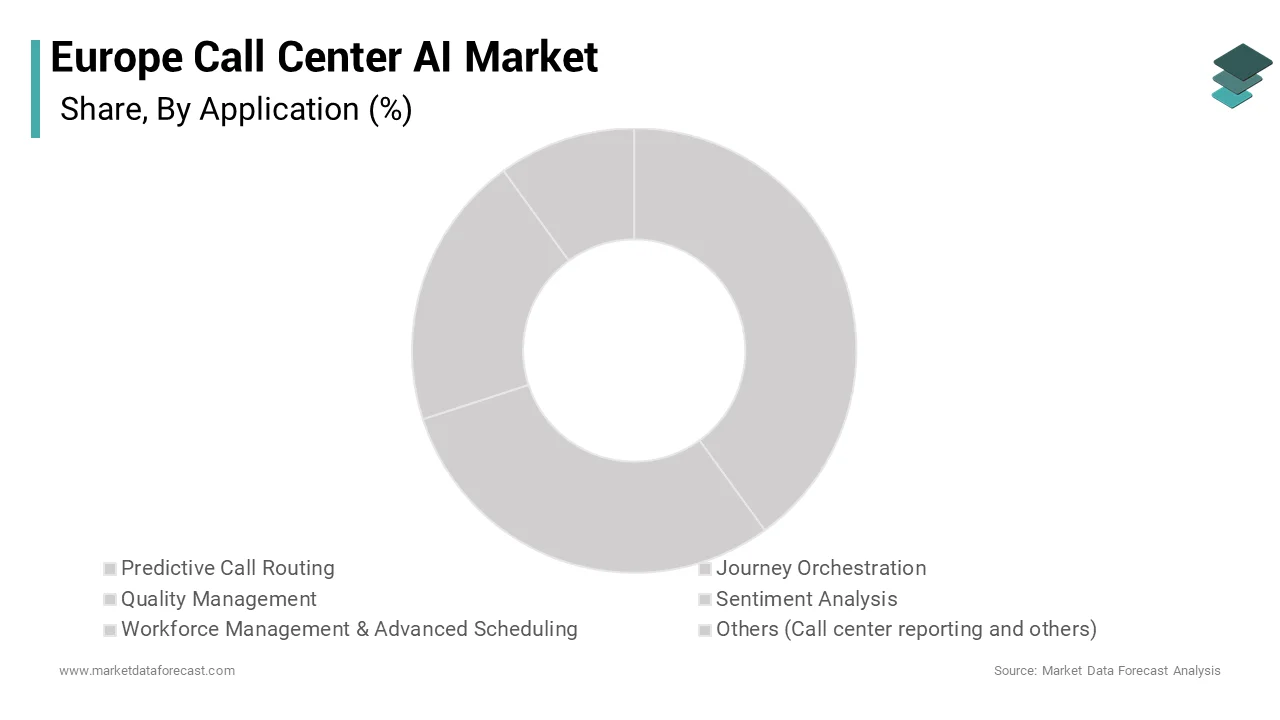
On the other hand, the sentiment analysis segment is anticipated to record a CAGR of 25.5% over the forecast period in the European call center AI market owing to the increasing recognition of emotional intelligence as a key differentiator in customer service. Businesses are leveraging AI to understand customer emotions in real time that allow agents to adjust their approach dynamically. According to the European Consumer Organisation, consumers are more likely to remain loyal to brands that demonstrate empathy and understanding during interactions. Sentiment analysis tools analyze voice tonality, word choice, and pacing to gauge customer satisfaction levels accurately. As per Forrester Research, companies that utilize real-time sentiment analysis report a 15% increase in customer retention rates. This technology enables proactive intervention by supervisors when negative sentiments are detected, preventing escalations and churn. In the multilingual European market, advanced natural language processing models can detect nuances in various languages and dialects. This capability is crucial for multinational corporations serving diverse populations. The integration of sentiment data with customer relationship management systems provides a holistic view of the customer journey. Marketing teams use these insights to tailor campaigns and improve product offerings based on emotional feedback. The rise of social media monitoring also drives demand for sentiment analysis as brands track public perception. AI algorithms can process vast amounts of unstructured data from social platforms, call logs, and surveys. This comprehensive analysis helps businesses identify emerging trends and address issues before they escalate. The focus on enhancing customer experience through emotional connection ensures rapid adoption of sentiment analysis technologies.
By Deployment Insights
The cloud-based deployment segment commanded for the highest share of 61.9% of the European market in 2025. The growth of the cloud segment in the European market is driven by the scalability, flexibility, and cost efficiency offered by software-as-a-service (SaaS) models. Organizations are increasingly moving away from capital-intensive on-premises infrastructure to embrace cloud solutions that allow for rapid deployment and easy updates. According to Eurostat, 45% of enterprises in the European Union used cloud computing services in 2023, reflecting a broader shift towards digital agility. Cloud-based AI solutions enable seamless integration with other business applications such as customer relationship management (CRM) and enterprise resource planning (ERP) systems. This interoperability facilitates a unified view of customer data, enhancing personalization and service efficiency. As per the European Commission, the Digital Single Market strategy promotes cross-border data flows and cloud adoption to boost competitiveness. Cloud platforms also support remote work arrangements, which have become prevalent in the post-pandemic era. Agents can access AI tools from anywhere, ensuring business continuity and flexibility. The automatic updates provided by cloud vendors ensure that organizations always have access to the latest AI capabilities without additional IT burden. Security concerns have diminished as major cloud providers invest heavily in compliance with European data protection regulations. The ability to scale resources up or down based on demand fluctuations helps companies manage costs effectively. This operational efficiency makes cloud deployment the preferred choice for businesses of all sizes. The continuous innovation in cloud infrastructure further reinforces its market dominance.
While cloud solutions dominate, the on-premises deployment segment is experiencing steady growth and is expected to grow at a CAGR of 8.1% over the forecast period. This growth is likely to be driven by stringent data sovereignty requirements and security concerns that compel certain organizations to keep sensitive customer data within their own physical infrastructure. According to the European Union Agency for Cybersecurity, some sectors face heightened risks of cyber espionage, making isolated on-premises systems a strategic choice for protecting confidential information. Companies in these sectors often have legacy systems that are deeply integrated with their core operations, making migration to the cloud complex and risky. As per the European Insurance and Occupational Pensions Authority, digital operational resilience regulations (like DORA) require strict control over data storage and processing, which can be more easily guaranteed with on-premises solutions. Additionally, organizations with existing significant investments in server infrastructure may find it cost-effective to utilize these assets for AI applications rather than incurring new cloud subscription fees. The desire for complete control over data governance and customization also contributes to the persistence of on-premises deployments. Some large conglomerates prefer to maintain isolated networks to prevent any potential leakage of competitive intelligence through shared cloud environments. This segment continues to serve organizations where absolute data control and security outweigh the benefits of cloud flexibility. The ongoing modernization of on-premises hardware also supports this segment by enabling better performance and integration capabilities.
By Enterprise Insights
The large enterprises segment occupied the largest share of 70.7% of the European market share in 2025. This dominance is primarily driven by the extensive customer bases and complex operational requirements of major corporations that necessitate sophisticated AI solutions. These organizations manage millions of customer interactions annually, requiring robust platforms for automation and analytics. According to the European Commission, large enterprises are at the forefront of digital transformation initiatives, with 77% using at least one advanced digital technology in 2023. The scale of their operations allows them to realize significant economies of scale from implementing centralized AI systems. Furthermore, large companies often have the financial resources and technical expertise required to deploy and maintain complex AI infrastructure. As per Eurostat, large enterprises account for 73% of total business expenditure on research and development in the service sector. Their ability to integrate AI with other enterprise applications creates a seamless ecosystem for customer engagement. The pressure to meet stringent sustainability and regulatory targets also drives large corporations to adopt tools that optimize resource usage. Regulatory compliance across multiple jurisdictions further necessitates the use of robust software solutions that can handle diverse legal requirements. The strategic importance of customer experience in maintaining competitive advantage ensures that large enterprises continue to lead in market adoption. Their early adoption sets industry standards and influences broader market trends. The capacity to invest in custom AI models tailored to specific business needs further solidifies their leadership.
On the other hand, the small and medium enterprises (SME) segment is emerging as the fastest-growing category in the Europe call center AI market and is predicted to expand at a CAGR of 23.5% over the forecast period owing to the increasing availability of affordable and user-friendly cloud-based AI solutions that lower the barriers to entry for smaller businesses. Previously, the high cost and complexity of AI systems restricted their adoption to large corporations. However, the rise of subscription-based models has made these tools accessible to small and medium-sized entities, allowing them to compete more effectively. According to the European Commission, SMEs represent 99% of all businesses in the EU and are increasingly recognizing the value of digital tools for efficiency. The need to improve customer service and operational efficiency in a competitive landscape drives this adoption. As per Eurostat, the number of small enterprises using cloud computing services has reached 38%, indicating a broader trend towards digitalization. These businesses benefit from automated responses and intelligent routing, which directly impacts their bottom line. The ability to scale services according to demand allows SMEs to manage growth without substantial capital investment. Furthermore, government initiatives supporting digital transformation in small businesses provide additional incentives for adoption. The fragmentation of the service market means that many small players are seeking ways to differentiate themselves through superior digital experiences. AI-enabled call centers enable them to offer 24/7 support and personalized interactions, enhancing their market position.
By Industry Insights
The BFSI segment led the market by accounting for 31.3% of the regional market share in 2025. The growth of BFSI segment in the European market is attributed to the high volume of customer inquiries related to transactions, account management, and claims processing that require accurate and secure handling. According to the European Banking Authority, banks are required to maintain detailed records of customer interactions for compliance and fraud detection purposes. AI solutions enable automated verification and routine query resolution, reducing wait times and operational costs. As per the European Central Bank, 60% of major European banks have integrated AI into their customer-facing operations. The sector faces intense competition, prompting banks and insurers to differentiate themselves through personalized and efficient service. AI-powered chatbots and virtual assistants handle common requests such as balance inquiries and policy updates, freeing human agents for complex issues. The integration of AI with fraud detection systems enhances security by identifying suspicious patterns in real time. Regulatory pressures, such as the Payment Services Directive 2 (PSD2), encourage open banking and digital innovation, further driving AI adoption. The need for 24/7 availability in global financial markets makes AI an essential tool for continuous service delivery. The high value of customer relationships in this sector justifies significant investment in advanced AI capabilities. Trust and reliability are paramount, making accurate and secure AI interactions critical. The sector’s digital maturity facilitates the seamless integration of AI into existing workflows.
However, the healthcare segment is estimated to be the fastest growing segment and grow at a CAGR of 26.2% over the forecast period in this regional market owing to the increasing demand for patient engagement and the need to manage high volumes of appointment scheduling and inquiry handling efficiently. According to the World Health Organization, the aging population in Europe is increasing the demand for healthcare services, requiring scalable communication solutions. AI-powered virtual agents can handle routine tasks such as appointment booking, prescription refills, and general health inquiries, reducing the burden on medical staff. As per the European Health Data Space framework, the digitization of health services is a priority, facilitating the integration of AI tools for better patient outcomes. The COVID-19 pandemic accelerated the adoption of telehealth and remote patient monitoring, creating a need for intelligent communication platforms. AI enables triage by assessing symptom severity and directing patients to appropriate care levels. This improves efficiency and ensures that critical cases receive immediate attention. The multilingual nature of European healthcare systems benefits from AI-driven translation and support. Patient privacy is a paramount concern, and AI systems designed with GDPR compliance in mind ensure secure data handling. The focus on patient-centric care drives the adoption of tools that provide personalized and timely information. The integration of AI with electronic health records enhances the accuracy and relevance of patient interactions. This digital transformation is essential for the sustainability of healthcare systems under increasing pressure.
COMPETITIVE LANDSCAPE
The competition in the Europe call center AI market is characterized by intense rivalry among established technology giants specialized software vendors and emerging artificial intelligence startups. Large incumbents leverage their extensive customer bases and integrated ecosystems to offer end to end contact center solutions. These companies focus on scalability security and seamless integration with existing enterprise systems to maintain their dominant positions. Meanwhile specialized AI startups differentiate themselves through innovative algorithms and niche applications such as advanced sentiment analysis or hyper personalization. These agile players often offer superior flexibility and faster innovation cycles. The market sees frequent collaborations between technology providers and telecommunications companies to enhance network capabilities and service quality. Regulatory compliance particularly regarding data privacy and ethical AI usage serves as a key differentiator influencing strategic decisions. Vendors that demonstrate robust security measures and transparency in algorithmic decision making gain a competitive advantage. The rapid pace of technological advancement requires continuous investment in research and development forcing competitors to innovate constantly. This dynamic environment fosters a culture of collaboration and competition driving overall market maturity. Customer experience quality and operational efficiency remain primary factors influencing purchasing decisions. The presence of strong local players in specific countries adds complexity to the competitive landscape.
KEY MARKET PLAYERS
A few of the market players that are dominating the Europe call center AI market
- IBM Corporation (U.S.)
- NICE (Israel)
- Genesys Cloud Services Inc
- Zendesk U.S.)
- BrightPattern (U.S.)
- SmartAction LLC (U.S.)
- Artificial Solutions (Sweden)
- SAP (Germany)
- Oracle (U.S.)
- Avaya Inc. (U.S.)
- Jio Haptik Technologies Ltd. (India)
Top Players In The Market
- Nice Ltd is a global leader in the Europe call center AI market providing comprehensive solutions for customer engagement and workforce optimization. The company contributes significantly to the global market through its Nice CXone platform which integrates artificial intelligence with cloud contact center capabilities. Nice recently enhanced its AI suite with advanced natural language processing features to improve agent assistance and customer self service. This innovation allows organizations to automate complex interactions while maintaining high quality standards. The company actively collaborates with European enterprises to deploy scalable AI solutions that address multilingual support needs. Nice focuses on real time analytics and sentiment analysis to drive operational efficiency. Their commitment to continuous innovation ensures that clients stay ahead of evolving customer expectations. By integrating AI deeply into workflow automation Nice strengthens its position as a preferred partner for digital transformation. The company’s robust security measures align with strict European data protection regulations. These strategic initiatives reinforce its leadership in delivering intelligent and compliant customer experience solutions.
- Genesys Cloud Services Inc plays a pivotal role in the Europe call center AI market by offering a powerful cloud native platform driven by artificial intelligence. The company contributes to the global market by enabling seamless omnichannel experiences that connect customers with brands across various touchpoints. Genesys has recently expanded its AI capabilities with predictive routing and personalized journey orchestration tools. These enhancements help businesses anticipate customer needs and deliver proactive support. The company emphasizes openness and interoperability allowing easy integration with third party applications and legacy systems. Genesys actively partners with technology providers in Europe to localize solutions for diverse markets. Their focus on employee experience includes AI driven coaching and performance management features. This holistic approach improves both customer satisfaction and agent productivity. Genesys continues to invest in research and development to advance conversational AI technologies. Their commitment to ethical AI practices builds trust among European regulators and consumers. These efforts solidify Genesys as a key innovator in the contact center industry.
- Avaya Holdings Corp is a prominent player in the Europe call center AI market known for its flexible and secure communication solutions. The company contributes to the global market by providing hybrid and cloud deployment options that cater to diverse organizational needs. Avaya has recently strengthened its AI portfolio with the introduction of Avaya Experience Platform which leverages machine learning for intelligent automation. This platform enables businesses to create personalized customer journeys at scale. The company focuses on enhancing agent productivity through AI powered insights and automated workflows. Avaya actively engages with European partners to ensure compliance with local regulations and standards. Their emphasis on security and reliability appeals to industries such as finance and healthcare. Avaya continues to innovate in voice and video communications integrating AI to improve interaction quality. The company’s strategy includes expanding its ecosystem of developers and integrators. These actions demonstrate Avaya’s dedication to empowering businesses with transformative customer experience technologies. Their adaptability to changing market dynamics ensures sustained relevance and growth.
Top Strategies Used By The Key Market Participants
Key players in the Europe call center AI market primarily focus on strategic partnerships and ecosystem expansion to enhance their competitive positioning. Companies frequently collaborate with cloud providers and technology vendors to integrate advanced AI capabilities such as natural language processing and machine learning into their platforms. This approach allows them to offer comprehensive and interoperable solutions that meet diverse customer needs. Another major strategy involves continuous investment in research and development to innovate new features like predictive analytics and sentiment analysis. Vendors emphasize compliance with European data protection regulations to build trust and ensure legal operation. They also prioritize user experience by developing intuitive interfaces that simplify AI adoption for agents and managers. Acquisitions of specialized AI startups are common to accelerate technology integration and expand product portfolios. Additionally companies focus on vertical specific solutions tailored for industries such as banking healthcare and retail. These strategies collectively drive market growth and enable participants to deliver superior value through intelligent and efficient customer engagement tools.
RECENT MARKET NEWS
- In March 2024, Nice Ltd launched an enhanced version of its AI assistant with improved natural language understanding. This launch is anticipated to allow Nice to provide more accurate customer interactions and strengthen the Europe call center ai market presence.
- In January 2024, Genesys Cloud Services Inc expanded its partnership with a major cloud provider to improve platform scalability. This expansion is anticipated to allow Genesys to offer better performance and strengthen the Europe call center ai market presence.
- In November 2023, Avaya Holdings Corp introduced new predictive routing capabilities within its Experience Platform. This introduction is anticipated to allow Avaya to optimize customer journeys and strengthen the Europe call center ai market presence.
- In September 2023, Five9 Inc acquired a specialized AI startup to enhance its conversational intelligence features. This acquisition is anticipated to allow Five9 to offer advanced analytics and strengthen the Europe call center ai market presence.
- In June 2023, Talkdesk Inc launched a new industry specific solution for healthcare providers in Europe. This launch is anticipated to allow Talkdesk to address sector specific needs and strengthen the Europe call center ai market presence.
MARKET SEGMENTATION
This research report on the Europe call center AI market is segmented and sub-segmented into the following categories.
By Application
- Predictive Call Routing
- Journey Orchestration
- Quality Management
- Sentiment Analysis
- Workforce Management & Advanced Scheduling
- Others (Call center reporting and others)
By Deployment
- Cloud-based
- On-premises
By Enterprise Type
- Large Enterprises
- Small & Medium Enterprises
By Channel
- Social Media
- Phone
- Chat
- Website
- Email or Text
By Industry
- BFSI
- IT & Telecommunication
- Retail & Ecommerce
- Healthcare
- Energy & Utilities
- Travels & Hospitality
- Others (Government and Education)
By Country
- UK
- France
- Spain
- Germany
- Italy
- Russia
- Sweden
- Denmark
- Switzerland
- Netherlands
- Turkey
- Czech Republic
- Rest of Europe
Frequently Asked Questions
What is currently driving growth in the Europe call center AI market?
Increasing demand for automated customer support and improved service efficiency is driving growth.
Why are companies in Europe adopting AI in call centers?
They use it to enhance customer experience and reduce operational costs.
How would you explain call center AI in simple terms?
It is the use of artificial intelligence to automate and improve customer service operations.
Where is call center AI most commonly used across Europe?
It is widely used in customer support, telecom, banking, and e-commerce sectors.
What makes AI important for modern call center operations?
It enables faster response times and better handling of customer interactions.
From a business perspective, is call center AI a worthwhile investment?
Yes, it improves efficiency and reduces labor costs over time.
What challenges are affecting the Europe call center AI market?
Data privacy concerns and integration complexity are key challenges.
How is digital transformation influencing this market?
Increasing adoption of AI and automation technologies is boosting demand.
Which applications contribute the most to call center AI demand?
Chatbots, virtual assistants, and speech analytics are major contributors.
Is the Europe call center AI market growing steadily?
Yes, it is expanding with increasing adoption of AI-driven solutions.
Access the study in MULTIPLE FORMATS
Purchase options starting from
$ 2000
Didn’t find what you’re looking for?
TALK TO OUR ANALYST TEAM
Need something within your budget?
NO WORRIES! WE GOT YOU COVERED!
Call us on: +1 888 702 9696 (U.S Toll Free)
Write to us: sales@marketdataforecast.com