Europe Satellite Market Size, Share, Trends, & Growth Forecast Report By End-User (Civil. Defense), Type, Application and Country (UK, France, Spain, Germany, Italy, Russia, Sweden, Denmark, Switzerland, Netherlands, Turkey, Czech Republic and Rest of Europe), Industry Analysis From 2026 to 2034
Europe Satellite Market Report Summary
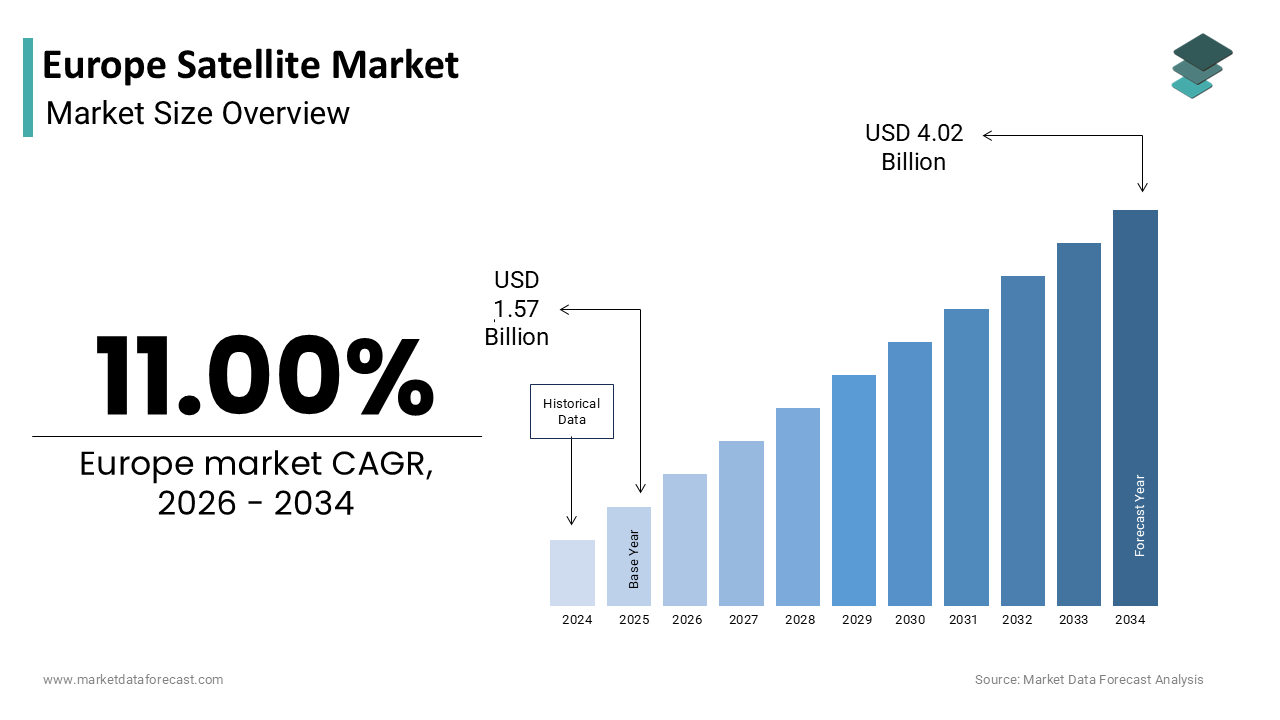
The Europe satellite market was valued at USD 1.57 billion in 2025, is estimated to reach USD 1.74 billion in 2026, and is projected to reach USD 4.02 billion by 2034, growing at a CAGR of 11.00% during the forecast period from 2026 to 2034. The growth of the Europe satellite market is driven by increasing investments in space infrastructure, rising demand for secure communication systems, and expanding use of satellite-based services across defense, navigation, and Earth observation sectors. Strategic initiatives such as the Galileo navigation system and Copernicus Earth observation program are strengthening Europe’s independent space capabilities. In addition, the growing need for climate monitoring, precision agriculture, and broadband connectivity in remote regions is further fueling market expansion. The emergence of low Earth orbit constellations and hybrid multi-orbit architectures is also transforming the European satellite ecosystem by enabling high-speed connectivity and advanced data-driven applications.
Key Market Trends
-
Increasing focus on sovereign satellite communication networks to ensure secure government and defense connectivity across Europe.
-
Growing adoption of Earth observation satellites for environmental monitoring, climate change tracking, and agricultural management.
-
Rising deployment of low Earth orbit satellite constellations to deliver low-latency broadband and IoT connectivity services.
-
Expanding development of hybrid satellite architectures combining GEO and LEO systems to improve global coverage and network efficiency.
-
Increasing investments in space sustainability solutions such as in-orbit servicing and space debris removal technologies.
Segmental Insights
- Based on end user, the civil segment was the largest and held a significant share of the Europe satellite market in 2025. The segment’s dominance is attributed to extensive use of satellites in telecommunications, environmental monitoring, navigation systems, and agricultural data services that support economic activities and government operations across Europe.
- Based on type, the large satellites segment accounted for the major share of the Europe satellite market in 2025. These satellites are widely used for high-capacity communication services, weather monitoring, and strategic Earth observation missions due to their high payload capacity and extended operational lifespan.
- Based on application, the communication segment occupied a prominent share of the Europe satellite market in 2025. The growth of this segment is driven by rising demand for broadband connectivity, satellite television broadcasting, maritime and aviation communication, and secure government communication networks.
Regional Insights
The Europe satellite market is experiencing strong growth across major countries supported by increasing investments in space programs, technological advancements in satellite manufacturing, and rising demand for satellite-based services.
-
France was the largest contributor, accounting for 26.2% of the Europe satellite market share in 2025, driven by its strong aerospace ecosystem and the presence of major space organizations and launch facilities.
-
Germany holds a significant share supported by its leadership in satellite payload engineering, optical systems, and advanced aerospace manufacturing capabilities.
-
The United Kingdom is emerging as a key satellite innovation hub due to strong investments in satellite communications, small satellite manufacturing, and spaceport infrastructure.
-
Italy plays a major role in Earth observation technologies and radar satellite systems through programs such as COSMO-SkyMed.
-
Spain is rapidly expanding its presence in the European space sector with growing investments in nanosatellite development and ground segment infrastructure.
Competitive Landscape
The Europe satellite market is characterized by the presence of major aerospace manufacturers and emerging NewSpace companies competing through technological innovation, strategic partnerships, and large-scale space programs. Leading companies are focusing on developing advanced satellite platforms, improving manufacturing efficiency, and expanding their capabilities in communication, Earth observation, and defense applications. Increasing investments in software-defined satellites, electric propulsion technologies, and space sustainability solutions are also shaping the competitive landscape. Strategic collaborations with space agencies and government programs play a critical role in securing long-term contracts and strengthening market positions. Prominent players in the Europe satellite market include Airbus Defence and Space, Thales Alenia Space, OHB SE, ArianeGroup, Safran S.A., Surrey Satellite Technology Ltd, GomSpace, AAC Clyde Space, Berlin Space Technologies, and EnduroSat.
Europe Satellite Market Size
The Europe satellite market size was valued at USD 1.57 billion in 2025 and is anticipated to reach USD 1.74 billion in 2026 from USD 4.02 billion by 2034, growing at a CAGR of 11.00% during the forecast period from 2026 to 2034.
Satellite represents a sophisticated ecosystem encompassing the design, manufacturing, launch, and operation of spaceborne assets dedicated to telecommunications, Earth observation, navigation, and scientific research. This sector is uniquely defined by the strategic interplay between state-led initiatives under the European Union and the European Space Agency, alongside a burgeoning commercial NewSpace segment. The region distinguishes itself through its autonomy in critical infrastructure, most notably the Galileo global navigation satellite system and the Copernicus Earth observation program, which provide independent data capabilities free from non-European control. According to Eurostat, the digital economy in Europe relies heavily on satellite connectivity, with households in remote rural areas depending on space-based broadband to bridge the digital divide where terrestrial fiber is economically unviable. Furthermore, as per the European Environment Agency, satellite imagery is extensively used to monitor climate change indicators, track biodiversity loss, and manage agricultural subsidies across the continent. Unlike other regions driven primarily by consumer broadband, the European landscape is shaped by regulatory frameworks such as the EU Space Programme, which mandates secure government communications and environmental monitoring. The market definition now extends to include mega-constellations in low Earth orbit aimed at providing ultra-low latency services, reflecting a shift towards high-throughput architectures that support emerging applications like autonomous mobility and precision agriculture.
MARKET DRIVERS
Strategic Imperative for Sovereign Connectivity and Defense Independence
The urgent geopolitical need for sovereign, secure, and resilient communication infrastructure that operates independently of non-European powers is propelling the growth of the Europe satellite market. According to recent global conflicts, the vulnerability of relying on foreign satellite assets for critical government and military communications, which is prompting the European Union to accelerate the development of its own secure connectivity initiative. According to the European Commission, the proposed IRIS² constellation aims to provide governmental services and commercial broadband across the bloc, ensuring that member states retain control over sensitive data transmission during crises. This strategic shift is reinforced by NATO, which has increasingly recognized space as a domain of operations, driving member nations to invest in hardened satellite capabilities that can withstand jamming and cyberattacks. As per the European Defence Agency, defense spending on space-based assets has risen, with nations seeking redundant systems to maintain command and control continuity. The drive for digital sovereignty extends beyond defense to include critical infrastructure protection, where energy grids and financial networks require secure satellite links. This convergence of national security concerns and the desire for technological autonomy creates a robust, policy-driven demand stream that guarantees long-term investment in European satellite manufacturing and launch services.
Expansion of Earth Observation Data for Climate Action and Agriculture
The escalating demand for high-resolution Earth observation data to support the European Green Deal and the Common Agricultural Policy is also contributing to the growth of the Europe satellite market. Satellites serve as the eyes of the continent, providing essential metrics for monitoring greenhouse gas emissions, tracking deforestation, and optimizing crop yields through precision farming techniques. According to the European Space Agency, the Copernicus program generates vast amounts of open data daily, which is utilized by thousands of downstream service providers to create actionable insights for farmers and policymakers. The mandatory requirement for farmers to demonstrate compliance with environmental standards to receive subsidies has created a large market for satellite-based monitoring solutions that verify land use and crop health. As per the Joint Research Centre of the European Commission, satellite data is indispensable for modeling climate change scenarios and managing natural disasters such as floods and wildfires. The integration of this data into artificial intelligence platforms allows for predictive analytics that enhance resource efficiency and reduce chemical usage in agriculture. This regulatory and environmental imperative transforms satellite imagery from a scientific tool into a critical operational asset, which is fuelling sustained growth in the procurement of advanced optical and radar satellites.
MARKET RESTRAINTS
Fragmented Regulatory Landscape and Complex Licensing Procedures
The implementation of a fragmented regulatory framework across European member states acts as a significant restraint on the satellite market in Europe by creating bureaucratic hurdles that delay project deployment and increase operational costs. While the European Union strives for a single market, space regulations regarding spectrum allocation, launch licensing, and frequency coordination often vary between national authorities, forcing companies to navigate differing legal requirements. According to the European Parliament, the lack of a unified European space law means that operators must seek approvals from multiple jurisdictions, leading to prolonged timelines before a mission can proceed. This administrative complexity disproportionately affects small and medium-sized enterprises and NewSpace startups that lack the legal resources to manage multi-national compliance efforts. As per the European Satellite Operators Association, the uncertainty surrounding liability regimes and debris mitigation rules further discourages private investment in innovative constellations. The absence of a streamlined, one-stop-shop for licensing stifles agility and prevents European companies from competing effectively with counterparts in the United States or China, where regulatory pathways are more centralized and predictable. These structural inefficiencies slow down the pace of innovation and act as a persistent brake on market dynamism.
High Capital Intensity and Limited Access to Risk Capital
The substantial upfront capital required to design, build, and launch satellites coupled with the long return on investment periods poses a major barrier to market expansion, particularly for emerging commercial ventures. Developing a single satellite involves hundreds of millions of euros in research, development, and testing, while launch services add further significant costs that must be borne before any revenue is generated. According to the European Investment Bank, access to patient risk capital remains a critical challenge for the European space sector, as traditional venture capitalists often shy away from the long development cycles and high technical risks associated with space hardware. The fragmentation of funding sources across different national space agencies and EU programs complicates the financing landscape, making it difficult for companies to secure the large-scale funding needed for mega-constellations. As per industry analysts, the cost of capital in Europe is often higher than in competing markets, reducing the financial viability of ambitious projects. Furthermore, the insurance premiums for launch and in-orbit operations remain steep due to perceived risks, adding another layer of financial burden. This capital constraint forces many innovative concepts to remain on the drawing board or leads to European startups being acquired by foreign entities with deeper pockets, thereby limiting the growth of indigenous European satellite champions.
MARKET OPPORTUNITIES
Development of Hybrid Multi-Orbit Architectures for Seamless Connectivity
The convergence of geostationary and low Earth orbit technologies provides a transformative opportunity for the Europe satellite market by enabling hybrid architectures that deliver ubiquitous, low-latency connectivity. As demand for bandwidth surges due to the Internet of Things and 5G backhaul requirements, single-orbit systems struggle to meet diverse needs, creating a niche for integrated solutions that leverage the coverage of high orbits and the speed of low orbits. According to the European Telecommunications Standards Institute, the future of mobile communications lies in non-terrestrial networks that seamlessly integrate with terrestrial 5G infrastructure, a vision that European manufacturers are well positioned to realize. This architectural shift allows service providers to offer uninterrupted coverage for maritime, aviation, and remote industrial applications, opening new revenue streams in sectors previously underserved by static networks. As per research from the University of Surrey, hybrid systems can optimize traffic routing dynamically, reducing congestion and improving quality of service for critical applications like telemedicine and autonomous driving. The opportunity extends to software-defined satellites that can reconfigure their payloads in orbit to adapt to changing traffic patterns, maximizing asset utilization. By leading the development of these complex interoperable systems, European companies can capture a significant share of the global market for next-generation connectivity solutions.
Commercialization of In-Orbit Servicing and Active Debris Removal
The growing congestion in Earth's orbit and the increasing value of space assets offer a lucrative opportunity for the Europe satellite market through the emergence of in-orbit servicing and active debris removal industries. With thousands of defunct satellites and fragments posing collision risks, there is an urgent need for missions that can extend the life of existing satellites through refueling and repair or remove hazardous debris to ensure the sustainability of space operations. According to the European Space Agency, the ClearSpace-1 mission represents a pioneering step in this direction, demonstrating the technical feasibility of capturing and deorbiting space junk, a capability that will soon become a commercial necessity. The economic potential lies in offering life-extension services that allow operators to defer the costly replacement of billion-euro assets, creating a new service-based revenue model for satellite manufacturers. As per the European Commission's space traffic management proposals, future regulations may mandate end-of-life disposal plans, effectively creating a regulated market for debris removal services. This sector also drives innovation in robotics and autonomous rendezvous technologies, which have spin-off applications in other industries. By establishing itself as the global leader in space sustainability services, Europe can unlock a high-value market segment that aligns with its strong environmental ethos and technological prowess.
MARKET CHALLENGES
Intensifying Global Competition and Price Pressure from Mega-Constellations
The aggressive competition from established global players, particularly those deploying massive low Earth orbit constellations that benefit from economies of scale and vertical integration is a significant challenge to the growth of the Europe satellite market. Competitors in the United States have launched thousands of satellites, driving down the cost per bit of bandwidth and setting price expectations that European manufacturers, often operating with smaller production runs and higher labor costs, struggle to match. According to the Consultative Committee for Space Data Systems, the influx of low-cost capacity from these mega-constellations threatens to commoditize the broadband market, squeezing margins for European operators who rely on traditional high-throughput geostationary satellites. The ability of foreign rivals to reuse rocket boosters and mass-produce satellites in assembly-line fashion creates a significant cost disparity that undermines the competitiveness of European launch services and hardware suppliers. As per the International Astronautical Federation, the dominance of non-European constellations in the consumer broadband sector makes it difficult for European initiatives to gain market traction without substantial state subsidies. This pressure forces European companies to constantly innovate to differentiate their offerings through superior security or specialized services, yet the relentless downward pressure on pricing remains a persistent threat to profitability and market share.
Critical Shortage of Specialized Workforce and Technical Talent
The Europe satellite market faces a critical bottleneck due to the severe shortage of skilled professionals possessing the specialized knowledge required for advanced spacecraft engineering, orbital mechanics, and space cybersecurity. As the sector expands and technologies become more complex, the demand for experts in fields such as electric propulsion, software-defined payloads, and autonomous navigation has surged beyond the available supply of qualified personnel. According to Eurofound, the European labor market experiences a persistent mismatch in high-tech sectors, with universities struggling to update curricula fast enough to meet the rapid pace of innovation in the space industry. This talent gap delays project timelines and increases the cost of labor, as companies compete fiercely for a limited pool of experienced engineers and scientists. As per the European Space Policy Institute, the aging workforce in traditional aerospace primes is not being replaced at a sufficient rate, while the NewSpace sector struggles to attract talent away from more established tech industries. The lack of standardized training programs across member states further exacerbates the issue, hindering labor mobility within the single market. Until this skills deficit is addressed through targeted education initiatives and immigration policies, the European satellite industry risks being constrained by human capital limitations rather than technological capability.
REPORT COVERAGE
| REPORT METRIC | DETAILS |
| Market Size Available | 2025 to 2034 |
| Base Year | 2025 |
| Forecast Period | 2026 to 2034 |
| CAGR | 11.00% |
| Segments Covered | By Type, End-User, Application and Region. |
| Various Analyses Covered | Global, Regional & Country Level Analysis, Segment-Level Analysis, DROC, PESTLE Analysis, Porter’s Five Forces Analysis, Competitive Landscape, Analyst Overview of Investment Opportunities |
| Country Covered | UK, France, Spain, Germany, Italy, Russia, Sweden, Denmark, Switzerland, the Netherlands, Turkey, the Czech Republic, and the Rest of Europe. |
| Market Leaders Profiled | Airbus Defence and Space, Thales Alenia Space, OHB SE, ArianeGroup, Safran S.A., Surrey Satellite Technology Ltd, GomSpace, AAC Clyde Space, Berlin Space Technologies, and EnduroSat. |
SEGMENTAL ANALYSIS
By End User Insights
The civil segment led the market by holding the leading share of the Europe satellite market in 2025. The dominance of civil segment in the European market is attributed to the extensive reliance on space-based assets for telecommunications, environmental monitoring, and navigation services that underpin daily economic activity and the operational necessity of the Copernicus Earth observation program, which provides critical data for agriculture, urban planning, and disaster management across the continent. According to the European Commission, the Copernicus program serves millions of users globally, with its open data policy fostering a thriving downstream industry that generates significant value for the European economy. Furthermore, the Galileo global navigation satellite system has become integral to civil infrastructure, supporting everything from smartphone location services to precision timing for financial transactions and power grid synchronization. As per Eurostat, the digital single market depends heavily on satellite connectivity to bridge the broadband gap in rural areas where terrestrial networks are absent, ensuring social inclusion and economic parity. The widespread adoption of satellite data by the agricultural sector to comply with the Common Agricultural Policy also drives consistent demand, as farmers utilize these tools for crop monitoring and subsidy verification. This deep integration of satellite technology into civil governance, commercial logistics, and public services creates a massive and stable user base that dwarfs other segments in terms of volume and economic impact.
The defense segment is anticipated to register a promising CAGR of 12.2% over the forecast period in the Europe satellite market. Factors such as a paradigm shift in European security strategy following recent geopolitical instabilities and the establishment of the EU Secure Connectivity Programme, known as IRIS² are driving the expansion of the defense segment in the European market. According to the European Defence Agency, member states are increasing their budgets for space-based surveillance and early warning systems to monitor borders and track hybrid threats in real time. The recognition by NATO that space is an operational domain has further compelled European nations to invest in hardened satellites capable of withstanding jamming and cyberattacks. As per national defense ministries, the demand for tactical satellite imagery and secure beyond line-of-sight communications has surged, driving procurement of specialized military payloads. This strategic realignment towards autonomous defense capabilities ensures that the defense segment will outpace civil growth rates as nations prioritize space sovereignty.
By Type Insights
The large satellites segment accounted for the major share of the Europe satellite market in 2025. The dominance of large satellites segment in the European market is credited to their indispensable role in providing high throughput communications, strategic Earth observation, and secure government services that require substantial power and payload capacity. The continued investment in flagship missions such as the Galileo navigation satellites and the Meteosat third generation weather satellites is further boosting the expansion of the large satellites segment in the regional market. According to the European Space Agency, these mega-satellites carry sophisticated instruments like multi-spectral imagers and high-power transponders that cannot be miniaturized without compromising performance, making them essential for continental-scale monitoring and broadcasting. The telecommunications sector also relies on large geostationary satellites to deliver direct-to-home television and backbone connectivity across the region, leveraging their ability to cover vast areas with a single asset. As per industry data from Airbus and Thales Alenia Space, the bulk of contract value in the European market stems from these high-cost, high-capability platforms commissioned by state actors and major operators. The requirement for redundancy and radiation hardening in harsh orbital environments further necessitates the robust construction of large satellites, ensuring they remain the workhorses of critical European infrastructure despite the rise of smaller alternatives.
The small satellite segment is growing at the fastest and is anticipated to witness a CAGR of 15.1% over the forecast period. Factors such as the democratization of space access, the proliferation of NewSpace startups utilizing cube sat and nano sat architectures and the rising need for frequent revisit times and cost-effective constellations that can provide near real-time data for applications ranging from maritime tracking to IoT connectivity are propelling the growth of the small satellites segment in the European market. According to the European Small Satellite Alliance, numerous small satellite projects are in development across the continent, focusing on agile manufacturing techniques that allow for mass production and rapid iteration. The ability to deploy swarms of small satellites enables innovative business models such as on-demand imaging and distributed sensing, which were previously economically unviable with large monolithic platforms. As per venture capital data, investment in European small satellite companies has surged, which is fuelling innovation in propulsion, inter-satellite links, and onboard processing. This shift towards agile, scalable, and affordable space assets is redefining the market landscape and driving the highest growth rates among all satellite types.
REGIONAL ANALYSIS
France Satellite Market Analysis
France stood as the most dominating player in the Europe satellite market in 2025 with 26.2% of the regional market share. The dominance of France in the European market is driven by its status as the historical heart of European spaceflight and the headquarters of the European Space Agency. The country's market position is defined by a comprehensive industrial ecosystem that spans the entire value chain, from component manufacturing to system integration and launch services via Arianespace. According to the French Space Agency, national investment in space technologies remains robust, focusing on maintaining sovereign capabilities in telecommunications and defense observation. Furthermore, France hosts the Guiana Space Centre, the only active launch site in Europe capable of delivering heavy payloads to geostationary orbit, providing a unique logistical advantage that attracts international customers. As per the French Ministry of Armed Forces, the nation is aggressively expanding its military space command, driving demand for dual use satellites and anti-space defense systems. This combination of institutional leadership, industrial depth, and strategic infrastructure ensures France remains the central pillar of the European satellite endeavor.
Germany Satellite Market Analysis
Germany held a prominent share of the Europe satellite market in 2025. The growth of Germany in the European market is attributed to its engineering excellence in satellite payloads, optical systems, and robotic components. The strong focus on scientific research and Earth observation and country's leading role in the automotive and industrial sectors are further contributing to the German market expansion. According to the German Federal Ministry for Economic Affairs and Climate Action, significant funding is allocated to develop next generation communication satellites and quantum key distribution systems to ensure secure data transmission. The presence of major manufacturing hubs for high precision instruments allows German companies to supply critical subsystems for nearly every major European mission, embedding them deeply in the supply chain. As per the German Industry Association for Aerospace, the sector is seeing a surge in NewSpace startups focused on small satellite constellations for commercial applications, diversifying the market beyond traditional government contracts. This blend of high-tech manufacturing prowess and emerging commercial dynamism secures Germany's vital role in the regional market.
United Kingdom Satellite Market Analysis
The United Kingdom is anticipated to hold a notable share of the Europe satellite market during the forecast period owing to its world class capabilities in satellite communications, downstream data analytics, and emerging launch services. The vibrant NewSpace sector that has attracted substantial private investment, which is fostering innovation in small satellite manufacturing and orbital services is further boosting the market expansion in the UK. The principal driver for this market position is the government's ambitious National Space Strategy, which aims to double the size of the UK space economy by 2030 through supportive regulations and targeted funding for OneWeb and other constellation projects. According to the UK Space Agency, the nation is developing new spaceports in Scotland and Cornwall to enable domestic vertical and horizontal launches, reducing dependency on foreign launch providers and stimulating local industry growth. The strong heritage in telecommunications, anchored by companies like Inmarsat and OneWeb, ensures the UK remains a global hub for satellite connectivity solutions serving maritime and aviation sectors. As per Tech Nation, the concentration of space tech clusters in regions like Harwell and Glasgow creates a fertile environment for collaboration between academia and industry. This strategic focus on connectivity, combined with a pro-business regulatory environment, reinforces the UK's standing as a key innovator and market player.
Italy Satellite Market Analysis
Italy is predicted to grow at a healthy CAGR in the Europe satellite market during the forecast period due to its exceptional expertise in radar Earth observation, optical payloads, and human spaceflight modules. The success of the COSMO SkyMed constellation, a dual use synthetic aperture radar system that has established the country as a leader in all-weather monitoring capabilities is also favouring the Italy satellite market growth. According to the Italian National Institute of Statistics, the aerospace sector is a strategic asset for the national economy, receiving sustained government support to maintain technological sovereignty in observation and telecommunications. The country's geographical position also makes it a crucial hub for ground stations and data downlink facilities, enhancing its role in the operational phase of satellite missions. As per the Italian Association of Aerospace Industries, there is a growing emphasis on developing green propulsion technologies and sustainable satellite designs, aligning with broader European environmental goals. This specialization in high value niche technologies and strategic infrastructure ensures Italy remains a pivotal contributor to the European space architecture.
Spain Satellite Market Analysis
Spain is expected to hold a notable share of the Europe satellite market over the forecast period owing to its growing capabilities in small satellite manufacturing, ground segment infrastructure, and microelectronics. The dynamic transformation from a traditional subcontractor role to a prime contractor for specific missions, the establishment of the Plasea program that aims to boost the competitiveness of the Spanish space industry and foster the creation of a domestic launcher ecosystem are further boosting the Spanish market growth. According to the Spanish National Institute of Aerospace Technology, significant investments are being made in the development of nanosatellite constellations for Earth observation and IoT connectivity, leveraging the country's strong semiconductor design sector. The strategic location of Spanish territory, including the Canary Islands, provides ideal sites for ground stations and future launch complexes, attracting international operators seeking diverse geographic coverage. As per the Spanish Association of Companies in the Space Sector, the number of space related startups has multiplied in recent years, injecting fresh innovation into the supply chain. This combination of strategic geography, targeted industrial policy, and a burgeoning startup scene positions Spain as a rapidly ascending force in the European satellite landscape.
COMPETITIVE LANDSCAPE
The competition in the Europe satellite market is characterized by intense rivalry among established aerospace primes and agile NewSpace entrants who constantly innovate to capture market share through technological superiority and cost efficiency. Major players differentiate themselves by securing exclusive contracts for sovereign European programs and offering comprehensive end to end solutions that span manufacturing, launch, and operations. The market sees frequent announcements of strategic alliances and joint ventures aimed at pooling resources for mega constellation projects and reducing the financial burden of development. Price competition is moderating as the focus shifts towards value added services such as data analytics, cybersecurity, and in orbit servicing rather than hardware costs alone. Regional specialists compete by providing niche capabilities in optical communications, radar imaging, or small satellite buses that complement the offerings of larger integrators. The barrier to entry remains high due to significant capital requirements and stringent regulatory standards, yet the rise of venture capital in the space sector is lowering these hurdles for innovative startups. Collaboration between industry and academia is accelerating the development of breakthrough technologies like quantum encryption and autonomous navigation. Overall the landscape is dynamic with companies vying to establish leadership in the transition towards sustainable, software defined, and highly connected space architectures across the continent.
KEY MARKET PLAYERS
Some of the companies that are playing a dominating role in the Europe Satellite Market include
- Airbus Defence and Space
- Thales Alenia Space
- OHB SE
- ArianeGroup
- Safran S.A.
- Surrey Satellite Technology Ltd
- GomSpace
- AAC Clyde Space
- Berlin Space Technologies
- EnduroSat
Top Players in the Market
Thales Alenia Space
Thales Alenia Space stands as a premier aerospace manufacturer in the Europe satellite market, delivering advanced solutions for telecommunications, navigation, and Earth observation systems globally. The company significantly contributes to the international space sector by serving as the primary industrial partner for major European Union initiatives like Galileo and Copernicus. Thales Alenia Space recently strengthened its market position by securing contracts to build satellites for the new IRIS squared secure connectivity constellation, ensuring sovereign communication capabilities for European governments. The firm actively invests in developing sustainable space technologies, including electric propulsion and debris mitigation systems, to address orbital congestion concerns. By expanding its production facilities in France and Italy, the company enhances its capacity to deliver large scale constellations efficiently. Their commitment to innovation drives the creation of software defined satellites that offer unprecedented flexibility in orbit. This strategic focus on sovereignty and sustainability solidifies their reputation as a global leader in the space industry.
Airbus Defence and Space
Airbus Defence and Space leverages its extensive engineering heritage to maintain a dominant presence in the Europe satellite market through comprehensive offerings in military, civil, and commercial space segments. The company contributes globally by providing critical infrastructure for deep space exploration, planetary science, and secure government communications networks. Airbus recently enhanced its European footprint by announcing significant investments in automated manufacturing lines to accelerate the production of small satellite constellations and reduce time to market. The firm focuses on integrating artificial intelligence into satellite operations to enable autonomous collision avoidance and dynamic resource management. Through strategic partnerships with launch service providers, Airbus ensures reliable access to space for its diverse portfolio of missions ranging from Earth observation to quantum key distribution. Their dedication to developing next generation high throughput satellites supports the growing demand for global broadband connectivity. This customer centric approach combined with continuous technological evolution ensures the company remains a trusted partner for space agencies and commercial operators worldwide.
OHB SE
OHB SE is a leading innovator in the Europe satellite market, distinguished by its agility in designing and manufacturing medium sized satellites and specialized payloads for diverse mission profiles. The company plays a pivotal role globally by supplying components and complete systems for navigation, science, and security applications with a strong emphasis on cost efficiency. OHB recently strengthened its market position by winning key contracts for the development of satellites within the European secure connectivity program, highlighting its capability to handle complex governmental requirements. The firm actively invests in research and development to advance optical communication technologies and robotic servicing solutions for in orbit maintenance. By expanding its network of subsidiaries across Europe, OHB ensures robust supply chain resilience and localized expertise for international clients. Their focus on modular satellite platforms allows for rapid customization and deployment, meeting the specific needs of emerging NewSpace ventures. This dedication to versatility and technological excellence secures their status as a crucial enabler of European space autonomy and commercial growth.
Top Strategies Used by Key Market Participants
Key players in the Europe satellite market primarily employ strategies focused on vertical integration and strategic partnerships to secure supply chains and enhance technological capabilities. Companies heavily invest in research and development to pioneer software defined payloads and electric propulsion systems that extend satellite lifespans and operational flexibility. Strategic collaborations with national space agencies and the European Union enable firms to secure long term contracts for flagship programs like Galileo and Copernicus. Expanding manufacturing capacities through automation and digital twins helps companies reduce production costs and accelerate delivery times for large constellations. Firms increasingly adopt sustainable practices by developing active debris removal technologies and eco friendly propulsion methods to comply with emerging space traffic regulations. Offering end to end services from design to launch and ground segment management allows providers to capture greater value across the entire mission lifecycle. Acquisitions of specialized startups in areas such as quantum communications and artificial intelligence allow major players to rapidly integrate cutting edge innovations. Diversifying revenue streams by targeting commercial broadband and Internet of Things markets reduces dependency on government funding and fosters resilient growth.
MARKET SEGMENTATION
This research report on the Europe Satellite Market has been segmented and sub-segmented based on the following categories.
By End User
- Civil
- Defense
By Type
- Nanosatellite
- Micro Satellite
- Mini Satellite
- Large Satellite
By Application
- Earth Observation and Remote Sensing
- Scientific Research
- Communication
- Direct Broadcast
- Mapping and Navigation
- Weather Forecasting
- Surveillance and Security
By Country
- UK
- France
- Spain
- Germany
- Italy
- Russia
- Sweden
- Denmark
- Switzerland
- Netherlands
- Turkey
- Czech Republic
- Rest of Europe
Frequently Asked Questions
What is the Europe Satellite Market?
The Europe satellite market refers to the industry involved in the manufacturing, launching, and operation of satellites used for communication, navigation, earth observation, and scientific research
What are the major applications of satellites in Europe?
Satellites in Europe are mainly used for communication, weather monitoring, earth observation, navigation, broadcasting, and defense applications.
What factors are driving the growth of the Europe Satellite Market?
The market growth is driven by increasing demand for satellite-based communication services, advancements in space technology, and growing investments in space programs.
Which countries lead the Europe Satellite Market?
Countries such as the United Kingdom, France, Germany, and Italy are major contributors due to strong aerospace industries and investments in satellite technologies.
What types of satellites are commonly used in Europe?
The most common types include communication satellites, earth observation satellites, navigation satellites, and scientific research satellites.
How are satellites used for communication in Europe?
Communication satellites provide services such as television broadcasting, internet connectivity, mobile communications, and secure military communication.
What role do satellites play in earth observation in Europe?
Earth observation satellites help monitor environmental changes, weather patterns, climate change, agriculture, and disaster management.
What is the role of government space agencies in the Europe Satellite Market?
Government space agencies support satellite development, research, and launches while promoting innovation in the space sector.
What are the major challenges in the Europe Satellite Market?
High development costs, complex regulatory frameworks, and space debris management are key challenges in the market.
What is the future outlook for the Europe Satellite Market?
The market is expected to grow steadily due to increasing investments in space exploration, rising demand for satellite-based services, and advancements in satellite technologies.
Access the study in MULTIPLE FORMATS
Purchase options starting from
$ 2000
Didn’t find what you’re looking for?
TALK TO OUR ANALYST TEAM
Need something within your budget?
NO WORRIES! WE GOT YOU COVERED!
Call us on: +1 888 702 9696 (U.S Toll Free)
Write to us: sales@marketdataforecast.com