Europe Software Market Size, Share, Trends & Growth Forecast Report By Type, By Deployment, By Vertical, and By Country (Germany, United Kingdom, France, Netherlands, Sweden, Italy, Spain & Rest of Europe) – Industry Analysis and Forecast, 2026 to 2034
Europe Software Market Size
The Europe software market was valued at USD 243.22 billion in 2025, is estimated to reach USD 270.07 billion in 2026, and is projected to reach USD 624.19 billion by 2034, growing at a CAGR of 11.04% from 2026 to 2034.

Software is a collection of instructions, data, or programs used to operate computers and execute specific tasks. This market transcends mere code delivery to represent the foundational layer of the European digital economy, integrating artificial intelligence, cloud-native architectures, and cybersecurity frameworks into daily operations. The region distinguishes itself through a unique blend of industrial heritage and cutting-edge digital transformation, heavily influenced by regulatory frameworks that prioritize data sovereignty and ethical technology use. In early 2025, Eurostat data indicated that 52.7% of enterprises in the European Union with ten or more employees utilized paid cloud computing services, a significant increase from previous years but still short of the 75% target set for the decade. The European Commission emphasizes that digital technologies are central to achieving the goals of the Digital Decade policy program, which aims for a fully connected and skilled society by 2030. Unlike other regions,s the European landscape is characterized by a fragmented yet collaborative environment where cross-border data flows are meticulously governed by the General Data Protection Regulation. As per the International Telecommunication Union (ITU), the European region boasts the highest rate of fixed-broadband penetration globally, which serves as the critical infrastructure backbone for large-scale software-as-a-service (SaaS) deployment. This definition now includes the burgeoning sector of sovereign cloud solutions designed to keep sensitive data within European jurisdiction. The market evolves from static licensing models to fluid consumption-based ecosystems where software acts as a strategic asset for resilience and sustainability.
MARKET DRIVERS
Regulatory Mandates Driving Digital Compliance and Automation
The intricate web of European regulations acts as a powerful driver of the European software market. It forces organizations to adopt sophisticated software solutions for compliance management and operational automation. The implementation of the Digital Operational Resilience Act for the financial sector and the updated NIS two Directive for critical infrastructure mandates rigorous reporting and security standards that manual processes cannot satisfy. Financial regulators are moving toward requiring constant oversight of digital risks to ensure institutions can react immediately to threats. These legal requirements compel businesses to replace legacy systems with agile applications capable of automated audit trails and instant data retrieval. Although the total value of penalties can fluctuate yearly based on massive individual cases, the frequency of reported data breaches is steadily rising. Companies are increasingly investing in artificial intelligence-driven tools that continuously scan for regulatory changes and adjust internal protocols automatically. The complexity of navigating twenty-seven different national implementations of EU directives further drives demand for centralized software hubs that ensure uniform adherence. This regulatory pressure transforms software from a supportive tool into a critical necessity for legal survival. Consequently, the need to mitigate legal risks and avoid substantial penalties fuels continuous investment in compliance-oriented software architectures across all industries.
Accelerated Industrial Digitization and Industry 4.0 Adoption
The relentless push towards Industry 4.0 and the digitalization of traditional manufacturing sectors serves as a primary engine for the expansion of the European software market. The continent's strong industrial base is undergoing a profound transformation where physical production lines merge with cyber-physical systems driven by complex software algorithms. Industrial leaders are increasingly moving data processing to the edge to enable faster decision-making and reduce the environmental impact of factory operations. This shift requires specialized software for predictive maintenance, digital twins, and supply chain visibility that can handle massive streams of real-time data. Germany and France lead this charge with national strategies that incentivize the adoption of smart factory technologies through substantial public funding. The integration of cognitive internet technologies in factories is helping businesses eliminate production errors and maintain continuous operations without human intervention. The need to compete with global rivals forces European firms to adopt software that enables mass customization and rapid prototyping. Small and medium enterprises are also joining this wave, leveraging cloud-based enterprise resource planning tools to modernize operations without heavy capital expenditure. The convergence of operational technology and information technology creates a vast demand for industrial software suites. This industrial renaissance ensures that the software market remains deeply intertwined with the physical economy, driving sustained expansion.
MARKET RESTRAINTS
Severe Shortage of Advanced Digital Skills and Talent
A critical scarcity of professionals possessing advanced skills in software development, artificial intelligence, and cybersecurity acts as a limitation to the European software market. Despite high unemployment rates in some sectors, the technology industry faces a paradoxical deficit of qualified personnel capable of designing and maintaining complex software systems. Europe is struggling to produce enough high-level technology experts to meet the rapid demands of industrial digitisation. This talent gap forces companies to delay software implementation projects or rely heavily on expensive external consultants, which inflates costs and slows innovation. The rapid evolution of technology means that existing workforces require constant upskilling, yet many organizations lack the resources for comprehensive training programs. As per the European Commission, only 54% of the population in 202possessedes basic digital skills, which limits the pool of potential recruits for technical roles. The competition for top talent among tech giants and startups drives salary inflation, making it difficult for small and medium enterprises to attract the t necessary expertise. This human capital constraint leads to underutilization of purchased software licenses and hampers the ability to fully leverage new technological capabilities. A concerted effort to reform education and attract global talent is necessary. However, without it, the growth trajectory of the software market will remain constrained by labor availability.
Fragmented Regulatory Landscape and Compliance Complexity
The lack of complete harmonization in digital regulations across European member states creates a complex barrier that hinders the seamless scaling of software solutions and the overall European software market. The European Union is pushing for a single digital market, but national legal interpretations still vary widely. These differences in data, tax, and consumer laws create a difficult patchwork of compliance requirements. The European Chamber of Commerce emphasizes that software vendors often need to customize their products for each country to meet specific local legal nuances, which increases development costs and time to market. This fragmentation discourages startups from expanding beyond their home markets and complicates the deployment of unified cloud infrastructures for multinational corporations. The uncertainty surrounding evolving legislation, such as the Artificial Intelligence Act, causes hesitation among investors and business leaders who fear future regulatory shifts. Complexities in trading digital services across European borders continue to hinder the financial growth of small and medium-sized enterprises. The need to navigate twenty-seven distinct legal environments dilutes the economies of scale that typically drive software profitability. This regulatory disjointedness forces companies to maintain redundant systems and legal teas, thereby reducing the agility that software is meant to provide. Until full regulatory alignment is achieved, ed the market will struggle to realize its full potential for integrated growth.
MARKET OPPORTUNITIES
Expansion of Sovereign Cloud and Data Infrastructure
The growing emphasis on digital sovereignty offers a transformative opportunity for the European software market. This shift fuels the development and deployment of European-owned and operated cloud software infrastructure. Concerns over data privacy and foreign surveillance have prompted governments and enterprises to seek software solutions that guarantee data residency within European borders. The Gaia X initiative represents a monumental effort to create a secure and federated data infrastructure that adheres to European values and regulations. The European Commission has allocated billions of euros to support projects that enhance technological sovereignty and reduce dependency on non-European providers. Businesses in Europe are showing a stronger preference for cloud solutions that offer localized data control to meet strict regional regulations. This shift opens vast avenues for local software vendors to build applications specifically designed for these compliant environments. Industries such as healthcare, defense, and public administration are leading the adoption of sovereign solutions to protect sensitive information. The opportunity extends to creating interoperable software layers that allow data to flow securely between different sovereign clouds. By championing data independence, Europe can foster a thriving ecosystem of trusted software providers. This strategic pivot towards sovereignty ensures long-term growth for domestic software innovations.
Integration of Generative Artificial Intelligence in Enterprise Workflows
The emergence of generative artificial intelligence offers a potential opening for software vendors to revolutionize enterprise productivity and creativity across diverse sectors, which is likely to promote the growth of the European software market. European businesses are eager to integrate AI capabilities that can automate content creation, code generation, and customer interactions to gain competitive advantages. Companies that integrated advanced AI early are finding they can complete routine tasks faster, though the exact gains vary by industry. Software companies have the chance to embed these advanced models into existing enterprise resource planning and customer relationship management platforms to offer enhanced value. The demand for industry-specific AIAI solutions that comply with the European Artificial Intelligence Act is particularly high in regulated sectors like finance and law. New AI technologies are expected to create a massive surge in global wealth, with Europe well-positioned to benefit through its leadership in high-tech and regulated sectors. The opportunity lies in developing user-friendly interfaces that allow non-technical employees to leverage AI power safely and ethically. Furthermore, the need for AI governance software to monitor model bias and ensure transparency creates a new niche market. This technological leap forward positions software vendors as key enablers of the next industrial revolution.
MARKET CHALLENGES
Escalating Cybersecurity Threats Targeting Software Supply Chains
The increasing sophistication of cyberattacks targeting software supply chains poses a severe challenge to the integrity and trustworthiness of the European software market. Hackers are shifting focus from direct infrastructure attacks to compromising the development tools and third-party libraries used to build software applications. Adversaries are increasingly targeting the digital building blocks of software to gain broad access to multiple downstream organizations simultaneously. A single vulnerability in a widely used software component can cascade into widespread breaches compromising sensitive data and critical services. This threat landscape forces vendors to invest heavily in secure coding practices and rigorous vetting of open source dependencies, which increases development costs and timelines. The complexity of modern software ecosystems with hundreds of interconnected components makes it difficult to maintain complete visibility and control. As per the SANS Institute, many organizations lack the resources to continuously monitor their software bill of materials for emerging vulnerabilities. The fear of reputational damage and legal liability following a breach causes customers to delay software procurement decisions. End-to-end security in an era of rapid deployment and continuous integration remains a daunting task. This pervasive insecurity threatens to erode confidence in digital solutions and stifle market momentum.
Ethical and Legal Uncertainties Surrounding Artificial Intelligence
The ambiguous legal and ethical framework surrounding the deployment of artificial intelligence creates significant uncertainty for software developers and enterprises alike. This impedes the expansion of the European software market. The recently enacted European Artificial Intelligence Act introduces strict categorizations and compliance obligations for AI systems based on their risk levels. The European Data Protection Supervisor warns that non-compliance could result in prohibitive fines and the forced withdrawal of products from the market. Software vendors struggle to interpret these complex rules and implement the necessary transparency and explainability features in their algorithms. The requirement to document training data and mitigate bias adds layers of complexity to the development process, ss potentially slowing down innovation cycles. As per the Centre for Information Policy Leadership, many companies are pausing AI projects until clearer guidelines and standardized testing procedures are established. The fear of unintended consequences, such as discriminatory outcomes or privacy violations,s makes organizations cautious about adopting new AI-driven software. Balancing the drive for technological advancement with the imperative for ethical responsibility remains a delicate and challenging act. This regulatory ambiguity acts as a drag on the speed of AI adoption across the European software landscape.
REPORT COVERAGE
| REPORT METRIC | DETAILS |
| Market Size Available | 2025 to 2034 |
| Base Year | 2025 |
| Forecast Period | 2026 to 2034 |
| Segments Covered | By Type, Deployment, Vertical, and Region. |
| Various Analyses Covered | Global, Regional, and Country-Level Analysis, Segment-Level Analysis, Drivers, Restraints, Opportunities, Challenges; PESTLE Analysis; Porter’s Five Forces Analysis, Competitive Landscape, Analyst Overview of Investment Opportunities |
| Countries Covered | UK, France, Spain, Germany, Italy, Russia, Sweden, Denmark, Switzerland, Netherlands, Turkey, Czech Republic, Rest of Europe |
| Market Leaders Profiled | Microsoft Corporation, SAP SE, Oracle Corporation, IBM Corporation, Adobe Inc., Salesforce, Inc., Google LLC, Sage Group plc, Dassault Systèmes SE, Atlassian Corporation, ServiceNow, Inc., Siemens Digital Industries Software, VMware, Inc., Autodesk, Inc., Capgemini SE |
SEGMENTAL ANALYSIS
By Type Insights
The application software segment held the majority share of 42.7% of the European software market in 2025. The supremacy of the segment is attributed to the critical need for specialized tools that directly support core business functions and customer engagement strategies across diverse industries. Apart from all the factors, the primary aspect sustaining the leadership of application software is the universal reliance on Enterprise Resource Planning and Customer Relationship Management systems to streamline operations and enhance client interactions. European enterprises are aggressively modernizing their legacy ERPs to integrate real-time analytics and artificial intelligence capabilities that drive decision-making.ng According to Eurostat, over 75% of large enterprises in the European Union utilized integrated ERP systems in 2024 to manage complex supply chains and financial reporting. The shift toward remote work has further accelerated the adoption of cloud-based CRM platforms that enable sales teams to collaborate effectively from any location. As per the European Commission, digital transformation initiatives have made these applications indispensable for maintaining competitiveness in a globalized economy. Companies are investing heavily in modular application suites that allow them to customize workflows without disrupting entire IT infrastructures. The ability of modern application software to seamlessly connect with third-party services and mobile devices creates a sticky ecosystem that encourages continuous upgrades and expansions. This operational dependency ensures that application software remains the largest expenditure category for IT departments across the continent. An additional critical driver is the surge in demand for industry-specific applications on software tailored to meet unique regulatory and operational challenges within sectors like healthcare, finance, and manufacturing. Generic software solutions often fail to address the nuanced compliance requirements of European regulations such as the General Data Protection Regulation or the Medical Device Regulation. The European Banking Authority notes that financial institutions are increasingly deploying specialized fraud detection and anti-money laundering applications to satisfy stringent oversight mandates. Similarly, the healthcare sector is adopting electronic health record systems designed specifically for European data interoperability standards to improve patient care coordination. Businesses across Europe are spending more on software built specifically for their own industry rather than using the same general tools as everyone else. These specialized tools offer pre-built templates and workflows that reduce implementation time and ensure immediate compliance. The high value derived from solving specific industry pain points justifies premium pricing and fosters long-term vendor relationships. This trend toward specialization ensures that application software continues to dominate the market landscape by delivering targeted business value.
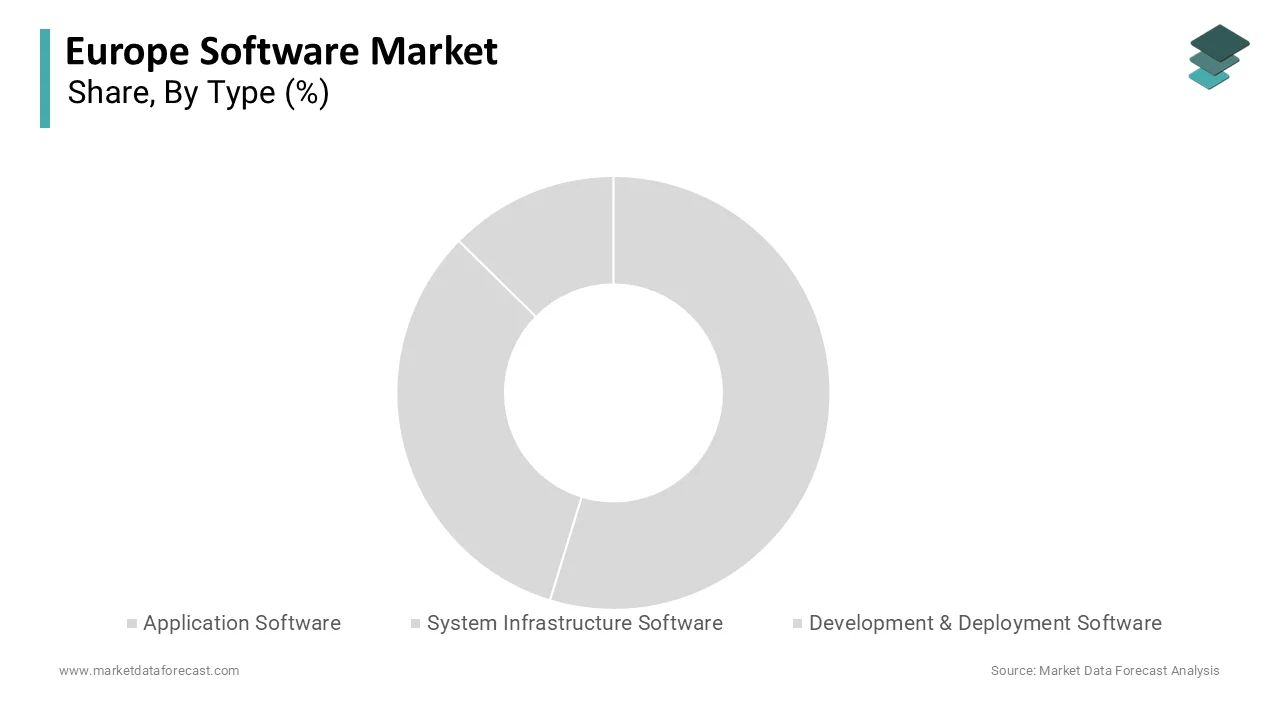
The Development and Deployment Software segment is predicted to witness the highest CAGR of 16.5% during the forecast period due to the urgent need to accelerate software delivery cycles and support the proliferation of cloud native architectures. The main catalyst for the explosive growth in this segment is the widespread adoption of DevOps methodologies and Continuous Integration Continuous Deployment pipelines that fundamentally change how software is built and released. European organizations are under immense pressure to innovate faster and bring digital products to market ahead of competitors, which necessitates automated development environments. Development teams across the continent are adopting more collaborative workflows to speed up the delivery of new digital features. Tools that facilitate automated testing, code integration, and deployment orchestration are becoming essential components of every IT stack. Competitive businesses are moving toward a model where software updates are released continuously rather than in large, infrequent batches. The complexity of managing microservice architectures further drives the need for sophisticated containerization and orchestration platforms. Developers rely on these tools to manage dependencies, ensure consistency across environments, and minimize human error. The cultural shift toward collaboration between development and operations teams creates sustained demand for platforms that bridge these functions. This transformation in software engineering practices ensures that development and deployment tools will experience the fastest growth trajectory. A further key factor propelling this segment is the democratization of software creation through low-code and no-code platforms that empower non-technical users to build applications. Businesses face a severe shortage of professional developers, which forces them to seek alternative ways to digitize processes and create custom solutions. The European Commission highlights that low-code adoption could help fill the digital skills gap by enabling business analysts and citizen developers to contribute to application portfolios. These platforms provide visual interfaces and drag-and-drop components that simplify the coding process while maintaining governance and security standards. Companies are increasingly turning to simplified programming tools that allow non-technical staff to build and launch their own business applications. Departments can rapidly prototype and deploy apps for internal workflows, customer portals, and data collection without waiting for central IT resources. The ability to iterate quickly based on user feedback allows companies to respond agilely to changing market conditions. This empowerment of the broader workforce to participate in software creation drives massive uptake of development tools. The convergence of talent shortages and the need for speed ensures this segment remains the fastest-growing area in the software market.
By Deployment Insights
The Cloud deployment segment led the European software market and captured a 58.1% share in 2025. The leading position of the segment is supported by the strategic shift toward flexible, scalable, lean, cost-efficient IT infrastructure models that support modern business agility. In addition, the foremost driver for cloud dominance is the pervasive preference among European CFOs and CIOs for operational expenditure models over heavy capital investments in physical hardware. The economic uncertainty and inflationary pressures of recent years have made the pay-as-you-go nature of cloud software highly attractive for preserving cash flow. More European businesses than ever are moving their core operations to the cloud, shifting from traditional physical servers to flexible online software subscriptions. Moving software to the cloud eliminates the need for upfront server purchases, maintenance contracts, and dedicated data center space, which significantly lowers the total cost of ownership. The ability to scale resources up or down instantly based on demand allows businesses to optimize spending and avoid overprovisioning. Organizations are finding that moving to the cloud can lower IT expenses, but only if they actively manage their digital resources to avoid unnecessary spending. This financial flexibility enables companies to redirect funds toward innovation and growth initiatives rather than static assets. The predictability of subscription billing also simplifies budget planning and financial forecasting. This economic imperative ensures that cloud deployment remains the preferred choice for the majority of software implementations across the region. A further reason for this growth is the indispensable role of cloud software in facilitating seamless collaboration and supporting the hybrid work models that have become standard across Europe. The pandemic permanently altered work patterns, leading to a distributed workforce that requires access to applications and data from anywhere at any time. Although many workers still prefer flexible schedules, more people are returning to physical offices as companies adjust their long-term workplace policies. Cloud deployment ensures that employees can access centralized systems securely via web browsers or mobile apps without being tethered to office networks. Real-time co-authoring, video conferencing, and shared project management platforms are only possible through robust cloud architectures. The use of digital tools for team communication has become a standard part of professional life, fundamentally changing how colleagues interact regardless of their location. The inherent scalability of the cloud supports sudden spikes in usage during peak business periods without performance degradation. This capability to connect dispersed teams and maintain operational continuity makes cloud software essential for modern organizational resilience. The enduring legacy of remote work guarantees the continued dominance of cloud deployment.
The cloud segment is estimated to register the fastest growth rate over the forecast period, owing to the exclusive availability of advanced generative artificial intelligence and machine learning capabilities that are inherently cloud native. Muscattering-edge AIAI models require massive computational power and vast datasets that are only feasible to host and train within hyperscale cloud environments. Researchers are increasingly utilizing high-powered digital clusters to access the massive computing strength required to train and run modern artificial intelligence. Software vendors are embedding AI features directly into their cloud offerings, making on-premises versions obsolete for users seeking intelligent automation. As per Nvidia, the demand for cloud-based AI inference services in Europe has doubled in the last year as companies rush to implement chat prediction analytics cs and automated content generation. The rapid pace of AI innovation means that cloud providers can update models continuously, providing customers with state-of-the-art functionality without manual upgrades. This access to transformative technology creates a powerful pull factor that drives migration from legacy-premises systems to the cloud. The inability to replicate these AI advantages locally ensures that cloud software will continue to grow at the fastest rate as businesses race to harness intelligent capabilities. In addition, this segment is supported by the emergence of sovereign cloud solutions that address European data residency and security concerns while retaining cloud benefits. Governments and regulated industries are launching initiatives to create cloud environments that are physically located in Europe and operated by trusted entities to comply with strict data laws. The Gaia X project and various national sovereign cloud programs are stimulating a new wave of cloud adoption among previously hesitant public sector and defense organizations. The European Union is dedicating significant capital to building local technology infrastructure that allows for better data protection and less dependence on foreign service providers. These specialized clouds offer the scalability of public cloud with the control of private infrastructure, appealing to entities with sensitive data. As per the sovereign cloud segment, it is growing at twice the rate of the general commercial cloud market in Europe. The regulatory-driven demand unlocks a vast pool of potential customers who were previously constrained by compliance fears. The development of federated cloud architectures allows for secure data sharing across borders while maintaining local jurisdiction. This alignment with European strategic autonomy goals ensures that cloud deployment remains the most dynamic and rapidly expanding segment.
By Vertical Insights
The BFSI segment dominated the European software market and accounted for a 24.5% share in 2025. The dominance of the segment is driven by the sector's intense reliance on digital transactions, rigorous regulatory compliance needs, and the high value of data assets. A big force shaping the segment’s dominance is the overwhelming burden of regulatory compliance, which forces financial institutions to invest heavily in specialized software for reporting, monitoring, ng and risk management. The implementation of the Digital Operational Resilience Act and Basel IV requirements mandates sophisticated IT systems capable of real-time data aggregation and stress testing. Banks are dedicating an increasing portion of their development resources to meeting new digital safety and reporting laws. Institutions must deploy advanced software to automate money laundering, know your customer verification, and transaction monitoring to avoid massive fines. The potential for massive legal penalties is making it more expensive for banks to ignore digital risks than it is to invest in new security software. The complexity of navigating multiple jurisdictions within the EU requires centralized platforms that can adapt to varying national rules instantly. Furthermore,th e need for audit trails and immutable records drives the adoption of blockchain and secure ledger technologies. This regulatory arms race ensures that BFSI remains the largest consumer of enterprise software, as legal survival depends on technological capability. The constant evolution of financial regulations guarantees sustained high levels of software investment in this sector. Also, this segment is boosted by the aggressive push toward digital banking and enhanced customer experiences driven by competition from fintech startups and changing consumer expectations. Traditional banks are compelled to modernize their core banking systems and launch mobile-first platforms to retain customers who demand seamless, instant, and personalized services. Consumers are rapidly moving away from traditional bank branches in favor of mobile and online services for their daily financial needs. Banks are investing billions in software to enable open banking,kinAIs''Is real-time payments, and AI-driven financial advisory services. By moving complex paperwork to digital platforms, banks are becoming both faster for customers and cheaper to run. The integration of biometric authentication and predictive analytics enhances security while simplifying user interactions. The race to offer innovative products such as buy now pay later schemes and robo-advising requires agile software architectures that can support rapid feature deployment. This competitive pressure to transform digitally ensures that the BFSI sector continues to lead the software market in terms of expenditure and adoption rates.
The Healthcare segment is anticipated to witness the fastest CAGR of 17.8% from 2026 to 2034. This rapid expansion is propelled by the urgent digitization of patient records, the rise of telemedicinea nd the integration of AI in diagnostics. A key reason for the explosive growth in the healthcare sector is the continental mandate to establish interoperable Electronic Health Record systems that allow seamless data exchange between providers. The European Health Data Space regulation aims to create a unified framework for health data sharing, which requires massive upgrades to existing hospital information systems. The EU is channeling billions into health technology to unify different national systems and reduce the waste caused by duplicated medical tests. Hospitals and clinics are rushing to adopt standardized EHR platforms that comply with new data formats and privacy protocols to participate in the cross-border network. As per Eurostat, the percentage of citizens with access to their electronic health records online is targeted to reach 100% by 203,0 driving widespread system replacements. The need to aggregate patient data from diverse sources for better care coordination fuels demand for integration engines and health information exchanges. This regulatory push transforms healthcare IT from a supportive function into a strategic priority funded by national governments. The scale of this harmonization effort ensures that healthcare software spending will grow at the fastest pace among all verticals. Additionally, the segment is helped by the permanent shift toward telemedicine and remote patient monitoring solutions following the pandemic-induced changes in care delivery. Patients and providers alike have embraced virtual consultations and wearable devices that transmit vital signs in real-time, requiring robust software platforms for management and analysis. Doctors are finding that tracking patient health from home leads to fewer emergency hospital visits and better long-term survival for those with chronic heart conditions. Healthcare providers are deploying comprehensive telehealth suites that include video conferencing, secure messaging, and automated triage bots to handle increasing patient volumes. After the initial surge during the health crisis, digital health services have become a permanent and frequent feature of modern European medical care. The aging population in Europe further accelerates the need for home-based care technologies that rely on sophisticated software to alert caregivers to emergencies. The integration of these tools with insurance systems for reimbursement creates additional software requirements. This fundamental change in how care is delivered ensures that the healthcare vertical will remain the fastest-growing market for software solutions.
COUNTRY LEVEL ANALYSIS
Germany Software Market Analysis
Germany was the top performer in the European software market and occupied a 23.1% share in 2025. The prominence of the German market is attributed to its robust industrial base and strong emphasis on engineering excellence. The nation serves as the primary hub for Industry 4.0 initiatives, which drive massive demand for industrial automation and enterprise software. The German Federal Ministry for Economic Affairs and Climate Action has launched the "Digital Hub Initiative,, allocating billions to foster software innovation in key sectors like automotive and manufacturing. This government support accelerates the adoption of specialized software for predictive maintenance and supply chain optimization. The country's strong data privacy culture also drives the market for compliant and secure software architecture, particularly in the financial and healthcare sectors. The presence of numerous Mittelstand companies creates a unique demand for scalable ERP systems tailored to mid-sized enterprises. The collaborative ecosystem between research institutes and tech firms ensures a steady pipeline of innovative software products. This combination of industrial necessity and policy support solidifies Germany's position as the dominant force in the regional software landscape.
United Kingdom Software Market Analysis
The United Kingdom was the second largest country in the European software market and captured a 19.6% share in 2025. The growth of the UK market is supported by its world-leading fintech sector and vibrant startup ecosystem. Despite post-Brexit adjustments, the UK remains a global powerhouse for software development,t particularly in financial services and artificial intelligence. The Ugovernment's Digital Strategy aims to make the country a global tecsuperpower, encouraging significant investment in software R&D and skills training. London acts as a magnet for venture capital funding, with many of Europe's most successful software startups, including unicorns in cybersecurity and SaaS. The strong presence of multinational corporations' headquarters drives demand for enterprise-grade software and cloud services. The focus on regtech and insurtech solutions addresses the complex regulatory environment of the City of London. The abundance of top-tier universities supplies a steady stream of talented developers fueling innovation. This dynamic environment, characterized by agility and financial strength, ensures the UK remains a critical growth engine for the European software market.
France Software Market Analysis
France is another key player in the European market by leveraging a state-led digitalization strategy and a strong focus on technological sovereignty. The French government views software independence as a national security priority, driving substantial public investment in domestic software champions and cloud infrastructure. The "France 2030" investment plan dedicates significant resources to developing sovereign software solutions in critical areas like defense, energy, and healthcare. This approach fosters a protected market for local vendors who can meet strict data residency requirements. The country's strong aerospace and luxury goods industries drive demand for specialized product lifecycle management and customer experience software. The establishment of tech hubs in Paris and Sophia Antipolis attracts international talent and fosters collaboration. The emphasis on ethical AI and responsible digitalization aligns with European values, creating a favorable environment for compliant software growth. This strategic blend of state support and industrial depth ensures France maintains a strong and influential position in the regional market.
Netherlands Software Market Analysis
The Netherlands is moving ahead steadfastly in the European software market due to its role as a digital gateway to Europe and advanced cloud infrastructure. The country's strategic location and excellent connectivity make it a preferred destination for hyperscalers establishing regional data centers, which stimulates local software consumption. The Dutch government's proactive digital agenda promotes the adoption of cloud-first policies and open standards across public and private sectors. The port of Rotterdam and Schiphol Airport drive demand for complex logistics and supply chain software solutions. The strong tradition of international trade necessitates robust cross-border e-commerce and payment platforms. The collaborative approach between government, industry, and academia fosters rapid experimentation with emerging technologies like blockchain and IoT. The high level of English proficiency facilitates the entry of global software vendors and the export of Dutch software services. This unique positioning as a digital hub ensures the Netherlands remains a key growth market with high adoption rates.
Sweden Software Market Analysis
Sweden emerges as a rapidly growing market in Europe owing to its status as a global innovation leader and early adopter of digital technologies. The nation boasts one of the highest rates of software intensity in the world, with a thriving ecosystem of unicorns and tech giants spawning spin-offs. The Swedish government's ambitious digitalization goals aim to make the country the best in the world at harnessing the opportunities of digital transformation. This vision drives widespread adoption of cutting-edge software in sectors like gaming and communication, ns and green tech. The strong emphasis on sustainability drives demand for software solutions that optimize energy usage and support circular economy models. The presence of major telecom equipment manufacturers fuels innovation in network software for fifth-generation applications. The culture of trust and transparency encourages the rapid uptake of new digital services. This relentless pursuit of innovation and digital excellence positions Sweden as a disproportionate influencer in the European software landscape relative to its size.
COMPETITIVE LANDSCAPE
The competition in the European software market is intense and characterized by a dynamic interplay between global technology giants and agile local specialists vying for dominance in a highly regulated environment. Incumbent players leverage their extensive installed bases and deep industry expertise to secure large-scale digital transformation contracts from multinational corporations and public sector entities. Meanwhile, emerging disruptors challenge the status quo with cloud native solutions and open-source platforms that offer superior flexibility and cost efficiency. The rivalry intensifies as firms strive to differentiate their offerings through unique value propositions such as enhanced data sovereignty features or specialized artificial intelligence capabilities tailored to European needs. Strategic alliances have become essential as no single entity possesses all the resources required to deliver fully integrated ecosystems that comply with fragmented national regulations. Competitors constantly monitor each other's moves to quickly replicate successful innovations or counter new market entries with improved versions of existing products. The pressure to adhere to stringent European Union laws regarding privacy and ethical AI further shapes competitive strategies significantly. Companies that can demonstrate tangible improvements in security compliance and operational efficiency while respecting local data rights gain a distinct advantage. This fierce yet collaborative environment drives rapid technological advancement and ensures that European organizations remain at the global forefront of software innovation.
KEY MARKET PLAYERS
Some of the companies that are playing a dominating role in the global European Software Market include
- Microsoft Corporation
- SAP SE
- Oracle Corporation
- IBM Corporation
- Adobe Inc.
- Salesforce, Inc.
- Google LLC
- Sage Group plc
- Dassault Systèmes SE
- Atlassian Corporation
- ServiceNow, Inc.
- Siemens Digital Industries Software
- VMware, Inc.
- Autodesk, Inc.
- Capgemini SE
TOP LEADING PLAYERS IN THE EUROPEAN SOFTWARE MARKET
- SAP SE stands as a cornerstone of the European software market by delivering comprehensive enterprise resource planning solutions that power businesses globally. The company enables organizations to integrate finance, supply chain, and human resources into unified digital ecosystems. Globally, SAP contributes by setting standards for business process automation and real-time data analytics across diverse industries. Recently, the company accelerated its cloud transformation by migrating thousands of customers to its Business Technology Platform, which enhances artificial intelligence capabilities. This strategic shift strengthens its ability to support European enterprises seeking sovereign cloud solutions that comply with strict data regulations. SAP also partners extensively with hyperscalers to ensure seamless hybrid deployments. Their commitment to sustainability drives the development of green software tools that help clients track and reduce carbon footprints. SAP focuses on industry-specific clouds and continuous innovation. This approach helps businesses navigate complex global challenges while maintaining operational excellence.
- Microsoft Corporation plays a pivotal role in the European software market through its Azure cloud platform and productivity suites that empower hybrid work environments. The company specializes in providing secure and scalable infrastructure that supports digital transformation initiatives for governments and corporations alike. GlobalMicrosoft drives the adoption of artificial intelligence by integrating generative models into everyday applications used by billions. Recent actions include significant investments in European data centers to expand sovereign cloud regions and meet local residency requirements. This expansion addresses growing concerns about data privacy and ensures compliance with European Union regulations. Microsoft also collaborates with startups and academic institutions to foster innovation in cybersecurity and quantum computing. Their focus on empowering every person and organization through technology resonates with European digital sovereignty goals. Microsoft leverages advanced security features and AI-driven insights. These tools enable customers to achieve more while protecting critical assets against evolving threats.
- Oracle Corporation is a key contributor to the European software market by offering robust database technologies and cloud applications to manage mission-critical workload. The company excels in providing high-performance infrastructure, financial services, telecommunications, and public sector entities requiring absolute reliability. Globally, Oracle leads in autonomous database technologies that use machine learning to automate management tasks and eliminate human error. The company expanded its cloud infrastructure footprint in Europe by opening new regions in Spain and Italy to serve local demand for low-latency services. This expansion strengthens its position as a preferred provider for organizations needing data residency within European borders. Oracle also enhances its software suite with embedded artificial intelligence to improve decision-making and operational efficiency. Their commitment to delivering secure and resilient cloud solutions helps European businesses modernize legacy systems without compromising performance. Oracle focuses on integration and automation. This empowers enterprises to innovate faster and respond agilely to market changes.
TOP STRATEGIES USED BY KEY MARKET PARTICIPANTS
Key players in the European software market primarily employ strategic acquisitions to rapidly acquire niche technologies and expand their product portfolios. Companies frequently purchase specialized artificial intelligence startups or cybersecurity firms to gain immediate access to innovative capabilities that enhance their core offerings. Another prevalent strategy involves forming extensive partnerships with local telecommunications providers and system integrators to ensure robust deployment and support across diverse European regions. Market participants also focus heavily on research and development to pioneer sovereign cloud solutions that address strict data residency and privacy regulations unique to the continent. Expanding physical infrastructure through the construction of new data centers allows firms to offer low-latency services and guarantee data localization for government and enterprise clients. Furthermore, companies actively engage in ecosystem building by launching developer platforms and marketplaces that encourage third-party innovation and integration. These collaborative and investment-driven approaches enable stakeholders to navigate the complex regulatory landscape while meeting the urgent demands of digital transformation effectively.
MARKET SEGMENTATION
This research report on the europe software market is segmented and sub-segmented into the following categories.
By Type
- Application Software
- System Infrastructure Software
- Development & Deployment Software
By Deployment
- Cloud
- On-Premises
By Vertical
- BFSI (Banking, Financial Services & Insurance)
- Healthcare
- IT & Telecommunications
- Retail & E-commerce
- Manufacturing
- Government & Public Sector
- Education
- Others
By Country
- Germany
- United Kingdom
- France
- Netherlands
- Sweden
- Italy
- Spain
- Rest of Europe
Related Reports
Access the study in MULTIPLE FORMATS
Purchase options starting from
$ 2000
Didn’t find what you’re looking for?
TALK TO OUR ANALYST TEAM
Need something within your budget?
NO WORRIES! WE GOT YOU COVERED!
Call us on: +1 888 702 9696 (U.S Toll Free)
Write to us: sales@marketdataforecast.com