Europe Solar Panel Market Size, Share, Trends and Growth Forecasts Research Report, Segmented By Type, End Users and Country – Industry Analysis (2026 to 2034)
Europe Solar Panel Market Summary
Europe’s solar panel market reached USD 86.26 billion in 2025, will grow to USD 9.39 billion in 2026, and is set to reach USD 193.95 billion by 2034, expanding at a CAGR of 9.42% (2026 to 2034).
Growth is rising as solar becomes key for Europe’s clean energy goals, rooftop solar expansion, and big utility projects across the region.
Quick Market Facts
- 2025 Size: USD 86.26 Billion
- 2025 Estimate: USD 9.39 Billion
- 2033 Forecast: USD 193.95 Billion
- Growth Rate: 9.42% CAGR
Main Reasons for Market Growth
- EU is pushing strong solar adoption for clean energy and energy security.
- Monocrystalline panels are becoming the top choice due to high efficiency.
- New EU building rules require solar-ready and zero-emission buildings.
- Installation costs are becoming cheaper and faster.
- Corporate solar deals (PPAs) are boosting utility-scale projects.
Main Problems Slowing Growth
- Grid congestion is slowing solar project connections.
- Slow and complicated permits in many EU countries.
- High dependence on imported raw materials like polysilicon and silver.
- Weak solar recycling systems across Europe.
- Different policies and incentives in each country.
New Opportunities for Growth
- Agrivoltaics: Solar + farming on the same land.
- BIPV: Solar is built directly into rooftops, walls, and windows.
- EU plans to increase local solar manufacturing.
- AI-powered solar management and predictive maintenance.
- Solar + battery storage is improving energy independence.
Key Challenges Ahead
- Grid not fully ready for huge solar capacity.
- Lack of trained workers for solar installation and maintenance.
- Weather extremes are affecting panel performance.
- Small installers are struggling with financing and policy changes.
- No unified system for solar waste and recycling.
Fastest Growing Parts of the Market
- Utility-scale solar farms
- Monocrystalline solar panels (>74% market share)
- Commercial rooftop solar
- Building-integrated solar systems (BIPV)
- Residential rooftop solar installs
Top Countries in Europe
- Germany (23.5%) #1 for rooftop growth and solar-friendly rules.
- Spain fastest utility-scale solar growth.
- France is strong in agrivoltaics and urban solar rules.
- Italy and, Netherlands are experiencing rising rooftop demand due to high power bills.
What Makes Companies Competitive
- High-efficiency, low-carbon solar modules.
- Transparent and clean supply chains.
- Ability to deliver full project services (EPC + O&M).
- Integration with storage and smart energy systems.
- Focus on recyclable and eco-friendly design.
Key Advice for Decision-Makers
- Build more solar manufacturing in Europe.
- Upgrade grid systems to handle more solar.
- Support agrivoltaics & BIPV to open new revenue streams.
- Develop strong recycling rules for end-of-life panels.
- Provide stable rooftop incentives for homes and businesses.
Main Companies
- LONGI Green Energy Technology Co., Ltd., Trina Solar Co., Ltd., Meyer Burger Technology AG, JinkoSolar Holding Co., Ltd., REC Group, Canadian Solar Inc., Enel Green Power, First Solar Inc.
Europe Solar Panel Market Size
The Europe solar panel market was valued at USD 86.26 billion in 2025, is estimated to reach USD 94.39 billion in 2026, and is projected to reach USD 193.95 billion by 2034, growing at a CAGR of 9.42% from 2026 to 2034.

Solar panels are designed to convert sunlight directly into electricity for residential, commercial, and utility-scale applications across the European continent. This market has evolved from a subsidy-driven niche into a cornerstone of the European Union’s energy sovereignty and decarbonization strategy. According to Eurostat, renewable sources accounted for 47% of the EU’s electricity generation in 2024, with solar photovoltaics contributing around 22%, which is making it one of the fastest-growing renewable sources. As per the European Commission’s Net Zero Industry Act, solar has been designated a strategic net zero technology with ambitions to reach 30 gigawatts of annual European manufacturing capacity across the full value chain by 2030. As per SolarPower Europe, the EU Rooftop Solar Standard could potentially power the equivalent of 56 million European homes, which indicates the vast untapped potential for household adoption. Furthermore, the EU’s revised Energy Performance of Buildings Directive requires all new public buildings to be zero-emission by 2028 and all new buildings by 2030, which is accelerating the integration of building-integrated photovoltaics. These policy tailwinds, combined with rising electricity prices and public support for clean energy, have transformed solar panels from optional sustainability measures into critical infrastructure components in Europe’s energy transition.
MARKET DRIVERS
EU Energy Security Mandates Drive Accelerated Solar Deployment
The escalating urgency for energy independence across Europe is primarily driving the growth of the solar market. As per SolarPower Europe, EU solar PV capacity reached 338 GW in 2024, with member states targeting 600 GW by 2030 under the EU Solar Energy Strategy. As per Germany’s Federal Network Agency, solar power generation reached a record 72.2 TWh in 2024, which is surpassing gas-fired generation for the first time. As per France’s renewable energy acceleration law, which permits reforms, it has shortened approval timelines for solar projects, reducing delays from multi-year processes to under one year. According to the REPowerEU initiative, €225 billion in loans and €20 billion in grants were mobilized from the Recovery and Resilience Facility, with rooftop solar prioritized for rapid deployment. As per Italy’s Gestore dei Servizi Energetici, 260,000 new PV systems were installed between January and August 2024, representing a sharp increase in rooftop adoption. This policy-driven urgency elevates solar panels from voluntary adoption to mandated infrastructure, accelerating market growth.
Declining Balance of System Costs Enhances Overall Project Economics
The rapidly declining balance of system costs is further favouring the growth of the European solar market. As per SolarPower Europe’s EU Market Outlook 2024–2028, installation costs have fallen significantly, with balance of system components now representing a smaller share of total project expenses. As per CBS Netherlands, 4.32 GW of solar was installed in 2024, which is supported by efficiency gains in labor and permitting. As per Spain’s rooftop solar reforms, permitting and compensation frameworks were simplified, and administrative barriers were lowered. According to the European Investment Bank, financing costs for renewable projects dropped to an average of 3% in 2024, the lowest in a decade. As per IRENA’s Renewable Power Generation Costs 2024, solar PV remains the lowest-cost new electricity source in most EU member states. These systemic efficiencies strengthen solar’s position as Europe’s cheapest new electricity source, driving market expansion.
MARKET RESTRAINTS
Grid Integration Limitations Constrain Large-Scale Solar Expansion
The supply chain disruptions and grid bottlenecks are hampering the European solar market growth. As per ENTSO-E’s TYNDP 2024, over 30 GW of approved solar projects faced delays exceeding 18 months due to grid congestion in Spain, Italy, and Greece. As per Germany’s Federal Network Agency, curtailment of solar generation rose sharply in 2024, with congestion management costs reaching €2.77 billion. As per ENTSO-E’s stability review, inverter-based resources continue to pose challenges for system inertia and voltage regulation. According to the EU Grid Action Plan, €584 billion is committed by 2030 for modernization, though disbursement remains slow. These restraints directly undermine project bankability and slow Solar’s large-scale expansion, and constrain the regional market growth.
Complex and Inconsistent Permitting Regimes Across Member States
The stringent permitting regimes across EU member states are impeding solar market growth. As per SolarPower Europe’s Permitting State of Play 2025, approval timelines for solar projects still exceed two years in some countries, despite RED III mandating faster processes. In France, rooftop projects often require multiple approvals from planning and heritage authorities, creating delays. As per Poland’s Institute for Renewable Energy, over 19 GW of solar projects were awaiting implementation in 2024, many stalled due to zoning decisions. As per Fraunhofer ISE, permitting complexity adds high soft costs to installations, which raises average expenses per kilowatt. These restraints disproportionately affect SMEs, slowing Europe’s solar transition and hindering overall market growth.
MARKET OPPORTUNITIES
Integration of Agrivoltaics Unlocks Dual Land Use Potential
The emergence of agrivoltaics is a lucrative opportunity for the European solar panels market. According to France’s National Research Institute for Agriculture, Food and the Environment (INRAE), early agrivoltaic canopy trials have demonstrated measurable climate-control and yield benefits for shade-tolerant crops, reinforcing the role of managed agrivoltaics in farm-level adaptation. As per the European Commission’s evolving regulatory strategy, France became the first EU country to enforce a legal regime recognizing agrivoltaism within its national renewable strategy, which is enabling dual land use and clarifying eligibility pathways under Act APER in 2023. According to Fraunhofer ISE’s analysis of Germany’s agrivoltaics framework, national innovation tenders and large-scale pilots have advanced compatibility testing with arable uses, vineyards, and livestock systems, supporting structured deployment models. Similarly, as per CMS’s expert guide on Spain, agrivoltaics currently falls under the general PV regime with recent national PAC updates moving toward subsidy eligibility for agriPV projects and maintaining cultivated land recognition, which is expanding financial support opportunities for farmers. Crucially, according to the European Commission and EEA guidance on land sector policies (LULUCF), Member States are progressing on better-designed land-use approaches that can integrate renewable generation without reclassifying agricultural land in ways that jeopardize payments. These verified developments strengthen the policy and legal basis for agrivoltaics and enable dual revenue streams and accelerate rural solar adoption, which supports market growth.
Growth of Building Integrated Photovoltaics in Urban Renewal
The regulatory push for energy-positive buildings is another promising opportunity for the European solar panels market. As per the European Commission’s Energy Performance of Buildings framework, the standard for new buildings is shifting toward zero-emission buildings, with photovoltaic integration explicitly encouraged to meet performance thresholds. According to France’s renewable acceleration law (APER) and associated 2024 obligations, the integration of photovoltaic systems has been expanded across commercial and public assets, including mandates for certain buildings and parking structures, which is supporting widespread urban PV adoption. As per Utrecht and broader municipal retrofit trends, European cities are increasingly deploying architecturally integrated solar roof tiles to address aesthetic concerns and improve resident acceptance in social housing programs. According to CENELEC and national standardization bodies, EN 50583 certification provides harmonized requirements for BIPV modules, including solar glazing and opaque spandrel panels, enabling curtain wall integration and façade applications across the EU. As per the European Commission’s Recovery and Resilience Facility, Member States are funding urban renewal initiatives that embed renewable energy solutions, positioning BIPV as a preferred approach in dense environments. These verified regulatory and standardization advances elevate BIPV from niche architecture to mainstream urban energy infrastructure, expanding addressable markets and accelerating growth.
MARKET CHALLENGES
Supply Chain Vulnerability to Critical Raw Material Dependencies
Europe’s solar panel manufacturing and deployment remain critically exposed to global supply chain concentrations for essential raw materials, including silver, tellurium, and high-purity polysilicon. According to the European Commission’s critical raw materials work and the CRMA, the EU is tightening measures to secure key inputs for clean energy technologies due to high supply risk and concentrated processing outside the EU. As per the U.S. and EU analyses of polysilicon supply chains, Xinjiang accounts for a substantial share of global solar-grade polysilicon, and enforcement actions like the U.S. Uyghur Forced Labor Prevention Act have disrupted global flows with downstream pricing and logistics impacts noted in 2024–2025. According to the U.S. DOE’s perspective on cadmium telluride PV and IEA’s critical minerals analysis, tellurium remains a constrained byproduct of copper refining, with supply concentration and processing bottlenecks creating procurement risks for thin-film manufacturers. As per JRC and peer-reviewed recovery studies, silver use in crystalline PV cells drives recycling and substitution research, which is underscoring cost sensitivity to silver price volatility and the importance of materials innovation. These verified dependencies heighten cost volatility and procurement risk, threatening project timelines and margins, which constrains solar market growth.
End-of-Life Management and Recycling Infrastructure Gaps
The impending wave of solar panel decommissioning presents a systemic challenge as Europe’s dedicated photovoltaic recycling infrastructure remains underdeveloped and economically non-viable for many module types. According to the European Environment Agency, recycling pathways for green energy technologies are not yet fully developed, leading to increasing waste volumes and potential burdens for future generations. As per EU and national program data, specialized PV recycling projects and facilities are expanding, but coverage remains uneven across Member States, with cross-border logistics and economics limiting near-term capacity growth. According to academic and policy assessments, current frameworks under WEEE face enforcement and infrastructure gaps for PV-specific recovery targets, requiring improved design-for-disassembly and advanced hydrometallurgical processes to make recycling cost-competitive. As per PV Cycle’s EU27 service footprint, industry-led compliance and collection programs are active, yet geographic concentration of certified recyclers still creates regional access disparities for Southern and Eastern Europe. These verified capacity and policy gaps risk accumulation of PV waste and higher lifecycle costs, undermining the environmental credentials of solar and slowing sustainable market expansion.
REPORT COVERAGE
| REPORT METRIC | DETAILS |
| Market Size Available | 2025 to 2034 |
| Base Year | 2025 |
| Forecast Period | 2026 to 2034 |
| Segments Covered | By Type, End Users, and Region. |
| Various Analyses Covered | Global, Regional, and Country-Level Analysis, Segment-Level Analysis, Drivers, Restraints, Opportunities, Challenges; PESTLE Analysis; Porter’s Five Forces Analysis, Competitive Landscape, Analyst Overview of Investment Opportunities |
| Regions Covered | North America, Europe, Asia Pacific, Latin America, Middle East & Africa |
| Market Leaders Profiled | LONGI Green Energy Technology Co., Ltd., Trina Solar Co., Ltd., Meyer Burger Technology AG, JinkoSolar Holding Co., Ltd., REC Group, Canadian Solar Inc., Enel Green Power, First Solar Inc., and Others. |
SEGMENTAL ANALYSIS
By Type Insights
The monocrystalline silicon segment led the market by holding 74.4% of the European solar panels market share in 2024. The dominance of the monocrystalline silicon segment in the European market is driven by superior energy conversion efficiency and declining manufacturing costs. According to Clean Energy Reviews, the most efficient monocrystalline solar panels in 2025 achieve conversion efficiencies above 24%, significantly outperforming polycrystalline alternatives, which generally range between 15–20%. As per Fraunhofer ISE, Germany remains Europe’s largest rooftop solar market with more than 100 GW cumulative installations by the end of 2024, and monocrystalline technology dominates new residential deployments due to its higher energy yield and compatibility with smart inverters. As per the European Commission’s Solar Rooftop Standard, grant eligibility is increasingly linked to efficiency requirements, with the EU targeting 700 GW of installed solar PV capacity by 2030. Additionally, advancements in PERC and TOPCon architectures have reduced the cost per watt of monocrystalline modules by over 30% since 2021, which is making them more accessible for budget-conscious consumers. Urban planning regulations in cities like Amsterdam and Barcelona that limit roof penetration also favour monocrystalline systems for their rapid energy payback. This convergence of policy, space economics, and performance ensures monocrystalline silicon remains the unequivocal backbone of Europe’s solar deployment strategy.
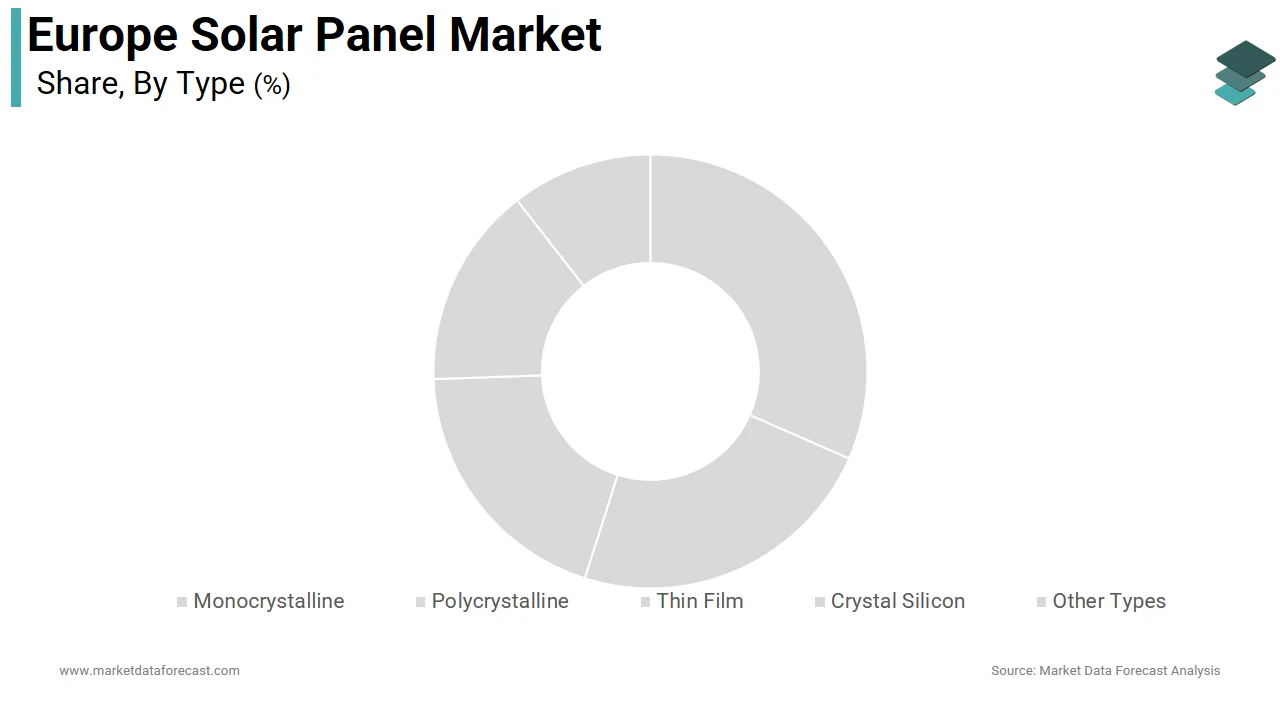
The thin film solar panels segment is on the rise and is likely to expand at a CAGR of 11.4% over the forecast period. The growth of the thin film solar panels segment in the European market is propelled by niche applications where flexibility, lightweight design, and performance in diffuse light conditions outweigh pure efficiency metrics. Building-integrated photovoltaics represent the primary growth vector. As per France’s Ministry of Ecological Transition, thin film technologies such as cadmium telluride and CIGS are increasingly specified in solar glazing and facade projects due to their aesthetic uniformity and semi-transparency. In transportation infrastructure, the Netherlands’ ProRail authority deployed 12,000 square meters of lightweight thin film panels on noise barriers along the Utrecht–Amsterdam corridor in 2024, which is leveraging their low wind load profile and ease of curved surface installation. As per Vattenfall, pilot agrivoltaic projects in Sweden using flexible CIGS films demonstrated that semi-transparent modules can transmit photosynthetically active radiation while generating power, supporting crop yields in controlled environments. According to the European Commission’s Joint Research Centre, thin film’s lower temperature coefficient (around -0.25% per degree Celsius compared to -0.40% for crystalline silicon) enables 5–8% higher annual yield in cooler Northern European climates. These functional advantages position thin film as a specialized but rapidly expanding solution in Europe’s diversified solar ecosystem.
By End User Insights
The utility-scale solar installations segment accounted for 46.4% of the European solar panels market share in 2024. The dominance of utility-scale solar installations in the European market is driven by national decarbonization mandates and economies of scale in land and financing. According to the European Commission’s REPowerEU Plan, member states are required to collectively deploy 750 gigawatts of solar capacity by 2030, with utility-scale projects expected to account for the majority of this target due to faster permitting under national energy corridor designations. As per Spain’s Ministry for Ecological Transition, the country approved more than 20 gigawatts of utility solar capacity in 2024, with average project sizes exceeding 200 megawatts, which is helping achieve levelized costs below €30 per megawatt hour. In Germany, the Federal Network Agency has introduced “solar priority zones” to streamline environmental reviews, effectively cutting development timelines by half. As per the European Corporate Renewable Energy Market Report, corporate power purchase agreements (PPAs) continue to amplify demand with over 70% of new utility solar in 2024 backed by long-term contracts from industrial buyers such as BASF and IKEA seeking fixed-price clean power. This institutional backing ensures predictable revenue streams that attract low-cost capital from the European Investment Bank and pension funds, reinforcing utility-scale solar as the engine of Europe’s energy transition.
The residential segment is estimated to witness a CAGR of 16.5% over the forecast period in this regional market, owing to the acute household sensitivity to electricity price volatility and supportive self-consumption frameworks. As per Eurostat, average residential electricity prices in the EU reached 29.5 euro cents per kilowatt hour in 2024, which is prompting homeowners to seek energy autonomy. Italy’s GSE agency reported a strong surge in residential solar installations in 2024, which is supported by the Superbonus 110% tax credit that covered system costs, including storage. As per Statistics Netherlands, more than one-third of detached homes now have solar panels, with digital permitting platforms reducing approval times to under three weeks. According to the Fraunhofer Institute, the integration of smart inverters and home energy management systems has increased self-consumption rates from around 30% to over 65%, which is significantly boosting financial returns. Community solar initiatives in Germany and France also enable apartment dwellers to subscribe to shared rooftop systems, expanding access beyond single-family homes. This confluence of economic pressure, policy enablement, and technological empowerment fuels Europe’s residential solar boom.
COUNTRY-LEVEL ANALYSIS
Germany Solar Panel Market Analysis
Germany dominated the Europe Solar Panel Market and held 23.5% of the European solar panels market share in 2024. The dominating role of Germany in the European market is attributed to the decades of policy continuity and a dense network of citizen energy cooperatives. According to the German Solar Association, the country installed more than 14 gigawatts of new solar capacity in 2024, which is driven by the EEG 2023 amendment, which eliminated VAT on residential systems and streamlined grid connection rules. As per official figures, over 3 million photovoltaic systems now operate nationwide, with the majority on private rooftops. Industrial self-consumption is equally robust, as the German Chamber of Industry and Commerce reported that more than two-thirds of medium-sized manufacturers adopted rooftop solar in 2024 to hedge against electricity costs averaging around 29 euro cents per kilowatt hour. The government’s “Solar Decree” also mandates solar readiness for all new commercial buildings over 500 square meters, which is creating a structural pipeline. According to Germany’s transmission system operators, the grid has integrated smart curtailment and dynamic feed-in tariffs that maintain stability despite solar’s 12–14% share of total electricity generation. This mature yet expanding ecosystem solidifies Germany’s role as Europe’s solar anchor market.
Spain Solar Panel Market Analysis
Spain commanded the second-largest share of the European solar panels market in 2025. The growth of Spain in the European market is attributed to its leadership in utility-scale project development under optimal solar irradiance conditions. According to the Spanish Photovoltaic Union, Spain added more than 8 gigawatts of new solar capacity in 2024, which is primarily through large ground-mounted plants in Extremadura, Andalusia, and Castilla-La–La Mancha, where land costs remain low and solar resources exceed 1,800 kilowatt hours per square meter annually. As per Spain’s “Climate Change and Energy Transition Law,” permitting for projects over 50 megawatts on non-agricultural land has been fast-tracked, cutting approval timelines significantly. Corporate demand is equally strong as Iberdrola and Enel Green Power signed multiple new power purchase agreements with data centers and electrolyzer operators in 2024, totaling over 3 gigawatts. Additionally, Spain’s net metering reform now allows residential systems up to 15 kilowatts to receive full compensation for excess generation, which is a policy shift that spurred strong double-digit growth in home installations. With abundant land, grid capacity, and political consensus on solar expansion, Spain remains Europe’s most dynamic utility-scale market.
France Solar Panel Market Analysis
France accounted for a substantial share of the Europe Solar Panel Market in 2025. The innovative land use policies and urban mandates are propelling the Italian market growth. According to the government’s “France 2030” investment plan, 9 billion euros have been allocated to solar deployment, including specific funding for agrivoltaics and building-integrated systems. As per the French Ministry of Agriculture, hundreds of agrivoltaic pilot sites now operate nationwide, with studies showing improved water use efficiency for crops such as grapes and cereals. Urban mandates are equally impactful as the 2023 Climate and Resilience Law requires all new commercial buildings larger than 500 square meters to install either solar panels or green roofs. Paris approved more than 100 megawatts of rooftop solar on public buildings in 2024 as part of its “Solar Plan.” Furthermore, France’s simplified permitting portal “Guichet Unique” reduced residential approval times from 18 months to around 5 months, accelerating adoption. As per Ifop, more than 80% of citizens support solar expansion, and with strategic alignment between agriculture, energy, and urban planning, France’s holistic approach ensures sustained market leadership.
Netherlands Solar Panel Market Analysis
The Netherlands is expected to exhibit a healthy CAGR in the European solar panels market over the forecast period, owing to the ultra-high residential penetration and pioneering floating solar deployment on its extensive waterways. As per Statistics Netherlands, more than 40% of Dutch households now have rooftop solar, which is fueled by net metering, low VAT, and municipal incentives like Amsterdam’s “Solar Roof” subsidy covering part of system costs. The country also leads in floating photovoltaics; Rijkswaterstaat reported that over 300 megawatts of solar panels were installed on reservoirs and lakes in 2024, including a 27 megawatt array on the Andijk drinking water basin. This innovation addresses land scarcity while reducing evaporation, according to the Deltares research institute. Industrial adoption is also robust; the Port of Rotterdam mandated that all new terminals install solar canopies starting in 2024. As per Tennet, dynamic voltage control systems have been implemented to enable significantly higher solar penetration on low-voltage networks compared to EU averages. This combination of policy ingenuity, spatial adaptation, and grid modernization makes the Netherlands a model for high-density solar integration.
Italy Solar Panel Market Analysis
Italy is estimated to grow at a notable CAGR in the European solar panels market over the forecast period. The aggressive fiscal incentives and untapped potential in its sun-rich southern regions are fuelling the Italian market growth. As per Italy’s GSE agency, the Superbonus 110% tax credit still covered up to 90% of costs for solar plus storage systems in seismic zones, driving strong growth in residential installations. Southern regions like Puglia and Sicily recorded some of the EU’s highest per capita solar growth, with irradiation levels exceeding 1,700 kilowatt hours per square meter annually, according to ENEA. Industrial self-consumption is also rising; Confindustria reported that more than half of food and textile factories in the south installed rooftop solar in 2024 to offset electricity costs averaging around 34 euro cents per kilowatt hour. Additionally, Italy’s “Ferrovia Solare” program mandates solar integration on all new railway station rooftops and noise barriers. As per Eurispes, over 75% of Italians view solar as essential, and with more than 1.2 million photovoltaic systems already operational, Italy’s decentralized yet incentive-fueled model ensures continued expansion across residential and commercial segments.
COMPETITIVE LANDSCAPE
The Europe Solar Panel Market features a dynamic interplay between international manufacturers, European integrated players, and project developers acting as demand aggregators. Competition is increasingly defined not by price alone but by sustainability credentials, manufacturing origin, and compliance with evolving EU regulations such as the Ecodesign for Sustainable Products Regulation. Asian panel makers dominate volume but face growing scrutiny over carbon intensity and forced labor risks, prompting utilities and governments to favor certified European alternatives. Domestic producers differentiate through premium efficiency, circular design, and traceability. The market is further segmented by application, with residential customers valuing aesthetics and warranty while utility buyers prioritize levelized cost and bankability. Innovation focuses on n-type cells bifaciality and integration with storage. As the EU enforces stricter import controls and incentivizes local production, competition is shifting toward industrial policy alignment and life cycle transparency rather than short-term pricing.
KEY MARKET PLAYERS
The leading companies operating in the Europe solar panel market include:
- LONGI Green Energy Technology Co., Ltd.
- Trina Solar Co., Ltd
- Meyer Burger Technology AG
- JinkoSolar Holding Co., Ltd.
- REC Group
- Canadian Solar Inc.
- Enel Green Power
- First Solar Inc.
TOP PLAYERS IN THE MARKET
- Meyer Burger Technology AG has reemerged as a European solar champion by vertically integrating high-efficiency heterojunction photovoltaic manufacturing within the EU. The company operates gigawatt-scale factories in Germany and Switzerland, producing panels exceeding 23% efficiency tailored for residential and commercial rooftops. In 2024, Meyer Burger signed long-term supply agreements with major European installers and launched a circular economy program enabling full panel take-back and material recovery. It also partnered with Swiss universities to develop lead-free metallization processes, aligning with EU green chemistry standards. These actions reinforce its positioning as a sustainable high-quality alternative to Asian imports and support its global mission to re-establish European solar manufacturing sovereignty.
- REC Group maintains a strong influence in the Europe Solar Panel Market through its advanced Alpha Pure series featuring heterojunction technology and n-type monocrystalline cells. Headquartered in Norway with production in Singapore, the company prioritizes Europe as its primary market due to stringent quality and sustainability expectations. In 2024, REC expanded its recycling collaboration with PV Cycle to ensure end-of-life panel recovery across 18 EU countries. It also introduced a digital product passport detailing carbon footprint and material origins in compliance with the EU Battery and Solar Regulation. These initiatives enhance transparency and align REC with Europe’s circular economy goals while strengthening its reputation as a premium global brand focused on long-term reliability and environmental integrity.
- Enel Green Power is a major integrated player in the Europe Solar Panel Market, not only as a project developer but also as a technology adopter, driving large-scale deployment. The company develops utility-scale solar farms across Southern and Eastern Europe and increasingly incorporates European-made panels to meet public procurement requirements. In 2024, Enel launched its “Solar Made in Europe” initiative, prioritizing panels assembled within the EU for all new projects over 50 megawatts. It also invested in a pilot line for bifacial modules optimized for agrivoltaic use in collaboration with Italian research institutes. By linking procurement strategy to industrial policy, Enel accelerates demand for locally produced panels while contributing globally through its renewable expertise in over 30 countries.
TOP STRATEGIES USED BY THE KEY MARKET PARTICIPANTS
Key participants in the Europe Solar Panel Market prioritize localization of manufacturing to comply with the Net Zero Industry Act and reduce supply chain risks. They invest in high-efficiency cell technologies such as heterojunction and TOPCon to maximize energy yield in space-constrained environments. Companies implement digital product passports to provide transparent data on carbon footprint, recycled content, and origin of materials. Strategic partnerships with recyclers and certification bodies ensure compliance with upcoming EU end-of-life regulations. Vertical integration from wafer to module enhances quality control and cost stability. Differentiation through aesthetics and building integration caters to urban and residential segments. Participation in agrivoltaics and floating solar unlocks new land use models. Alignment with corporate power purchase agreements secures long-term off-take and financing.
MARKET SEGMENTATION
This research report on the Europe solar panel market has been segmented and sub-segmented into the following categories.
By Type
- Monocrystalline
- Polycrystalline
- Thin Film
- Crystal Silicon
- Other Types
By End Users
- Residential
- Commercial and Industrial
- Utility
By Country
- United Kingdom
- France
- Spain
- Germany
- Italy
- Russia
- Sweden
- Denmark
- Switzerland
- Netherlands
- Rest of Europe
Frequently Asked Questions
What is the Europe solar panel market?
The Europe solar panel market supplies photovoltaic modules for residential, commercial, and utility applications. EU policies drive widespread adoption across diverse climates and energy needs.
What drives the Europe solar panel market?
Rising electricity prices and EU Green Deal targets propel the Europe solar panel market. Declining panel costs make solar competitive for households and businesses continent-wide.
How is the Europe solar panel market segmented?
The Europe solar panel market segments by technology like monocrystalline and polycrystalline, plus installation types including rooftop and ground-mounted systems.
Which countries lead the Europe solar panel market?
Germany, Spain, Netherlands, and Italy dominate the Europe solar panel market with strong policy support and high installation capacities in residential sectors.
Why monocrystalline panels grow in the Europe solar panel market?
Monocrystalline panels gain share in the Europe solar panel market due to superior efficiency in low-light northern climates and space-constrained urban rooftops.
What role do incentives play in the Europe solar panel market?
Tax rebates, feed-in tariffs, and grants accelerate the Europe solar panel market. They lower upfront costs for residential and commercial photovoltaic installations.
What applications define the Europe solar panel market?
Residential rooftops, commercial buildings, and utility farms characterize the Europe solar panel market. Each targets energy independence and carbon reduction goals.
What challenges face the Europe solar panel market?
Grid integration and permitting delays challenge the Europe solar panel market. Supply chain issues impact module availability despite strong regional demand.
How does regulation shape the Europe solar panel market?
EU Renewable Energy Directive mandates drive the Europe solar panel market toward 2030 targets. National schemes streamline approvals for faster deployment.
Why residential segment booms in the Europe solar panel market?
Energy self-sufficiency and bill savings fuel residential growth in the Europe solar panel market. Smart inverters and batteries enhance system appeal.
Related Reports
Access the study in MULTIPLE FORMATS
Purchase options starting from
$ 2000
Didn’t find what you’re looking for?
TALK TO OUR ANALYST TEAM
Need something within your budget?
NO WORRIES! WE GOT YOU COVERED!
Call us on: +1 888 702 9696 (U.S Toll Free)
Write to us: sales@marketdataforecast.com