Europe Tulip Market Size, Share, Trends & Growth Forecast Report By Type, By Application, By Variety, By Distribution Channel, and By Country (Netherlands, Germany, France, United Kingdom, Italy, Spain, Sweden & Rest of Europe) – Industry Analysis and Forecast, 2026 to 2034
Europe Tulip Market Size
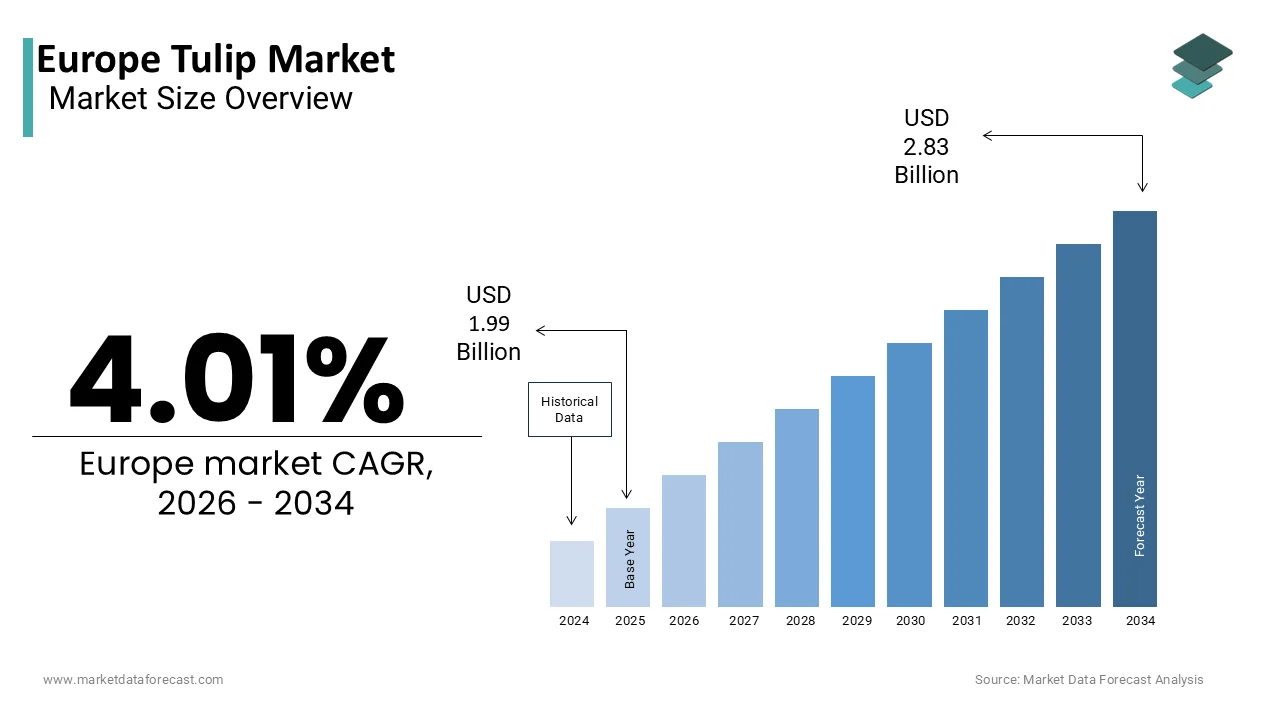
The Europe tulip market was valued at USD 1.99 billion in 2025, is estimated to reach USD 2.07 billion in 2026, and is projected to reach USD 2.83 billion by 2034, growing at a CAGR of 4.01% from 2026 to 2034.
Tulips are popular, spring-blooming perennial flowers in the Tulipa genus and lily family (Liliaceae), known for their large, cup-shaped, often bright-colored blooms. While tulips are grown across temperate regions of the continent, the Netherlands remains the epicenter of global production and distribution, leveraging centuries of horticultural expertise and advanced greenhouse technologies. Tulips hold deep cultural resonance in Europe, symbolizing spring renewal, and are featured prominently in national festivals, public gardens, and floral design. According to data published in 2025, the Netherlands (the primary EU producer) alone dedicated over 14,000 hectares to tulip cultivation in 2025, which accounts for over half of all flower bulb cultivation area in the country. As per the International Society for Horticultural Science and Dutch industry data, the Netherlands produces over 4 billion tulip bulbs annually, with a significant majority being exported worldwide either as bulbs or cut flowers. Beyond commerce, tulips contribute to urban greening initiatives. Cities across Europe, including Amsterdam and Vienna, invest heavily in public parks and green spaces as part of municipal biodiversity and urban wellbeing strategies. This blend of economic activity, cultural heritage, and ecological function positions the tulip not merely as a commodity but as a living emblem of European seasonal identity.
MARKET DRIVERS
Cultural Embedding in Seasonal Festivals and Public Landscaping
Tulips are intrinsically woven into the region’s annual cultural calendar, which fuels the growth of the European tulip market. They drive consistent demand through civic and community rituals. Each spring, cities across the continent host tulip festivals that attract millions of visitors. Keukenhof in the Netherlands alone welcomed 1.4 million guests in 2025, according to its official attendance records. Municipalities invest significantly in public bulb planting. Vienna’s municipal urban greening department invests significant public funds annually to plant millions of tulip bulbs across public parks and streets. Similarly, the Istanbul Tulip Festival features widespread displays of numerous tulip varieties, with Emirgan Park serving as a major venue drawing substantial crowds. These events are not merely tourist attractions but expressions of communal identity and seasonal celebration. Schools, churches, and local councils participate in bulb planting drives, fostering intergenerational engagement. This institutionalized cultural practice ensures stable baseline demand from public sector procurement, independent of consumer market fluctuations, and reinforces the tulip’s status as a non-discretionary element of European springtime aesthetics.
Expansion of Urban Greening and Therapeutic Horticulture Programs
The integration of tulips into mental health and urban sustainability agendas has opened new demand channels beyond traditional floristry, which further propels the expansion of theEuropeane tulip market. The European Commission’s Green City Accord encourages cities to improve biodiversity and increase urban green space by 2030, with seasonal planting, including bulbs, acting as a cost-effective method to enhance urban environments. European cities are increasingly incorporating therapeutic gardens, featuring spring-blooming bulbs, into schools, hospitals, and senior care facilities to support health and well-being. Research from Wageningen University indicates that incorporating spring-flowering bulbs into urban landscapes can improve the mental health and well-being of city dwellers. Furthermore, social prescribing programs in the UK and Sweden refer patients to community gardening projects where tulip cultivation is a core activity. The Royal Horticultural Society notes that early-blooming, colorful plants such as tulips are often used in therapeutic gardening to provide sensory stimulation and improve well-being. This alignment with public health and climate resilience policies transforms tulips from decorative items into instruments of social well-being, securing institutional funding and long-term planting commitments.
MARKET RESTRAINTS
Climate Instability Disrupting Bulb Vernalization Requirements
Tulip cultivation is highly sensitive to precise chilling periods during dormancy, a process known as vernalization, which restricts the growth of the European tulip market. This process requires sustained soil temperatures between 2 and 9 degrees Celsius for 12 to 16 weeks. Rising winter temperatures across Europe are increasingly disrupting this cycle. The Copernicus Climate Change Service indicates that European winter temperatures are consistently rising, leading to warmer winters that impact crop development and blooming cycles. Dutch growers have experienced fluctuations in bulb yield quality, with industry reports citing challenges to first-grade bulb production from a combination of unseasonal warmth, untimely frost, and heavy rainfall. Southern regions like Spain and Italy now face near total unsuitability for outdoor tulip production. Even controlled environment agriculture cannot fully compensate, as artificial cooling significantly increases energy costs and carbon footprint. This climatic mismatch threatens the geographic concentration of production and elevates input volatility, undermining the reliability of supply chains that global markets depend on.
Stringent Phytosanitary Regulations and Cross-Border Trade Barriers
Tulip exports face escalating phytosanitary scrutiny both within and outside the region, which increases compliance complexity and cost, and thereby hinders the European tulip market. This is despite EU harmonization. The European and Mediterranean Plant Protection Organization mandates rigorous testing for pests like the tulip breaking virus and nematodes, requiring certified disease-free stock and traceable propagation histories. Exported Dutch flower bulbs undergo rigorous, mandatory inspections for quality and pathogens, with documentation discrepancies and pathogen detections acting as major causes for shipment rejection by importing countries. New post-Brexit phytosanitary inspection requirements for Dutch horticultural products entering the UK have resulted in significant logistics bottlenecks, risking the quality of perishables and creating financial strain on supply chains. Additionally, countries like Germany and France enforce regional restrictions on certain cultivars deemed invasive. These regulatory layers fragment the single market, deter small growers from exporting, and inflate administrative overhead. Rising global biosecurity concerns threaten to make the tulip trade excessively bureaucratic and exclusionary, favoring only large-scale, integrated producers with dedicated compliance teams. Increased sanitary regulations may limit market access for smaller players.
MARKET OPPORTUNITIES
Development of Climate Resilient and Early Blooming Cultivars
Plant breeding innovations offer a strategic pathway to mitigate climate vulnerability and extend commercial relevance, which is likely to promote the growth of the European tulip market. Dutch research institutes like Wageningen University and private breeders such as Dümmen Orange have developed tulip varieties requiring shorter chilling periods, some as low as 8 weeks, while maintaining stem strength and flower longevity. Dutch bulb exporters are introducing new, pre-cooled tulip varieties tailored to thrive in warmer, milder winter climates by addressing the need for reduced natural chilling periods. These advances enable cultivation in previously marginal regions like Northern France and Southern England, diversifying production geography. Moreover, early blooming types allow staggered harvests, reducing labor bottlenecks during peak seasons. To meet the challenges of an unpredictable climate, breeders are developing high-end, "future-proof" product lines that guarantee spring color for municipal and commercial landscape projects.
Integration into Circular Economy and Pollinator-Friendly Landscaping
Tulips are being repositioned within ecological frameworks, which creates potential prospects for the European tulip market. These frameworks emphasize post-bloom utility and biodiversity support. New management protocols, promoted by the European Network of Botanic Gardens, advise leaving bulb foliage intact after blooming to nourish the plant for naturalization, departing from traditional annual treatment. This practice allows for better long-term plant health and sustainability. More significantly, late-season tulip varieties with open cup shapes provide early nectar sources for emerging pollinators. Cities adopting pollinator action plans, such as Berlin and Copenhagen, now specify tulip cultivars in municipal planting schemes based on pollen accessibility. Additionally, spent tulip biomass is being trialed as compost feedstock in closed-loop urban farming systems. This ecological reframing transforms tulips from transient ornaments into functional components of resilient urban ecosystems, unlocking public funding and aligning with EU biodiversity strategy targets for 2030.
MARKET CHALLENGES
Labor Shortages in Harvest and Post-Harvest Handling
Tulip production remains heavily reliant on manual labor for critical tasks, including bulb lifting, sorting, and grading, which challenges the growth of the European tulip market. These processes resist full mechanization due to bulb fragility and size variability. The Dutch horticultural sector continues to face challenges in securing adequate seasonal labor, driven by high demand and a tightening labor market, which has prompted increased reliance on foreign workers and automation to mitigate shortages. Harvest must occur within a narrow three-week window in summer; delays cause bulb desiccation or disease ingress, downgrading entire batches. Growers in key production regions, including Flevoland, have reported that labor shortages have created difficulties in harvesting, leading to potential, though unquantified, yield losses. High costs and limited dexterity hinder the adoption of robotic prototypes among small and medium-sized farms. This structural dependency on human labor creates bottlenecks that constrain scalability and increase wage pressure, threatening the economic viability of traditional bulb farming despite strong end-market demand.
Overreliance on Aesthetic Novelty and Short Product Lifecycles
Its dependence on rapidly shifting consumer preferences for color, form, and novelty causes inherent instability, which impedes the expansion of the European tulip market. Breeders introduce hundreds of new cultivars annually, yet most achieve commercial relevance for only 2 to 4 years before fading from catalogs. According to the Royal General Bulb Growers' Association, the tulip market is driven by the introduction of newer cultivars with unique aesthetic features, though established varieties still represent the majority of commercial trade due to the lengthy time required to develop and scale new bulbs. This churn complicates inventory planning for retailers and landscapers, who risk unsold stock when trends shift. Social media accelerates this cycle, viral colors like “millennial pink” or “mood violet” spike demand unpredictably, then collapse. Unlike perennial ornamentals with stable identities, tulips function as seasonal fashion items, making long-term brand loyalty difficult. The absence of mechanisms to extend product lifespans or base value on performance rather than aesthetics leaves the market susceptible to speculative overproduction and faddishness, thereby undermining grower profitability and supply chain stability.
REPORT COVERAGE
| REPORT METRIC | DETAILS |
| Market Size Available | 2025 to 2034 |
| Base Year | 2025 |
| Forecast Period | 2026 to 2034 |
| Segments Covered | By Type, Application, and Region. |
| Various Analyses Covered | Global, Regional, and Country-Level Analysis, Segment-Level Analysis, Drivers, Restraints, Opportunities, Challenges; PESTLE Analysis; Porter’s Five Forces Analysis, Competitive Landscape, Analyst Overview of Investment Opportunities |
| Countries Covered | UK, France, Spain, Germany, Italy, Russia, Sweden, Denmark, Switzerland, Netherlands, Turkey, Czech Republic, Rest of Europe |
| Market Leaders Profiled | Royal Anthos, Royal FloraHolland, Jan de Wit en Zonen B.V., Van den Bos Flowerbulbs B.V., De Ree Holland B.V., JUB Holland, Boot & Co Boomkwekerijen B.V., Vletter & Den Haan B.V., Stoop Flowerbulbs, Holland Bulb Market, Eurobulb B.V., Gardenia Bulb Company |
SEGMENTAL ANALYSIS
By Type Insights
The fresh tulips segment dominated the European tulip market and accounted for a substantial share in 2025. The dominance of the segment is driven by the centrality of cut flowers in European gifting culture, seasonal celebrations, and commercial floristry. Fresh tulips are deeply embedded in European social rituals, from Valentine’s Day and Easter to graduation ceremonies and municipal welcome gestures. Tulips are among the most popular spring flowers for households across Europe. The tulip is a major cultural icon in the Netherlands, celebrated with a national, public-picking event to mark the start of the season. Similarly, hospitals across Germany and Scandinavia use fresh tulips in patient rooms to signal recovery and renewal, with procurement contracts ensuring weekly deliveries. The emotional resonance of vibrant, ephemeral blooms, symbolizing hope and transience, makes them irreplaceable in moments of personal and civic significance. Unlike bulbs, which require planning and cultivation knowledge, fresh tulips offer immediate aesthetic impact, aligning with contemporary preferences for instant gratification and visual storytelling on social media. The professional floral industry relies heavily on fresh tulips for their versatility, color range, and affordability. Due to their seasonal availability and visual appeal, tulips are popular, particularly for spring wedding arrangements in Europe. Event planners in cities like Paris, Milan, and Amsterdam specify tulips for corporate launches and fashion shows, valuing their minimalist form and photogenic quality. Royal FloraHolland is a major international auction hub, where tulips consistently rank as one of the top categories of cut flowers handled. The development of long vase life cultivars such as ‘Fancy Frills’ and ‘Menton’ has extended usability to 10–14 days, reducing waste and enhancing value. This seamless integration into high-volume commercial channels ensures consistent demand that far exceeds the cyclical, knowledge-intensive nature of bulb sales.
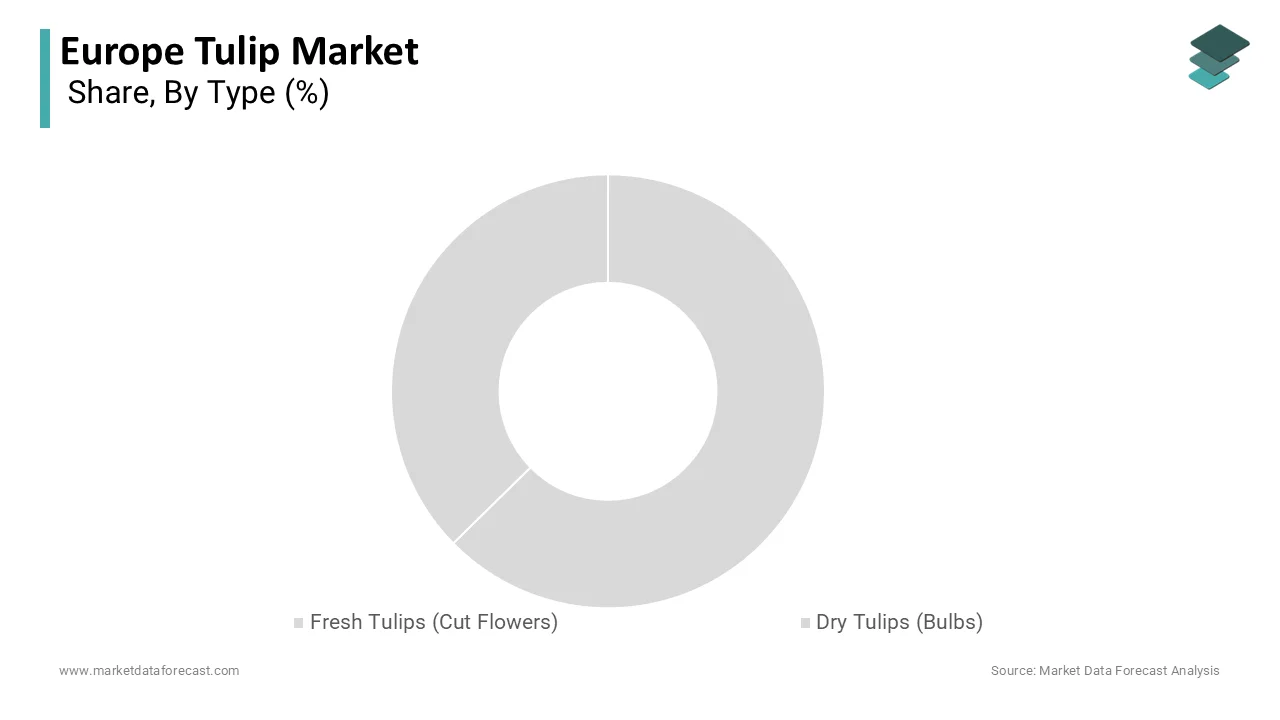
The dry (bulb) tulip segment is anticipated to witness the fastest CAGR of 6.3% from 2026 to 2034 due to the rise of home gardening and climate-conscious landscaping, and the expansion of educational and therapeutic horticulture programs. Post-pandemic, European households have embraced gardening as both a leisure activity and climate action. Eurostat reports a growing interest in sustainable, urban gardening and plant-based consumption across EU households. Tulip bulbs are a gateway product due to ease of planting and dramatic visual payoff. Municipalities amplify this trend through “Plant Your City” initiatives. Berlin is implementing urban nature initiatives, including public tulip planting and festivals, to increase urban biodiversity and improve climate adaptation. Crucially, new climate-resilient cultivars requiring shorter chilling periods enable successful cultivation in regions previously deemed unsuitable, such as Southern England and Northern France. The Royal Horticultural Society reports that environmental concerns, specifically supporting pollinators, are increasingly driving consumer decisions, shifting trends from solely aesthetic, ornamental gardening to ecological intent. This values-driven adoption transforms bulb purchases from seasonal impulse buys into intentional acts of environmental stewardship. Schools, care homes, and mental health facilities increasingly use tulip bulb planting as a pedagogical and therapeutic tool. The European Commission's education partnerships are encouraging schools to integrate green spaces and sustainable education, featuring diverse plantings to enhance environmental awareness. In Sweden, the National Board of Health recommends horticultural therapy for anxiety disorders, with bulb planting a core activity due to its tactile engagement and delayed reward structure. Many European Botanic Gardens are increasingly hosting community-led autumn planting events to promote public engagement and education, fostering, in part, intergenerational participation. These institutional programs create stable autumn demand spikes independent of retail trends, while also cultivating future generations of informed consumers who prioritize quality and origin, key drivers of premium bulb sales.
By Application Insights
The commercial applications segment led the European tulip market and captured a 65.6% share in 2025. The leading position of the segment is attributed to the scale of institutional procurement for hospitality, events, and public spaces. Hotels, restaurants, and corporate offices maintain year-round floral budgets that prioritize seasonal relevance and brand aesthetics. High-end European hotels frequently use fresh tulips as part of their seasonal spring decor in public areas. Major corporations like Siemens and Novartis contract florists for weekly office arrangements, with tulips favored for their clean lines and color versatility. Event agencies handling trade fairs in Frankfurt, Milan, and Barcelona specify thousands of stems per event. Messe Frankfurt incorporates significant floral arrangements, including tulips, to enhance the ambiance of its trade exhibitions during spring. This B2B demand is less price sensitive and more volume-driven than home consumption, creating predictable revenue streams for growers and wholesalers. Long-term contracts often include sustainability clauses, pushing suppliers toward certified eco-friendly production methods. Municipal governments across Europe allocate significant funds to seasonal floral displays as part of urban well-being strategies. Major European cities with high tourist appeal, such as Amsterdam, implement extensive annual tulip planting campaigns in public spaces to boost seasonal tourism and enhance urban aesthetics. A large proportion of European cities implement municipal spring bulb planting programs as part of their urban landscaping and tourism promotion strategies. These projects are increasingly designed with ecological criteria, selecting pollinator-friendly varieties and avoiding chemical treatments. The scale of public procurement dwarfs individual home gardening, making commercial application the structural backbone of the tulip economy despite the cultural visibility of domestic use.
The home application segment is likely to experience the fastest CAGR of 7.1% over the forecast period, owing to the growth of mindful living and domestic aesthetic curation, and democratization through subscription and direct-to-consumer models. European consumers are increasingly viewing home environments as sanctuaries for mental restoration, with fresh flowers playing a central role. Younger city residents are increasingly purchasing fresh flowers to improve their mental well-being and enhance the aesthetic appeal of their living spaces. Visual platforms like Instagram and Pinterest have significantly boosted the popularity of seasonal floral decor, with hashtags related to spring styling and tulip arrangements seeing high engagement across European audiences. Retailers respond with curated bundles. Also, retailers like Lidl have seen strong consumer interest in affordable, bundled floral products that combine seasonal blooms with decorative containers during the spring months. Unlike commercial buyers focused on cost per stem, home users prioritize uniqueness, seeking rare parrot or fringed varieties through specialty florists. This emotional and aesthetic engagement fosters brand loyalty and willingness to pay premiums, creating high-margin opportunities for growers who differentiate through variety exclusivity and storytelling. Digital platforms have lowered barriers to consistent home tulip consumption. Companies like Bloom & Wild and Fleurop offer weekly or seasonal subscription boxes featuring hand-tied tulip bouquets with care instructions and vase life extenders. Online floral subscription services are experiencing a period of expansion, with tulips frequently cited as one of the fastest-growing and most sought-after varieties for spring deliveries. These models provide convenience, reduce decision fatigue, and build habitual purchasing. Additionally, Dutch bulb exporters now sell directly to consumers via e-commerce, offering pre-selected mixes for balcony containers or cutting gardens. This bypassing of traditional retail not only improves margins but also enables personalized communication about planting times and care, transforming one-time buyers into engaged hobbyists. The result is a self-reinforcing cycle of accessibility, education, and repeat purchase that accelerates home segment growth beyond seasonal spikes.
By Distribution Channel Insights
The supermarkets and hypermarkets segment was the largest segment in the European tulip market and held a 52.7% share in 2025. The supremacy of the segment is credited to accessibility, pricing power, and impulse purchase dynamics. Supermarkets like Carrefour, Tesco, and Albert Heijn integrate fresh tulips into everyday shopping journeys, placing them near entrances or checkout lanes to trigger spontaneous purchases. These retailers leverage volume buying power to secure a consistent supply from Dutch auctions at competitive rates, enabling promotions like “buy one get one free” during peak season. Packaging innovations, such as water-filled travel sleeves and recyclable wraps, enhance convenience and reduce damage. Crucially, supermarkets normalize tulip ownership across income groups, transforming what was once a luxury gift into an affordable weekly ritual. This democratization sustains baseline demand even during economic downturns, as consumers trade down from expensive bouquets to single-variety bunches. Major retailers coordinate tulip promotions with broader spring campaigns, linking them to Easter eggs, gardening tools, or picnic ware to boost basket size. Their vertically integrated logistics ensure daily replenishment, minimizing waste through dynamic markdown algorithms. Unlike florists who rely on artisanal sourcing, supermarkets benefit from standardized grading and bulk handling, reducing per-unit costs. This operational efficiency allows them to absorb minor price fluctuations in wholesale markets, maintaining stable shelf prices that build consumer trust. The result is a self-sustaining ecosystem where scale, convenience, and predictability reinforce supermarket leadership in tulip distribution.
The online retail segment is on the rise and is expected to be the fastest-growing segment in the market by witnessing a CAGR of 18.4% during the forecast period. The swift expansion of the segment is propelled by personalization, gifting convenience, sustainability, transparency, and direct farmer connections. Online platforms excel in solving the core pain points of traditional flower gifting, last-minute needs, geographic distance, and customization. Advanced filtering allows buyers to select by vase life, color symbolism, or sustainability certification, options unavailable in physical stores. AI-driven recommendations further enhance relevance, suggesting complementary items like chocolates or candles. This precision and convenience resonate particularly with millennials and Gen Z, who prefer digital transactions and value transparency in sourcing. The ability to schedule recurring deliveries, for birthdays or anniversaries, creates sticky subscription relationships that drive lifetime customer value far beyond one-off purchases. E-commerce enables unprecedented storytelling about origin and ethics. Online retailers prominently display farm locations, carbon footprint metrics, and fair labor certifications, appealing to conscious consumers. Bloom & Wild’s “Letters to Farmers” program, where customers send notes to Dutch growers, humanizes the supply chain and builds emotional connection. Additionally, online channels facilitate the sale of niche products, such as organic or heirloom tulip varieties, that lack shelf space in supermarkets. Direct-to-consumer bulb sellers like DutchGrown provide planting guides, bloom trackers, and community forums, transforming transactions into educational journeys. This depth of engagement fosters trust and loyalty, allowing online players to command premium pricing while simultaneously reducing intermediaries and food miles. Digital literacy is growing, and last-mile logistics are improving. Because of this, online retail is poised to reshape tulip consumption from transactional to relational.
COMPETITIVE LANDSCAPE
TheEuropeane tulip market features a concentrated yet dynamic competitive landscape dominated by Dutch cooperatives, global breeders, and specialized exporters. Royal FloraHolland maintains structural influence through its auction and logistics infrastructure, while breeders like Dümmen Orange compete on genetic innovation and intellectual property. Smaller growers differentiate via organic certification or heritage varieties but face pressure from scale economies. Competition is intensifying in sustainability credentials, with brands vying for eco labels and carbon transparency. The rise of direct-to-consumer channels disrupts traditional wholesale models, empowering agile players with digital capabilities. Despite strong Dutch dominance, emerging producers in France and Germany are gaining niche traction through regional storytelling and pollinator-friendly positioning. Overall, success hinges on balancing horticultural excellence with digital engagement and environmental accountability in an increasingly values-driven marketplace.
KEY MARKET PLAYERS
Some of the companies that are playing a dominating role in the global europe tulip market include
- Royal Anthos
- Royal FloraHolland
- Jan de Wit en Zonen B.V.
- Van den Bos Flowerbulbs B.V.
- De Ree Holland B.V.
- JUB Holland
- Boot & Co Boomkwekerijen B.V.
- Vletter & Den Haan B.V.
- Stoop Flowerbulbs
- Holland Bulb Market
- Eurobulb B.V.
- Gardenia Bulb Company
TOP LEADING PLAYERS IN THE MARKET
- Headquartered in the Netherlands, Royal FloraHolland is the world’s largest flower auction cooperative and a pivotal force in the European tulip market. It connects growers with buyers across numerous countries, handling more than a billion cut flowers annually, including a significant volume of tulips. The cooperative provides integrated logistics, quality certification, and digital trading platforms that ensure freshness and traceability. Their move strengthens trust among eco-conscious retailers and aligns with EU deforestation and green procurement regulations, reinforcing its role as the backbone of global tulip distribution.
- Based in the Netherlands, Dümmen Orange is a leading global breeder and propagator of ornamental plants, including innovative tulip varieties. The company holds an extensive portfolio of proprietary tulip cultivars known for extended vase life, disease resistance, and unique color patterns. Dümmen Orange supplies bulbs and tissue culture materials to growers across Europe, North America, and Asia. These varieties address warming winter challenges and expand viable cultivation zones, enhancing grower reliability and securing long term supply stability in a changing climate.
- Operating from Aalsmeer in the Netherlands, Bakker Brothers is a major exporter of tulip bulbs and cut flowers with a strong direct-to-consumer presence across Europe and North America. The company specializes in retail-ready packaging, seasonal gift sets, and e-commerce fulfillment. It also launched an interactive online planting planner that recommends tulip varieties based on local soil and climate data. These initiatives deepen customer engagement, reduce environmental impact, and position the brand as a digitally enabled, sustainability-focused leader in the global tulip trade.
TOP STRATEGIES USED BY THE KEY MARKET PARTICIPANTS
Key players in the European tulip market are investing heavily in climate-resilient breeding to counter warming winters and ensure reliable flowering cycles. They are implementing blockchain and digital traceability systems to verify sustainable and ethical production for retailers and consumers. Direct-to-consumer e-commerce platforms are being enhanced with personalized planting tools and subscription models to build loyalty. Companies are adopting carbon-neutral logistics through electric delivery and optimized shipping routes. Additionally, strategic partnerships with municipalities and educational institutions promote bulb planting programs that drive long-term demand and public engagement with tulip cultivation.
MARKET SEGMENTATION
This research report on the europe tulip market is segmented and sub-segmented into the following categories.
By Type
- Fresh Tulips (Cut Flowers)
- Dry Tulips (Bulbs)
By Application
- Commercial Applications
- Hospitality (Hotels & Restaurants)
- Corporate Offices
- Events & Exhibitions
- Public & Municipal Landscaping
- Home Applications
By Variety
- Single Early
- Double Early
- Triumph
- Darwin Hybrid
- Parrot
- Fringed
- Others
By Distribution Channel
- Supermarkets & Hypermarkets
- Florists / Specialty Flower Shops
- Garden Centers & Nurseries
- Online Retail
- Direct-to-Consumer (DTC)
By Country
- Netherlands
- Germany
- France
- United Kingdom
- Italy
- Spain
- Sweden
- Rest of Europe
Related Reports
Access the study in MULTIPLE FORMATS
Purchase options starting from
$ 2000
Didn’t find what you’re looking for?
TALK TO OUR ANALYST TEAM
Need something within your budget?
NO WORRIES! WE GOT YOU COVERED!
Call us on: +1 888 702 9696 (U.S Toll Free)
Write to us: sales@marketdataforecast.com