Global Industrial Turbocharger Market Size, Share, Trends, & Growth Forecast Report, Segmented By Application (Automotive, Aerospace & Defence, Marine and Others Applications), Fuel Type (Diesel and Gasoline), Technology (Twin-Turbo, Variable Geometry and Wastegate Technology), & Region, Industry Forecast From 2026 to 2034
Global Industrial Turbocharger Market Size
The global industrial turbocharger market was valued at USD 11.85 billion in 2025 and is anticipated to reach USD 12.93 billion in 2026 to reach USD 25.95 billion by 2034, growing at a CAGR of 9.1% from 2026 to 2034.

A turbocharger is an internal combustion (IC) engine that improves performance by increasing air intake in the combustion chamber using ejected burnt air. An IC engine requires extra air to add additional combustion fuel for colossal power output, which reduces efficiency; consequently, turbochargers play an essential role in boosting efficiency by supplying compressed air.
MARKET DRIVERS
The growth of the global industrial turbocharger market is majorly driven by the enhanced engine performance and fuel efficiency, regulatory requirements, and engine downsizing to reduce vehicle weight.
During the forecast period, however, the increase in demand for fuel-efficient engines and gasoline engines is expected to augment the expansion of the industrial turbocharger market. The global turbocharger market is predicted to increase significantly in the future years, as these chargers ensure optimal engine performance and improved fuel efficiency. Turbochargers, in particular, work best at high engine speeds and do not require any other power source to operate. Various countries around the world have made aggressive steps to minimize emissions and reliance on non-renewable energy resources. The turbocharger primarily helps in the reduction of vehicle emissions. Using a turbocharger reduces the displacement volume of the cylinder, lowering the volume of fuel required for the same output and, as a result, lowering the vehicle's exhaust emissions. It also improves fuel efficiency.
Because of these factors, the demand for the adoption of turbocharger technology has increased. Because of the elimination of turbo lag, electric turbochargers provide higher power and improved fuel efficiency. It offers numerous advantages and presents fewer technical challenges. It also reduces the need for maintenance and cooling oil. Because of the multiple benefits that e-turbo offers and the growing desire for improved fuel efficiency and power output, it will have greater market penetration in the future years. The industry is being driven by the increasing advantages of industrial turbochargers over naturally aspirated engines of comparable energy capacity. Industry turbochargers have a substantially higher energy proportion than naturally aspirated engines
Additionally, they are powered by an exhaust system. As a result, the net energy usage of a turbocharged unit is less than an aspirated unit. Customers' rising knowledge of novel technology and purchasing power is propelling the global market.
MARKET RESTRAINTS
Factors such as increased shared mobility, growing oil prices, high vehicle pricing, and rising emphasis on marketing electric vehicles are primarily hampering the growth of the industrial turbocharger market.
Numerous technological concerns with turbochargers continue to hinder their market expansion. Because installation is a critical aspect in the proper operation of a turbocharger, any mistake during installation renders the turbocharger ineffective and affects the engine. As a result, the compatibility of turbochargers with engines is an issue that requires careful consideration. In addition, the rise of electric or battery-powered cars is a significant limitation on the industrial turbocharger market. BEV (battery electric vehicles) is expected to replace traditional passenger vehicles shortly, severely constraining the industrial turbocharger market. Furthermore, turbocharger installation and excessive rise in engine temperature due to overheating concerns in turbochargers are projected to hamper the turbocharger market's growth.
REPORT COVERAGE
| REPORT METRIC | DETAILS |
| Market Size Available | 2025 to 2034 |
| Base Year | 2025 |
| Forecast Period | 2026 to 2034 |
| CAGR | 9.1% |
| Segments Covered | By Product, End User, and Region. |
| Various Analyses Covered | Global, Regional & Country Level Analysis, Segment-Level Analysis, DROC, PESTLE Analysis, Porter’s Five Forces Analysis, Competitive Landscape, Analyst Overview on Investment Opportunities |
| Regions Covered | North America, Europe, APAC, Latin America, Middle East & Africa |
| Market Leaders Profiled | Honeywell International Inc., Mitsubishi Heavy Industries Ltd., BorgWarner Inc., Rotomaster International, Precision Turbo & Engine. Some other key Players of the Market include Bosch Mahle Turbo System GmbH & Co. KG, IHI Corporation, Eaton Corporation PLC, Cummins Inc., Continental AAGG and Others. |
SEGMENTAL ANALYSIS
By Product Insights
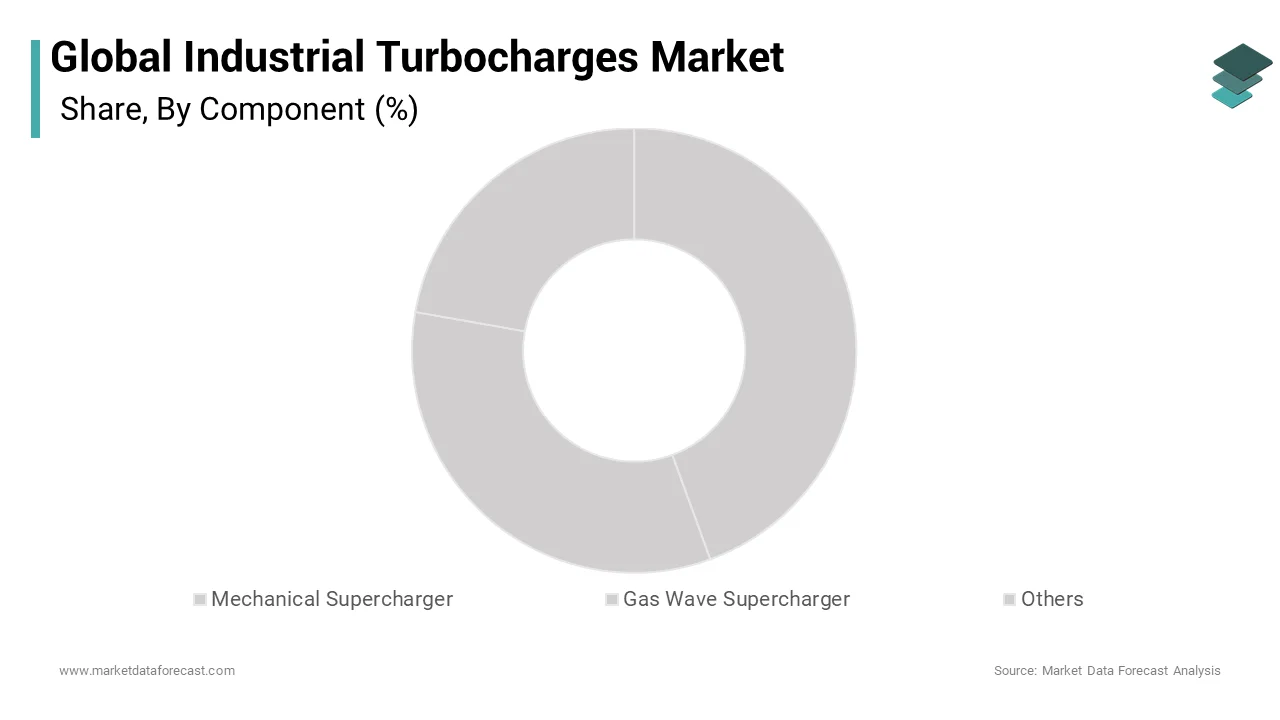
Due to cutting-edge technology in the turbocharger business, it is expected that gasoline turbochargers will unlock the sector's potential.
This enables market participants participating in the industrial turbochargers company to create new opportunities. A gasoline turbocharger is a device that increases the efficiency and power output of an engine's internal combustion by pumping more air into the combustion chamber. A turbocharger can improve an engine's performance. It allows more oxygen to enter the combustion chamber by compressing the air. Thus, in terms of fuel, an engine's power output rises. The market for gas wave superchargers will be driven by an increase in demand for gasoline engines in light-duty cars. The diesel turbocharger market has grown since practically all commercial vehicles are diesel-powered, and almost all of them have turbochargers. As a result, demand for gasoline turbochargers is rapidly increasing. TGDI in gasoline vehicles has boosted the market for gasoline turbochargers, and demanding emission standards will continue to push the market. As pollution rules become more stringent, OEMs are transitioning toward CNG or alternative fuel cars, even in heavy commercial trucks. Though alternative fuel vehicle penetration is modest, benefits including improved fuel efficiency, cleaner energy, and cheaper costs than standard fuels are expected to stimulate demand for these vehicles shortly. This would also change the need for turbochargers.
By End-User Insights
Among other end users, Agriculture is expected to be the fastest-growing segment.
Turbochargers are essential components of off-road vehicles such as construction vehicles and agricultural tractors. According to industrial analysts, low-horsepower tractors do not have turbochargers installed, whereas practically all high-horsepower tractors do. Alternatively, turbochargers are projected to be installed in almost all construction equipment. Because electrification in OHV equipment is expected to be limited for at least the next 4-5 years, demand for OHV turbochargers is unlikely to be impacted shortly. As a result, the construction equipment market has expanded significantly, particularly in rising markets like China and India.
REGIONAL ANALYSIS
The Asia Pacific remains the world's leading producer of industrial turbochargers. Given the development of production units in China, experts anticipate strong growth in global industrial turbocharger production in the coming years. China, Japan, India, and South Korea are significant industrial turbocharger producers. The presence of important players operating in the market has widened the possibilities for turbochargers. The Chinese are very interested in installing turbochargers in their cars, and as of 2017, over 75% of the Chinese vehicles are equipped with turbochargers, which is promoting the Asia-Pacific Industrial Turbocharger Market.
KEY MARKET PLAYERS
Companies such are playing a leading role in the global industrial turbocharger market.
- Honeywell International Inc.
- Mitsubishi Heavy Industries Ltd.
- BorgWarner Inc.
- Rotomaster International
- Precision Turbo & Engine
- Bosch Mahle Turbo System GmbH & Co. KG
- IHI Corporation
- Eaton Corporation PLC
- Cummins Inc.
- Continental AG
RECENT MARKET NEWS
- BorgWarner is delivering its regulated two-stage (R2S) turbocharger for Daimler's latest 2.9-liter six-cylinder inline diesel engine OM 656, initially featured in the upgraded Mercedes-Benz S-Class released in 2017. BorgWarner's breakthrough turbocharging technology meets the requirements of cutting-edge engine designs. In addition, BorgWarner's breakthrough turbocharging technology improves torque, performance, and exhaust gas recirculation rates even under full-load conditions while dramatically lowering emissions.
- Rheinmetall, a German automotive parts supplier, announced a deal with a lifetime value of more than €90 million (about Rs 626 crore) from a giant American carmaker for a new generation of divert-air valves. This arrangement satisfies the customer's need for local production, which is planned to begin in 2018. The contract will be in effect for six years. A US automaker will put the divert-air valves in a high-volume production series developed in other countries.
- Continental's first turbocharger with the groundbreaking RAAX (stands for "radial-axial") turbine technology is now in production on the Audi A3's new 2.0-liter gasoline engine (2.0l TFSI EA888, generation 3B).
MARKET SEGMENTATION
This research report on the global industrial charger market has been segmented and sub-segmented based on product, end-user, and region.
By Product
- Mechanical Supercharger
- Gas Wave Supercharger
- Others
By End-User
- Marine
- Agriculture
- Construction and Mining
- Power Generation
- Oil and Gas
- Others
By Region
- North America
- Europe
- Asia-Pacific
- Latin America
- Middle East and Africa
Frequently Asked Questions
How do industrial turbochargers enhance engine performance in heavy-duty applications?
Industrial turbochargers increase engine power by forcing more air into the combustion chamber for improved efficiency.
What factors are driving the growth of the industrial turbocharger market?
Rising demand for fuel-efficient engines and high-performance industrial machinery is boosting market growth.
Which industries commonly use industrial turbochargers?
Industries such as power generation, marine, oil and gas, and construction widely use turbocharger systems.
Why are turbochargers important in industrial engines?
They improve engine efficiency and output without significantly increasing engine size.
How do industrial turbochargers support fuel efficiency?
They optimize air-fuel combustion, allowing engines to generate more power with less fuel consumption.
What types of turbochargers are commonly used in industrial applications?
Single-stage and multi-stage turbochargers are widely used depending on performance requirements.
What challenges affect the industrial turbocharger market?
High maintenance costs and complex engineering requirements can impact adoption.
How is technology influencing turbocharger design and performance?
Advancements in materials and aerodynamics are improving durability and efficiency.
Which regions show strong demand for industrial turbochargers?
Regions with heavy industrial activity and infrastructure development show higher demand.
What future trend is expected in the industrial turbocharger market?
Increasing focus on energy-efficient and emission-reducing technologies is expected to drive market growth.
Related Reports
Access the study in MULTIPLE FORMATS
Purchase options starting from
$ 2500
Didn’t find what you’re looking for?
TALK TO OUR ANALYST TEAM
Need something within your budget?
NO WORRIES! WE GOT YOU COVERED!
Call us on: +1 888 702 9696 (U.S Toll Free)
Write to us: sales@marketdataforecast.com