Global Optical Transceiver Market Research Report By Form Factor (SFF & SFP; SFP+ & SFP28; QSFP, QSFP+, QSFP14, & QSFP28; CFP, CFP2, & CFP4; XFP, and CXP), By Wavelength (850 nm Band, 1310 nm Band, 1550 nm Band, and Other), and Region (North America, Europe, Asia-Pacific, Latin America, Middle East and Africa) – Industry Analysis (2024 to 2029). By Data rates (Less Than 10 Gbps, 10 Gbps to 40 Gbps, 41 Gbps to 100 Gbps, and More Than 100 Gbps), By Fiber Type (Single-mode and Multimode), By Distance (Less than 1Km, 1 Km to 10 Km, 11 Km to 100 Km, and More Than 100 Km), By Connector (LC, SC, MPO, and RJ-45), By Application (Telecommunication, Data Center, and Enterprise) – and Region (North America, Europe, Asia-Pacific, Latin America, Middle East and Africa) – Industry Analysis (2025 to 2033).
Global Optical Transceiver Market Size
The global optical transceiver market was valued at USD 6.56 billion in 2024, is expected to reach USD 7.44 billion in 2025, and is growing at a CAGR of 13.46% It is projected to reach USD 20.42 billion by 2033.

An optical transceiver is a self-contained module that converts electrical signals into optical pulses for transmission over fiber and vice versa upon reception, serving as the fundamental interface between digital infrastructure and photonic networks. These modules are engineered to precise wavelength, power, and modulation standards to ensure interoperability across data centers, telecom networks, and enterprise systems. According to studies, the vast majority of global internet backbone traffic now traverses fiber optic links, with each endpoint requiring at least one transceiver for signal conversion. As per the IEEE, modern hyperscale data centers deploy more than two hundred thousand transceivers per facility to sustain spine leaf architectures operating at four hundred gigabits per second and beyond. As per Cisco's annual networking index, global IP traffic reached multiple zettabytes in recent years, a volume that could not be managed without continuous densification of optical interfaces. The U.S. Department of Energy and other research entities confirm that optical transceivers account for a significant percentage of total power draw in next-generation data centers, which makes energy efficiency a critical design parameter. Their role has evolved from passive components to intelligent edge devices capable of real-time performance, telemetry, and self-calibration.
MARKET DRIVERS
Accelerating deployment of hyperscale data centers is compelling exponential transceiver volume growth.h
The global proliferation of hyperscale computing facilities is a major driver of the optical transceiver market. This is because each server rack and network switch requires multiple high-speed interfaces to sustain throughput. According to studies, hyperscale data centers are expanding globally, with a consistent increase in new facilities. These modern data centers incorporate a large number of optical transceivers, essential components for high-speed data transfer within their architecture, particularly to support advanced AI training and other demanding workloads. Major cloud service providers are continuously increasing their network capacity, driving a consistent need for new and replacement optical transceivers across their global infrastructure. The ongoing need for equipment replacement, due to both technological advancements and necessary maintenance, represents a significant portion of the total annual capital expenditure for high-tier data center operations. This structural dependency ensures that transceiver demand scales directly with compute expansion, irrespective of economic cycles.
MARKET RESTRAINTS
Supply chain fragility for specialized photonic components is constraining production scalability and delivery reliability ty.
Its reliance on a narrow set of suppliers for critical subcomponents such as indium phosphide lasers, lithium niobate modulators, and athermal arrayed waveguide gratings is a factor that constrains the expansion of the optical transceiver market. High-performance laser diodes for high-speed networking are highly concentrated among a small number of global manufacturers, many of which are located in areas subject to geopolitical or natural disaster risks, as per sources. This concentration has previously led to significant supply chain disruptions, including lengthy shipment delays following the implementation of export controls and extended global shortages resulting from natural disasters at key production facilities. The industry's reliance on these few critical suppliers poses ongoing vulnerabilities to the stability of high-speed transceiver availability for major cloud providers. Concurrently, as per the International Energy Agency, gallium and germanium, essential for III-V semiconductor fabrication, face supply concentration risks, with China producing over eighty percent of global refined output. These structural bottlenecks force transceiver vendors into long-term allocation agreements and inventory stockpiling, inflating costs and delaying customer deployments despite strong demand.
MARKET OPPORTUNITIES
Coherent optics penetration into metro and edge networks unlocks new volume markets beyond traditional data centers.
The migration of coherent transmission technology from long-haul backbone networks into metro access and enterprise edge environments is creating an opportunity for the growth of the optical transceiver market. According to research, the optical networking industry is experiencing a significant shift towards the adoption of pluggable coherent transceivers in metro optical networks due to their cost-effectiveness and flexibility compared to traditional fixed embedded optics. Major network equipment manufacturers like Nokia are increasingly integrating high-capacity 400G ZR coherent pluggables into metro networks to manage the growing traffic from 5G xHaul and fiber deep network expansions, as per various studies. In addition, the market share of coherent pluggables in regional and access networks is experiencing rapid growth, driven by standardization efforts (like those from the OIF and ETSI) and an increasing demand for higher bandwidth. Besides, large service providers such as AT&T are deploying coherent optical technology to extend the reach of their fiber-to-the-premises (FTTP) networks efficiently, reducing the need for costly signal regeneration sites over long distances. This architectural shift transforms coherent optics from a niche and high-cost solution into a volume product category, which expands the addressable market beyond hyperscalers to include regional carriers, cable MSOs, and private network operators.
MARKET CHALLENGES
Thermal and power density limitations at 800G and 1.6T interfaces are impeding performance scaling and reliability.
Thermal management and electrical power constraints are emerging as fundamental barriers to stable operation, which in turn hinders the growth of the optical transceiver market. This is because optical transceivers advance beyond four hundred gigabits toward eight hundred gigabits and one point six terabit speeds. According to the OIF Implementation Agreement for eight hundred gigabit modules, peak power consumption exceeds sixteen watts per unit, generating thermal loads that exceed conventional switch faceplate dissipation capacities. Early deployments of high-speed transceivers often require augmented cooling solutions to maintain reliable performance and prevent signal degradation. Moreover, module performance rapidly degrades as temperature increases, potentially rendering advanced prototypes commercially unviable without substantial thermal management redesign. Physical design limits are being reached as electrical connector density increases at these speeds, making crosstalk management a critical and increasingly difficult issue. These physics-bound constraints are forcing a multi-year R and D cycle focused on co-packaged optics and silicon photonics, delaying volume adoption and fragmenting technology roadmaps across vendors.
REPORT COVERAGE
| REPORT METRIC | DETAILS |
| Market Size Available | 2024 to 2033 |
| Base Year | 2024 |
| Forecast Period | 2025 to 2033 |
| Segments Covered | By Form Factor, Wavelength, Data Rates, Type, Distance, Connector, Application, and Region. |
| Various Analyses Covered | Global, Regional, and Country-Level Analysis, Segment-Level Analysis, Drivers, Restraints, Opportunities, Challenges; PESTLE Analysis; Porter’s Five Forces Analysis, Competitive Landscape, Analyst Overview of Investment Opportunities |
| Countries Covered | North America, Europe, APAC, Latin America, Middle East & Africa |
| Market Leaders Profiled | FIT Hong Teng Limited (Taiwan), Lumentum (US), Sumitomo Electric Industries Ltd (Japan), Accelink (China), Applied Optoelectronics (US), Fujitsu Optical Components (Japan), Innolight (China), Mellanox (Israel), NeoPhotonics (US), Ciena (US), Cisco (US), Hisense Broadband (China), Intel (US), NEC (Japan), Perle Systems (Canada), Reflex Photonics (Canada), Smartoptics (Norway), Solid Optics (US), Source Photonics (US), and Others. |
SEGMENTAL ANALYSIS
By Form Factor Insights
The QSFP segment held the leading share of 49.3% of the global optical transceiver market in 2024. Its optimal balance of port density, power efficiency, and backward compatibility in modern data center architectures propels the growth of the QSFP segment. The hyperscale industry’s relentless pursuit of higher bandwidth per rack unit is also a key driver of this segment. QSFP28 interfaces have become a dominant choice for high-speed network uplinks in major technology infrastructures. This form factor, standardized across the industry, allows for significantly increased faceplate density compared to earlier networking modules. Hyperscale cloud providers, such as Microsoft Azure, are widely integrating QSFP28 ports into their latest generation spine switches to achieve high aggregate throughput and improved power efficiency per gigabit. Industry analysis suggests that adopting QSFP-based architectures can lead to reduced capital expenditures for network deployments when compared to legacy technologies. This economic and spatial efficiency, coupled with hot swappability and MSA standardization, has entrenched QSFP as the default choice for cloud operators and enterprise adopters alike.
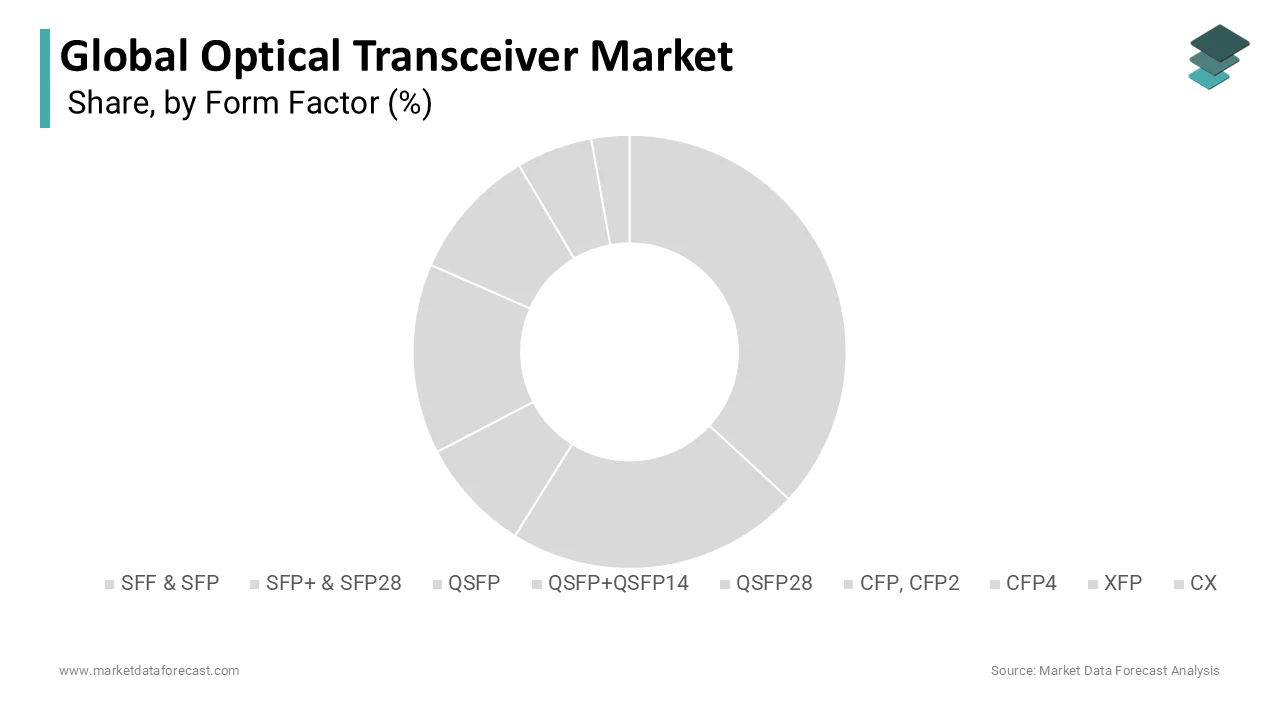
The OSFP and QSFP DD segment is estimated to register the fastest CAGR of 37.4% from 2025 to 2033 due to the architectural demands of artificial intelligence training clusters and next-generation switch ASICs. Unlike legacy QSFP28, these newer form factors support eight electrical lanes instead of four, enabling native eight hundred gigabit transmission without gearbox complexity. The NVIDIA DGX SuperPOD reference architecture for H100 systems, published in 2023, uses NVIDIA's proprietary InfiniBand technology for the main compute fabric, which primarily utilizes the OSFP form factor in its Quantum-2 switches. Broadcom's Tomahawk 5 switch chip is a 51.2 Tbps chip, and it supports both QSFP-DD and OSFP modules (typically 800G) to achieve its high line rates. OSFP and QSFP DD are the prevailing form factors for high-speed network modules, together dominating shipments of 800-gigabit technology in the industry. These specific module types are the current standards for modern infrastructure, notably used extensively in AI training clusters across major data centers to handle the growing demands of artificial intelligence workloads. This segment’s growth is not speculative; it is structurally mandated by the physics of AI compute scaling.
By Wavelength Insights
The 1310 nm band segment was the largest segment in the optical transceiver market and accounted for a 43.2% share in 2024. Factors such as its zero dispersion characteristics in standard single-mode fiber and cost-effective reach for metro and campus applications are mainly contributing to the supremacy of the 1310 nm band segment. An additional driver of this segment is its dominance in enterprise and carrier access networks, where distances between three hundred meters and forty kilometers are typical. Enterprise switch deployments frequently integrate 1310 nm SFP+ modules for uplink connectivity. 1310 nm transceivers are a fundamental component of fiber-to-the-building installations across major European nations. In Asia, 5G transport networks heavily rely on 1310 nm bidirectional transceivers for fronthaul connections. The wavelength’s maturity, component availability, and alignment with existing fiber infrastructure make it the default choice for cost-sensitive, medium-reach applications, a position unlikely to be displaced despite advances in coherent pluggables.
The 1550 nm coherent pluggable segment is anticipated to witness the fastest CAGR of 41.2% during the forecast period, owing to the convergence of IP and optical layers through ZR and ZR+ interoperability standards. Unlike traditional 1550 nm fixed optics, these modules embed full coherent DSPs into QSFP DD and OSFP housings, enabling direct router-to-router connectivity over eighty to one hundred and twenty kilometers without external transponders. Network architecture updates increasingly focus on integrating advanced coherent pluggable technology in metro IP edge deployments, as per studies. Industry agreements confirm broad interoperability among numerous vendors for the four-hundred-gigabit ZR standard. Major network operators are achieving significant reductions in operational complexity within their metro networks by transitioning from legacy transponders to pluggable coherent optics. Leading networking equipment manufacturers report that the vast majority of their high-capacity router shipments are now configured with four hundred gigabit ZR interfaces. This architectural simplification, combined with falling DSP costs and rising spectral efficiency, is transforming coherent optics from a backbone specialty into a volume metro product.
By Data Rate Insights
The 41 Gbps to 100 Gbps segment led the optical transceiver market and occupied a 38.4% share in 2024. The supremacy of the 41 Gbps to 100 Gbps segment is attributed to widespread enterprise network upgrades and mobile xHaul deployments. A different yet important driver of this segment is the transition from ten-gigabit and forty-gigabit legacy infrastructure to one hundred-gigabit as the new baseline for aggregation and core layers. Most global 5G midhaul and fronthaul deployments utilize one hundred gigabit gray optics. A majority of large global companies have upgraded their data center fabric to one hundred gigabit spine-leaf architectures. Standardization has significantly reduced the pricing of networking modules. A major Indian telecommunications provider deployed hundreds of thousands of one-hundred-gigabit transceivers to support a nationwide 5G rollout. This segment’s dominance reflects not peak innovation but pervasive, volume-driven infrastructure modernization.
The more than 100 Gbps segment is likely to experience the fastest CAGR of 49.8% between 2025 and 2033. The swift expansion of the more than 100 Gbps segment is propelled by exponential bandwidth demands from generative AI training clusters and hyperscale inter-data center links. NVIDIA's DGX H100 systems feature eight 400 gigabit per second (Gb/s) external network interconnects per system, using InfiniBand or Ethernet for cluster communication in a SuperPOD. Google's Cloud TPU v5e pods consist of 256 chips interconnected via high-speed interfaces, and the architecture supports extremely large distributed training jobs across tens of thousands of chips using efficient data center networking and the JAX framework. Meta's data centers are rapidly adopting 400 gigabit per second (Gb/s) optical transceivers as the primary solution for intra-data center links and are expanding their use of different variants optimized for various distances. The OIF's 800ZR Implementation Agreement, released in October 2024, defines the specifications for interoperable 800 gigabit per second (Gb/s) coherent optical interfaces capable of transmission over single-span DWDM links of up to 120 kilometers for data center interconnect applications. This segment’s growth is not cyclical; it is algorithmically driven by the insatiable data appetite of transformer-based neural networks.
By Application Insights
The data center segment dominated the global optical transceiver market by capturing a share of 52.4% in 2024. The leading position of the data center segment is fuelled by relentless hyperscale capacity additions and the physical networking requirements of artificial intelligence compute clusters. The primary driver is the architectural shift toward distributed training, where thousands of GPUs must communicate at near memory bandwidth speeds. Leading cloud providers are deploying a massive number of optical transceivers and have significant optical switching capacity. The replacement cycle for optical transceivers in AI data centers is becoming shorter, indicating a faster pace of technology upgrades. There is a substantial deployment of high-bandwidth optical modules to meet the demands of AI workloads. This segment’s dominance is structural. Every additional petaflop of AI compute demands proportional growth in photonic interconnects.
The telecom segment is on the rise and is expected to be the fastest-growing segment in the market by witnessing a CAGR of 33.7% from 2025 to 2033 due to 5G radio access network densification and the migration of coherent optics into metro aggregation layers. The primary catalyst is the shift from CPRI to eCPRI fronthaul, which requires higher bandwidth and lower latency interfaces. According to the Ericsson Mobility Report, global 5G subscriptions reached 1.6 billion by the end of 2023. Deutsche Telekom is actively engaged in modernizing its network, including expanding its fiber footprint, to support future demands like 5G. Major carriers like AT&T are increasingly adopting advanced optical technologies and pushing fiber deeper into their networks to manage growing data traffic and enhance network performance. This growth is not speculative; it is mandated by national broadband plans and spectrum auction obligations.
REGIONAL ANALYSIS
North Optical Transceiver Market Analysis
North America outperformed other regions in the global optical transceiver market and accounted for a 39.4% share in 2024. The demand for optical transceivers in North America is driven by its concentration of hyperscale cloud providers and pioneering artificial intelligence infrastructure. The United States is the primary driver of regional demand for high-speed transceivers. Major technology companies are deploying a significant number of high-speed transceivers annually. Specific AI computing deployments require a large quantity of high-capacity optical modules per installation. Optical interfaces represent a substantial portion of the overall power consumption in facilities optimized for AI operations. The telecom sector in a major northern North American country has increased its adoption of coherent pluggable technology to facilitate 5G network expansion. This region’s dominance is not just scale-based; it is innovation-led, setting global benchmarks for speed, density, and intelligence in optical interconnects.
Asia Pacific Optical Transceiver Market Analysis
Asia Pacific was the second most prominent region in the optical transceiver market and captured a 34.3% share in 2024 because of nationwide 5G deployments and the rise of regional cloud titans. Major Chinese telecom operators are deploying significant numbers of optical transceivers to support their extensive 5G networks. In addition, Indian telecom companies are deploying optical transceivers to support their 5G network expansion. Moreover, Japanese companies are adopting new types of optical transceivers for their metro networks to simplify architecture. Besides, South Korean telecom companies are building advanced, fully optical data centers to support AI workloads. The region’s growth is structurally diverse, spanning telecom, cloud, and enterprise, ensuring sustained momentum.
Europe Optical Transceiver Market Analysis
Europe remains a major player in the optical transceiver market, with aggressive adoption of coherent pluggables in metro networks and regulatory pressure for energy-efficient data centers. Deutsche Telekom is modernizing its network across Germany by replacing older optical technology with high-speed modules to decrease energy consumption per bit. In France, Orange has introduced numerous high-speed, pluggable modules to support its expansive fiber infrastructure buildout. Industry organizations have established new standards for higher-speed modules, promoting the use of compatible equipment from various manufacturers. Regulations within the EU require data centers to achieve greater energy efficiency, which is driving the adoption of faster, more power-efficient network components. Major technology companies are deploying hundreds of thousands of the latest generation of high-speed modules in their large data center regions across Europe. Europe’s influence lies not in volume but in standardization and sustainability leadership.
Latin America Optical Transceiver Market Analysis
Latin America is expanding rapidly in the optical transceiver market due to recent 5G spectrum auctions and hyperscale cloud region launches. Brazil's telecom agency has facilitated the deployment of 5G infrastructure, leading major carriers to install a significant number of high-capacity transceivers for fronthaul. Mexico's primary telecom providers have substantially increased their optical interface deployments to meet growing network demands. Major cloud service providers have established new data center regions in key Latin American cities, requiring the initial deployment of a large volume of high-speed transceivers. Argentina's regulatory body has approved the use of coherent pluggable technology in metro networks, allowing for greater efficiency and reach. Colombia is experiencing a notable rise in enterprise data center upgrades, a trend driven primarily by the adoption of hybrid cloud strategies. Though smaller in scale, the region’s growth is policy-catalyzed and structurally irreversible.
Middle East and Africa Optical Transceiver Market Analysis
The Middle East and Africa region is predicted to expand in the optical transceiver market between 2025 and 2033, with growth concentrated in sovereign cloud initiatives and subsea cable landing stations. Saudi Arabia is advancing artificial intelligence capabilities with a major AI data center project in NEOM. The United Arab Emirates is supporting its Smart Dubai initiative by widely deploying high-speed coherent pluggable modules for its backbone network. South African telecommunication companies are significantly scaling up transceiver deployments to meet the demands of their 5G transport networks. Though starting from a low base, the region’s combination of sovereign digital infrastructure and geographic connectivity positioning creates a unique, policy-driven growth vector.
COMPETITIVE LANDSCAPE
The optical transceiver market features fierce competition among vertically integrated manufacturers, fabless module designers, and contract assembly specialists, all vying for design slots in hyperscale, telecom, and enterprise infrastructure. Incumbents compete on time to market, thermal performance, and firmware intelligence rather than pricing alone. The race to eight hundred gigabit and one point six terabit interfaces has fragmented technology roadmaps, with some vendors betting on co-packaged optics while others pursue pluggable evolution. Patent portfolios around DSP algorithms and laser modulation techniques create legal moats. Regional players gain share by tailoring products to local 5G spectrum plans and fiber plant characteristics. Strategic alliances with cloud operators and equipment OEMs lock in multi-year supply agreements. Competition is increasingly nonlinear, spanning semiconductor process technology, mechanical design, and embedded software capabilities.
KEY MARKET PLAYERS
Some of the companies that are playing a dominating role in the global optical transceiver market include
- FIT Hong Teng Limited (Taiwan)
- Lumentum (US)
- Sumitomo Electric Industries Ltd (Japan)
- Accelink (China)
- Applied Optoelectronics (US)
- Fujitsu Optical Components (Japan)
- Innolight (China)
- Mellanox (Israel)
- NeoPhotonics (US), Ciena (US)
- Cisco (US)
- Hisense Broadband (China)
- Intel (US)
- NEC (Japan)
- Perle Systems (Canada)
- Reflex Photonics (Canada)
- Smartoptics (Norway)
- Solid Optics (US)
- Source Photonics (US)
TOP LEADING PLAYERS IN THE MARKET
- II-VI Incorporated, now operating under Coherent Corp, delivers high-performance optical transceivers leveraging vertically integrated indium phosphide and silicon photonics platforms. The company supplies critical components and full modules to hyperscalers and telecom equipment manufacturers globally. It also expanded its wafer-scale testing capacity in Pennsylvania to accelerate the yield ramp for coherent DSPs. Its close collaboration with NVIDIA and Cisco embeds its optics into next-generation AI and routing architectures, reinforcing technical leadership through co-engineering rather than commoditized volume.
- Innolight Technology Corporation specializes in high-density, low-power optical transceivers for hyperscale data centers and telecom transport networks. The company is a primary supplier to major cloud operators in North America and Asia. It also opened a new R and D center in Hangzhou, focused on co-packaged optics for switch ASIC integration. Innolight’s strategy emphasizes early sampling with tier one customers, locking in design wins before mass production, ensuring its solutions are embedded in next-generation infrastructure roadmaps.
- Applied Optoelectronics Inc. focuses on cost-optimized, high-reliability transceivers for enterprise and 5G wireless transport applications. The company leverages proprietary laser design and automated assembly to serve price-sensitive yet performance-critical segments. It also secured qualification in multiple Tier 1 telecom operator supply chains across Europe and Southeast Asia. Applied Optoelectronics invests in application-specific firmware to enable plug-and-play interoperability, reducing deployment friction and building long-term customer dependency through operational ease rather than pure speed metrics.
TOP STRATEGIES USED BY KEY MARKET PARTICIPANTS
Leading players in the optical transceiver market prioritize co-development partnerships with hyperscalers and switch ASIC vendors to embed their modules into next-generation system architectures before general availability. They vertically integrate critical components such as laser diodes and DSPs to secure supply and reduce bill of materials volatility. Geographic expansion targets regions with active 5G rollouts and new cloud region announcements to capture first-mover advantage. Investment in thermal and power efficiency R and D addresses the critical bottleneck in AI cluster scaling. Certification under multi-source agreements and OIF interoperability standards ensures seamless multi-vendor deployment. Early sampling programs lock in design wins eighteen to twenty-four months ahead of volume production. Differentiation now hinges on firmware intelligence, real-time telemetry, and field upgradability rather than raw speed alone.
MARKET SEGMENTATION
This research report on the global optical transceiver market is segmented and sub-segmented into the following categories.
By Form Factor
- SFF & SFP
- SFP+ & SFP28
- QSFP
- QSFP+QSFP14
- QSFP28
- CFP, CFP2
- CFP4
- XFP
- CX
By Wavelength
- 850 nm Band
- 1310 nm Band
- 1550 nm Band
- Other 850 nm Band
- 1310 nm Band
- 1550 nm Band
By Data Rates
- Less Than 10 Gbps
- 10 Gbps to 40 Gbps
- 41 Gbps to 100 Gbps
- More Than 100 Gbps
By Type
- Single-mode
- Multi-mode
By Distance
- Less than 1Km
- 1 Km to 10 Km
- 11 Km to 100 Km
- More Than 100 Km
By Connector
- LC
- SC
- MPO
- RJ-45
By Application
- Telecommunication
- Data Center
- Enterprise
By Region
- North America
- Europe
- Asia-Pacific
- South America
- Middle East & Africa
Frequently Asked Questions
1. How will the Global Optical Transceiver Market evolve with the expansion of 5G technology?
The Global Optical Transceiver Market will see significant growth due to the need for low latency and high bandwidth connections essential for 5G infrastructure.
2. Which regions are expected to dominate the Global Optical Transceiver Market by 2033?
Asia-Pacific is projected to be the fastest-growing region within the Global Optical Transceiver Market, driven by rapid digitalization, telecom infrastructure expansion, and government initiatives.
3. How does data center growth influence the Global Optical Transceiver Market?
The expansion of hyperscale data centers significantly boosts the Global Optical Transceiver Market by increasing demand for high-speed and reliable optical transceivers.
4. What technological advancements are shaping the Global Optical Transceiver Market?
Innovations such as silicon photonics, coherent pluggable modules, and 800G optical transceiver technologies are key trends driving the Global Optical Transceiver Market.
5. What challenges could impact the Global Optical Transceiver Market growth?
High costs, network complexity, and component supply issues are some challenges that could limit the rapid growth of the Global Optical Transceiver Market.
6. How do optical transceivers support telecom network upgrades in the Global Optical Transceiver Market?
Optical transceivers enable critical components for fronthaul, midhaul, and backhaul in telecom networks, supporting upgrades and 5G rollout within the Global Optical Transceiver Market.
7. What role does energy efficiency play in the Global Optical Transceiver Market?
Demand for compact, energy-efficient optical transceivers is a major factor driving growth in the Global Optical Transceiver Market.
8. Which key companies lead the Global Optical Transceiver Market?
Prominent players in the Global Optical Transceiver Market include Broadcom Inc., Cisco Systems, Lumentum Holdings, and Coherent Corp.
9. How important is fiber optic technology to the Global Optical Transceiver Market?
Fiber optic technology is fundamental to the Global Optical Transceiver Market, providing the necessary infrastructure for high-speed optical data transmission.
10. What end-use industries benefit the most from the Global Optical Transceiver Market?
Industries such as telecommunications, data centers, cloud computing, and emerging 5G networks are primary beneficiaries driving the Global Optical Transceiver Market.
Related Reports
Access the study in MULTIPLE FORMATS
Purchase options starting from
$ 2500
Didn’t find what you’re looking for?
TALK TO OUR ANALYST TEAM
Need something within your budget?
NO WORRIES! WE GOT YOU COVERED!
Call us on: +1 888 702 9696 (U.S Toll Free)
Write to us: sales@marketdataforecast.com