Global Smart Toys Market Size, Share, Trends, & Growth Forecast Report By Interfacing Devices (Smartphone Connected, Tablet Connected, Others Such As Console Connected), By Technology (Wi-Fi, Bluetooth and NFC & RFID), By Distribution Channel (Online Stores, Specialty Stores, and Convenience Stores) and Regional - (2025 to 2033)
Global Smart Toys Market Size
The global smart toys market was worth USD 11.14 billion in 2024. The global market is predicted to reach USD 12.92 billion in 2025 and USD 42.20 billion by 2033, growing at a CAGR of 15.95% during the forecast period.

MARKET DRIVERS
The rise in disposable income among middle-income groups is one of the major driving factors of the global Smart Toys market growth rate.
Another crucial factor of the Smart Toys market was technological advancements from various companies to build creative and interactive toys that attract children. Increasing demand for novel technologies like AR, VR, smart homes, and connected mobile devices is a few of the growth-promoting factors for the Smart Toys business in terms of revenue rate.
Another prominent growth driving factor of the global Smart Toys market is the rapid increase in the women workforce around the globe. Increasing awareness of smart toys and the availability of different types of products for indoor and outdoor sports and education boosts the growth of the global market for smart toys.
MARKET RESTRAINTS
The high cost of the manufacturing equipment is the critical factor that hinders the growth of the global Smart Toys Market. Another major restraint that is affecting the development of the market of Smart Toys is the availability of cheap alternative products.
REPORT COVERAGE
| REPORT METRIC | DETAILS |
| Market Size Available | 2024 to 2033 |
| Base Year | 2024 |
| Forecast Period | 2025 to 2033 |
| CAGR | 15.95% |
| Segments Covered | By Interfacing Devices, Technology, Distribution Channel, and Region. |
|
Various Analyses Covered | Global, Regional & Country Level Analysis, Segment-Level Analysis, DROC, PESTLE Analysis, Porter’s Five Forces Analysis, Competitive Landscape, Analyst Overview on Investment Opportunities |
| Regions Covered | North America, Europe, APAC, Latin America, Middle East & Africa |
|
Market Leaders Profiled | Lego Group, Mattel Inc., Leapfrog Enterprises, Inc., Pillar Learning, Sega Toys Co. Ltd, and Others. |
REGIONAL ANALYSIS
Europe holds a significant share of the market due to the rapid integration of technology in various products and offerings, which is supposed to promote the growth of the market for Smart Toys in European nations. Furthermore, increasing investments by major players in Europe is also one of the major driving factors that propel the growth of the market of Smart Toys in this area.
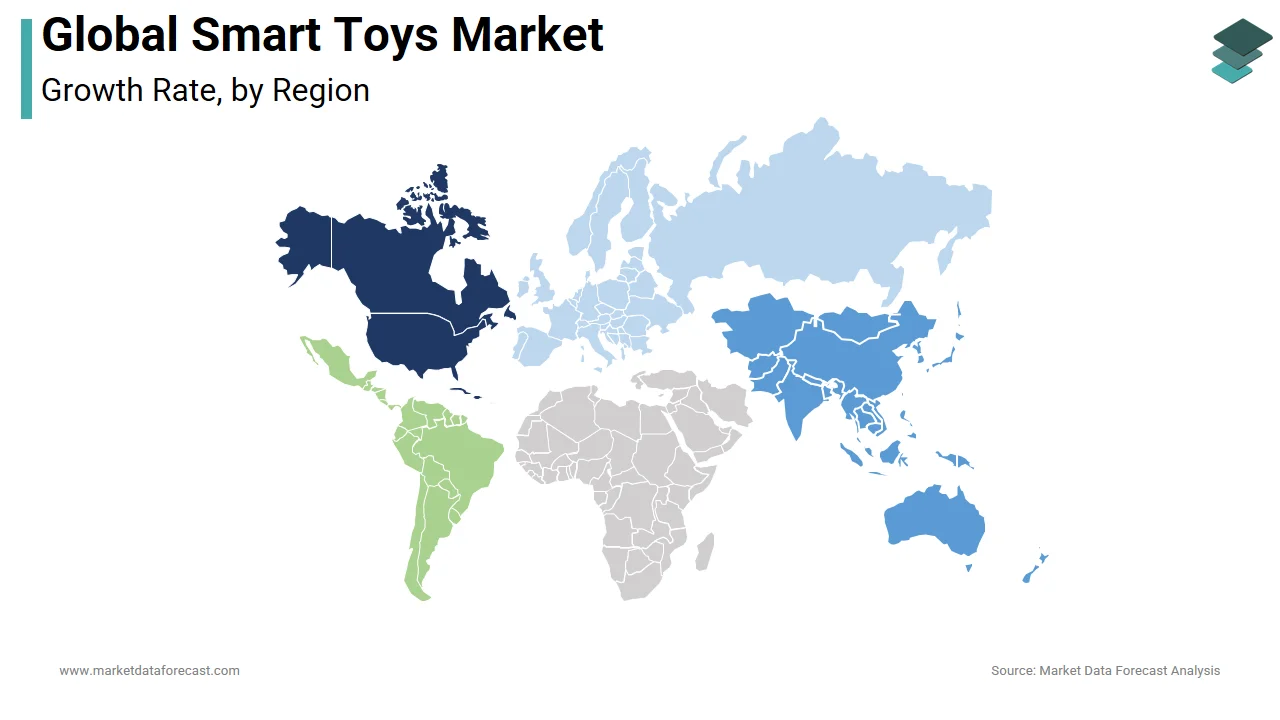
The Asia Pacific region holds the second largest share of the Smart Toys market, following Europe, owing to the increasing adoption of technologies like AR, VR, smart homes, etc., which is likely to help the market of Smart Toys grow further in Asia Pacific nations like India, China, etc.
North America is expected to record an increase in the market value of Smart Toys because of the rising investment in new product innovation by companies from the United States and Mexico in the coming years.
KEY MARKET PLAYERS
Some of the key players in the Smart Toys market are Lego Group, Mattel Inc., Leapfrog Enterprises, Inc., Pillar Learning, and Sega Toys Co. Ltd.
RECENT MARKET HAPPENINGS
-
In January 2020, the PlayShifu toy company launched new products, including Shifu Tacto.
-
In June 2019, Mattel Inc. launched a new product named Hot Wheels ID, which brings together physical and digital play in a mixed play experience with uniquely identified vehicles, a smart race portal, a smart track, and a digital hub to build a personalized fleet to measure performance.
MARKET SEGMENTATION
The global Smart Toys market is segmented based on interfacing devices, based on technology,distribution channel and region.
By Interfacing Device
- Smartphone Connected
- Tablet Connected
- Console Connected
By Technology
- Wi-Fi
- Bluetooth
- NFC
- RFID
By Distribution Channel
- Online Stores
- Specialty Stores
- Specialty Stores
By Region
- North America
- Europe
- Asia-Pacific
- Latin America
- The Middle East and Africa
Frequently Asked Questions
How is the smart toys market responding to concerns regarding children's privacy and data security?
Market players are increasingly focusing on implementing robust data encryption, strict privacy policies, and parental controls in smart toys to address privacy and security concerns. Additionally, industry stakeholders are actively collaborating with regulatory bodies to establish comprehensive guidelines and standards for data handling in children's products.
How are advancements in artificial intelligence (AI) influencing the evolution of smart toys?
AI advancements are driving the development of interactive and personalized smart toys capable of adapting to children's preferences and learning patterns. These toys offer immersive play experiences, foster cognitive development, and facilitate interactive learning through real-time feedback and adaptive content.
What role do environmental sustainability concerns play in the design and production of smart toys?
Increasing consumer awareness and environmental consciousness are driving market players to prioritize sustainable materials, eco-friendly packaging, and energy-efficient designs in smart toys. Additionally, initiatives promoting toy recycling, refurbishment, and extended product lifecycles are gaining traction to reduce environmental impact.
How are traditional toy manufacturers transitioning into the smart toys market?
Traditional toy manufacturers are embracing digital transformation by integrating smart technologies into their product lines, partnering with tech companies for expertise, and investing in research and development to create innovative smart toys that combine traditional play value with interactive features.
Related Reports
Access the study in MULTIPLE FORMATS
Purchase options starting from
$ 2500
Didn’t find what you’re looking for?
TALK TO OUR ANALYST TEAM
Need something within your budget?
NO WORRIES! WE GOT YOU COVERED!
Call us on: +1 888 702 9696 (U.S Toll Free)
Write to us: sales@marketdataforecast.com