Global Sulfuric Acid Market Size, Share, Trends & Growth Forecast Report Segmented By, Raw Material Type (Elemental Sulfur, Pyrite Ore, and Other Raw Material Types), Production Process, Concentration, End-User Industry, and Region (North America, Europe, Asia Pacific, Latin America, Middle East, and Africa), Industry Analysis from 2025 to 2033
Global Sulfuric Acid Market Size
The global sulfuric acid market size was valued at USD 15.45 billion in 2024, and the market size is expected to be worth USD 22.13 billion by 2033 from USD 16.08 billion by 2025. The market is growing at a CAGR of 4.07% during the forecast period.

Sulfuric acid is the backbone of modern industrial metabolism. Its molecular utility spans phosphate fertilizer synthesis, metal leaching in mining, petroleum refining, and chemical intermediates for dyes, detergents, and explosives. According to the U.S. Geological Survey, global sulfur production — the primary feedstock — exceeded 85 million metric tons in 2023, with over 90% destined for sulfuric acid manufacturing. Its omnipresence is such that national industrial output is often indirectly measured by sulfuric acid consumption.
MARKET DRIVERS
Surging Global Demand for Phosphate Fertilizers
The inexorable link between sulfuric acid and phosphate fertilizer production is major driving factor for the growth of the sulfuric acid market. Sulfuric acid is indispensable in converting phosphate rock into phosphoric acid, the precursor to monoammonium and diammonium phosphate fertilizers. According to the Food and Agriculture Organization of the United Nations, global fertilizer consumption is projected to reach 205 million metric tons by 2026, with phosphates constituting nearly 45% of this volume. As per the International Fertilizer Development Center, India’s phosphatic fertilizer imports surged by 17% year-over-year in 2023, which is directly correlating with a 1.2 million metric ton increase in sulfuric acid demand.
Expansion of Hydrometallurgical Processing in Minerals Extraction
The global pivot toward electrification and decarbonization has intensified mining of copper, nickel, cobalt, and lithium is also to enhance the growth of sulfuric acid market. According to the International Energy Agency, global copper demand alone is forecast to double by 2040, reaching 50 million metric tons annually, primarily driven by EV and grid infrastructure needs. Similarly, Indonesia’s nickel laterite processing, which uses high-pressure acid leaching with sulfuric acid, consumed over 2.1 million metric tons in 2023, according to Indonesia’s Ministry of Energy and Mineral Resources.
MARKET RESTRAINTS
Environmental Regulatory Stringency on Emissions and Waste Handling
Sulfuric acid production and utilization are intrinsically tied to sulfur dioxide emissions and acidic waste streams is restricting the growth of sulfuric acid market. According to the European Environment Agency, sulfur dioxide emissions from chemical manufacturing in the EU declined by 89% between 1990 and 2022, largely due to mandated scrubbing technologies and emission caps.
Volatility in Sulfur Feedstock Supply Chains
The sulfuric acid’s production is overwhelmingly dependent on elemental sulfur, which is primarily sourced as a byproduct of oil refining and natural gas processing. According to the U.S. Energy Information Administration, global sulfur production from petroleum and gas sources declined by 6.3% in 2023 due to reduced crude throughput in OECD nations and accelerated adoption of low-sulfur fuel standards under IMO 2020. Simultaneously, OPEC+ production cuts constrained sour crude volumes, which is the richest source of recoverable sulfur.
MARKET OPPORTUNITIES
Circular Integration of Smelter Off-Gases into Acid Production
The non-ferrous metal smelters particularly copper, zinc, and lead are integrated into acid production, which is one of the new opportunities for the growth of sulfuric acid market. According to the International Council on Mining and Metals, approximately 70% of global sulfuric acid supply already originates from smelter gas capture, yet significant untapped potential remains in Africa and Central Asia. This model not only mitigates emissions but converts a waste liability into a profit center. Scaling this circular approach globally could add over 8 million metric tons of acid capacity by 2030 without new sulfur inputs.
Strategic Localization of Acid Production in Fertilizer-Deficit Regions
Regions with high agrarian demand but minimal acid production capacity notably West Africa, Southeast Asia, and parts of Latin America is also to elevate the growth of the sulfuric acid market. According to the Alliance for a Green Revolution in Africa, sub-Saharan Africa imports over 90% of its sulfuric acid requirements, incurring 30–40% logistics premiums. Similarly, Indonesia’s Petrokimia Gresik commissioned a 3,000 metric ton-per-day acid plant in East Java in early 2024 to serve its domestic NPK fertilizer complex, as per Indonesia’s state-owned enterprise ministry. Localized production slashes supply chain fragility and enhances food system sovereignty.
MARKET CHALLENGES
Corrosion Management and Infrastructure Degradation in Handling and Transport
Sulfuric acid’s extreme corrosivity imposes formidable engineering and maintenance burdens across storage, transport, and application systems, which is degrading the growth of sulfuric acid market. According to the National Association of Corrosion Engineers, global industry loses an estimated $2.5 trillion annually to corrosion — with sulfuric acid environments among the most aggressive. In mining operations, acid-resistant alloy linings in leaching tanks and pipelines must be replaced every 3–5 years, adding 15–20% to operational expenditure, as per technical audits by Hatch Ltd. Material science innovation remains inadequate to fully mitigate lifecycle costs, constraining scalability in remote or capital-constrained regions.
Geopolitical Disruptions in Sulfur and Acid Trade Flows
The increasing vulnerable to geopolitical realignments that disrupt established trade corridors is also to limit the growth of sulfuric acid market. According to the Observatory of Economic Complexity, Russia supplied 18% of the EU’s sulfur imports in 2021, but post-2022 sanctions rerouted flows, creating regional shortages. Morocco, which relies on Russian sulfur for 40% of its acid production, faced a 23% production shortfall in 2023, as per Morocco’s Office Cherifien des Phosphates. These disruptions force end-users into volatile spot markets or costly substitutions, which is fragmenting global supply cohesion and exposing downstream industries to systemic risk.
REPORT COVERAGE
| REPORT METRIC | DETAILS |
| Market Size Available | 2024 to 2033 |
| Base Year | 2024 |
| Forecast Period | 2025 to 2033 |
| CAGR | 4.07% |
| Segments Covered | By Raw Material Type, Production Process, Concentration, End-User Industry, and Region. |
| Various Analyses Covered | Global, Regional & Country Level Analysis, Segment-Level Analysis, DROC, PESTLE Analysis, Porter’s Five Forces Analysis, Competitive Landscape, Analyst Overview of Investment Opportunities |
| Regions Covered | North America, Europe, APAC, Latin America, Middle East & Africa |
| Market Leaders Profiled | The Mosaic Company, AkzoNobel N.V., BASF SE, PVS Chemical Solution, Solvay, Agrium Inc., INEOS, and Others. |
SEGMENTAL ANALYSIS
By Raw Material Type Insights
The elemental sulfur segment was accounted in holding a dominant share of the sulfuric acid market in 2024. According to the U.S. Geological Survey, over 85 million metric tons of sulfur were recovered globally in 2023, with 92% of that volume sourced from petroleum refineries and natural gas processing plants industries that generate sulfur as a mandated byproduct under global desulfurization regulations. As per the International Energy Agency, global refinery sulfur production grew by 3.1% in 2023 despite crude throughput declines, due to stricter fuel sulfur caps under IMO 2020. Elemental sulfur’s purity is exceeding 99.9% in merchant-grade form minimizes catalyst poisoning and plant downtime, making it the default choice for integrated fertilizer and mining complexes.
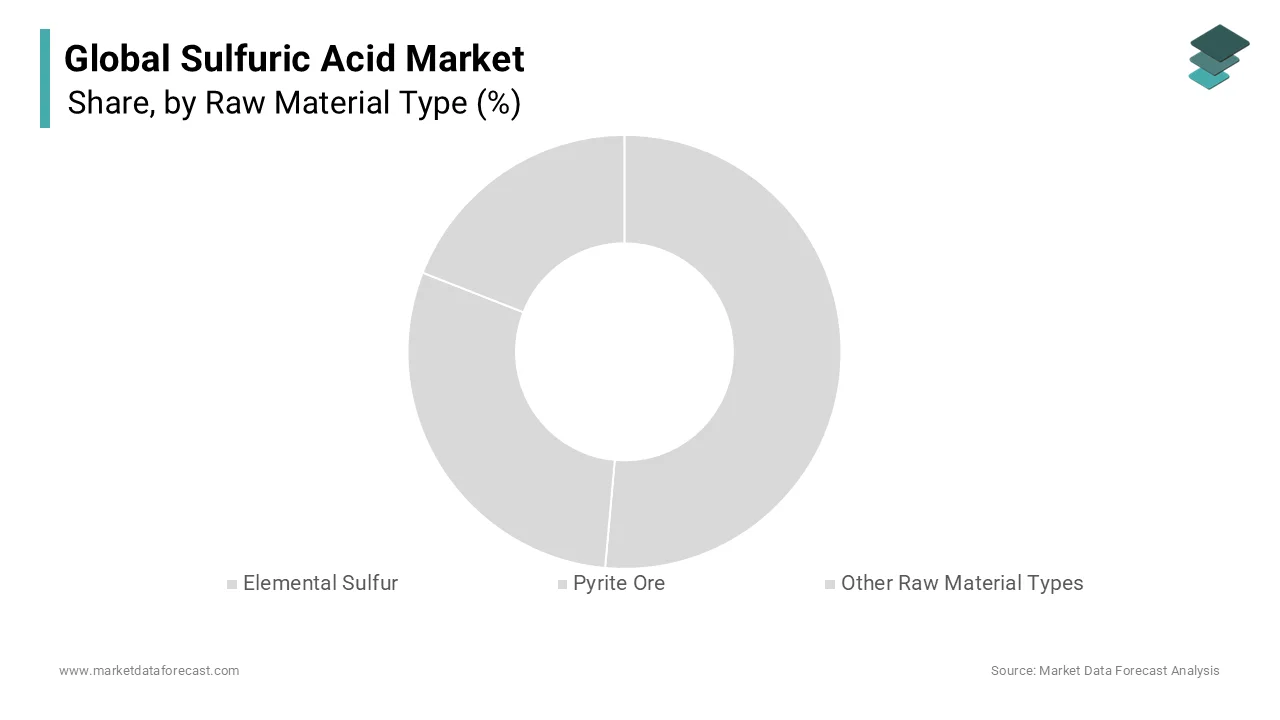
The pyrite ore segment is lucratively growing with an expected CAGR of 4.7% during the forecast period due to preference but necessity as sulfur supply chains fracture and geopolitical tensions constrain trade, regions lacking refinery-linked sulfur are turning to indigenous pyrite reserves. According to China’s Ministry of Natural Resources, pyrite-based sulfuric acid capacity in Anhui and Jiangxi provinces expanded by 12% in 2023 alone, which is driven by localized fertilizer demand and import substitution policies. India’s Geological Survey reports that pyrite mining in Rajasthan increased by 18% year-over-year in 2023 to feed acid plants serving the state’s phosphate rock beneficiation facilities.
By Production Process Insights
The DCDA process segment held a dominant share of the sulfuric acid market in 2024. According to the European Chemical Industry Council, DCDA achieves sulfur dioxide conversion efficiencies exceeding 99.7%, a threshold mandated under EU Industrial Emissions Directive 2010/75/EU. In contrast, single contact processes hover near 97–98%, releasing unacceptable volumes of SO₂. The U.S. Environmental Protection Agency mandates DCDA for all new acid plants above 50 metric tons per day, effectively locking out older technologies.
The single contact process segment is expected to register a CAGR of 3.2% during the forecast period. According to the African Minerals Development Centre, over 14 small-scale single contact acid plants were commissioned across Zambia, DRC, and Tanzania between 2022 and 2023, each under 200 tons per day, to serve isolated copper leaching operations. Single contact plants in Guinea and Mali achieved 92% operational uptime in 2023 despite grid instability.
By End-User Industry Insights
The fertilizer industry segment was the largest by capturing 38.2% of the sulfuric acid market share in 2024 with the metabolic engine of global food systems. According to the International Fertilizer Association, 268 million metric tons of phosphate fertilizers were produced globally in 2023, each ton requiring between 1.8 to 2.2 tons of sulfuric acid for phosphate rock digestion. Morocco’s OCP Group alone consumed 11.3 million metric tons of acid in 2023, which is equivalent to the entire annual output of Germany to produce 13.6 million tons of phosphate derivatives, as confirmed by the company’s annual operational review.
The chemical and pharmaceutical segment is expected to grow with an anticipated CAGR of 6.1% in coming years. According to the American Chemistry Council, U.S. chemical manufacturers increased sulfuric acid consumption by 7.8% in 2023. In pharmaceuticals, India’s Department of Pharmaceuticals confirms that acid-intensive API steps such as sulfonation and hydrolysis grew 11% in 2023.
REGIONAL ANALYSIS
Asia Pacific Market Analysis
Asia Pacific was the top performer in the sulfuric acid market by capturing 54.3% of share in 2024. China alone accounts for 35% of global acid production, as per the China Sulfur and Sulfuric Acid Industry Association, driven by its dual role as the world’s top fertilizer consumer and rare earth processor. India’s acid capacity expanded by 8.2% in 2023, per the Fertilizer Ministry, to support a 12% rise in DAP imports and domestic rock phosphate beneficiation. Indonesia’s nickel HPAL boom consumed 2.3 million tons of acid in 2023, according to the Ministry of Energy and Mineral Resources. Vietnam and Thailand are emerging as regional acid export hubs, leveraging captive sulfur from new refinery projects.
North America Market Analysis
North America’s sulfuric acid market was the largest by capturing 32.1% of share in 2024 with the structural maturity and metallurgical resilience. The United States Geological Survey confirms that 38% of U.S. acid output in 2023 originated from non-ferrous smelters with copper in Arizona and Utah by making it the world’s largest acid producer from off-gas recovery.
Europe Market Analysis
Europe’s sulfuric acid market is expecte to have significant CAGR throughput the forecast period. According to Eurostat, EU sulfuric acid production fell 4.3% in 2023 due to fertilizer plant closures in the Netherlands and Germany, yet acid consumption in battery recycling and titanium dioxide manufacturing rose 6.7%. According to the European Chemical Industry Council, 94% of operating acid plants now use DCDA technology to meet EU Industrial Emissions Directive thresholds.
Latin America Market Analysis
Latin America’s sulfuric acid market growth is eventually growing with prominent opportunities from the end user industries. Peru’s acid imports grew 14% in 2023 to support expansions at Cerro Verde and Antamina, per Peru’s Ministry of Energy and Mines. Brazil’s fertilizer-driven demand remains robust. As per the Brazilian Fertilizer Industry Association, acid consumption rose 6.2% in 2023, despite logistical bottlenecks in Amazonian phosphate transport. Argentina is investing in localized pyrite-based acid plants in Catamarca to reduce dependence on Chilean imports.
Middle East & Africa Market Analysis
The Middle East and Africa sulfuric acid market is strategically vital sulfuric acid frontier. Morocco is producing 9.8 million tons of acid annually, which is also a major factor to promote new opportunities for the growth of the market in this region. Saudi Arabia’s Ma’aden consumed 3.2 million tons of acid in 2023 for phosphate and aluminum processing, as per the Saudi Ministry of Industry and Mineral Resources.
COMPETITIVE LANDSCAPE
KEY MARKET PLAYERS
Some of the key players dominating the global sulfuric acid market are
- The Mosaic Company
- AkzoNobel N.V.
- BASF SE
- PVS Chemical Solution
- Solvay
- Agrium Inc.
- INEOS
MARKET SEGMENTATION
This research report on the global sulfuric acid market has been segmented and sub-segmented based on raw material type, production process, concentration, end-user industry, and region.
By Raw Material Type
- Elemental Sulfur
- Pyrite Ore
- Other Raw Material Types
By Production Process
- Single Contact Process
- Double Contact Double Absorption (DCDA)
By Concentration
- Standard (93–98 wt%)
- Oleum/Fuming Acid
By End-user Industry
- Fertilizer
- Chemical and Pharmaceutical
- Automotive
- Petroleum Refining
- Other End-user Industries (Pulp and Paper, Metal Processing)
By Region
- North America
- Europe
- Asia Pacific
- Latin America
- Middle East & Africa
Frequently Asked Questions
1. What is the Sulfuric Acid Market?
The sulfuric acid market refers to the global industry focused on the production, distribution, and utilization of sulfuric acid.
2. What are the main drivers of the sulfuric acid market growth?
Rising fertilizer demand, expanding chemical manufacturing, and growing metal refining activities are the primary drivers of market growth.
3. Which raw materials are commonly used to produce sulfuric acid?
Elemental sulfur, pyrite ore, and other sulfur-containing compounds are the major raw materials used in sulfuric acid production.
4. What production processes are used in sulfuric acid manufacturing?
The two main processes are the Single Contact Process and the Double Contact Double Absorption (DCDA) process, with DCDA being the most efficient and widely used.
5. Which end-use industry holds the largest market share?
The fertilizer industry dominates the sulfuric acid market, mainly due to its use in producing phosphate fertilizers like superphosphate and ammonium sulfate.
6. What are the major applications of sulfuric acid?
Key applications include fertilizer production, chemical synthesis, petroleum refining, and metal processing.
7. What are the key challenges faced by the sulfuric acid market?
Environmental concerns related to SO₂ emissions, fluctuating raw material prices, and regulatory restrictions on acid production are major challenges.
8. Which region dominates the global sulfuric acid market?
Asia-Pacific leads the market, driven by high fertilizer consumption and large-scale industrialization in China and India.
9. What are the emerging trends in the sulfuric acid market?
Trends include the development of cleaner production technologies, circular sulfur recovery systems, and increased use of elemental sulfur from refineries.
10. Who are the major players in the global sulfuric acid market?
Key companies include The Mosaic Company, BASF SE, AkzoNobel N.V., Solvay, Agrium Inc., INEOS, and PVS Chemical Solutions.
Access the study in MULTIPLE FORMATS
Purchase options starting from
$ 2500
Didn’t find what you’re looking for?
TALK TO OUR ANALYST TEAM
Need something within your budget?
NO WORRIES! WE GOT YOU COVERED!
Call us on: +1 888 702 9696 (U.S Toll Free)
Write to us: sales@marketdataforecast.com