Global Tourism Market Size, Share, Trends & Growth Forecast Report By Type (International Tourism and Domestic/Local Tourism), Purpose (Adventure Tourism, Business Travel, Conference or Seminar Travel, Family and Friend Visits and Others), and Region (North America, Europe, Asia-Pacific, Latin America, Middle East and Africa), Industry Analysis From 2025 to 2033.
Global Tourism Market Size
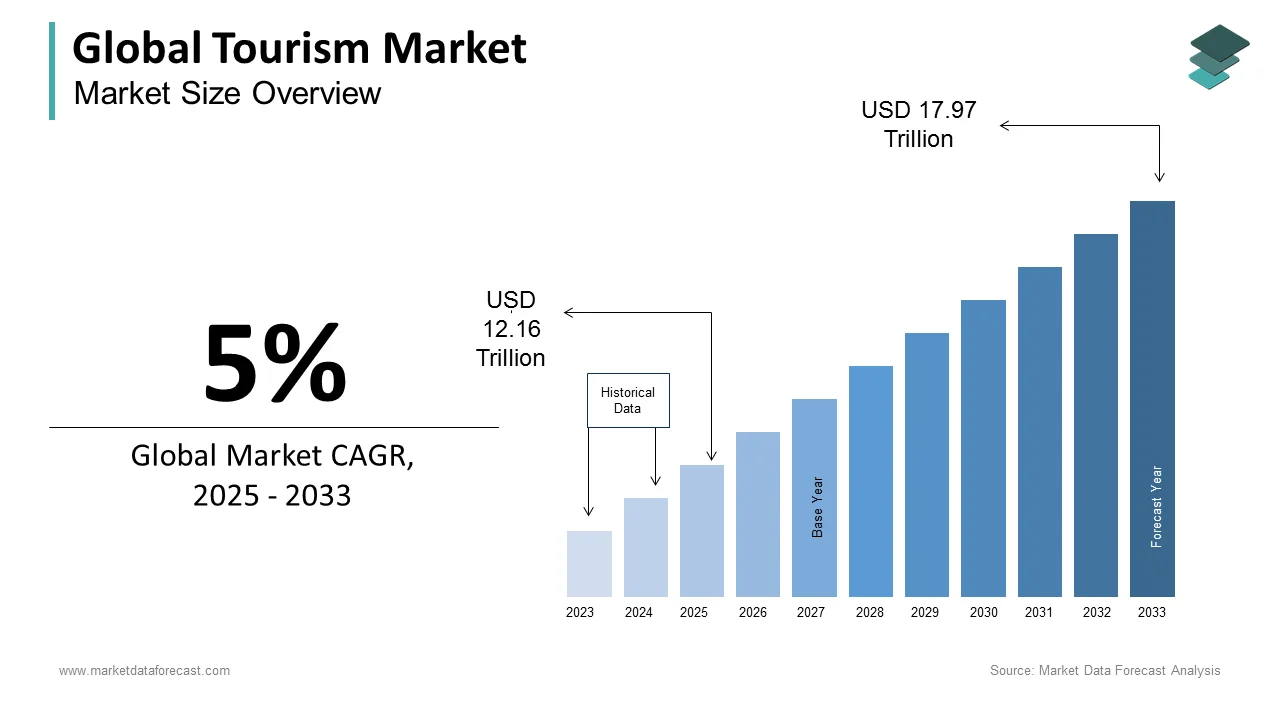
The global tourism market was worth US$ 11.58 trillion in 2024 and is anticipated to reach a valuation of US$ 17.97 trillion by 2033 from US$ 12.16 trillion in 2025. It is predicted to register a CAGR of 5% during the forecast period 2025-2033.
Tourism is the complex network of economic activities centered on the movement of individuals to destinations outside their usual environment for leisure, business, cultural, health, or educational purposes. According to the World Tourism Organization, international tourist arrivals surpassed 1.3 billion in 2023, reflecting a robust recovery from previous disruptions. As per the United Nations Development Programme, tourism contributes directly and indirectly to 10% of global employment, supporting over 330 million jobs worldwide.
MARKET DRIVERS
Rising Middle-Class Population and Disposable Income Boosting Tourism
The rising global middle-class population and disposable incomes are driving the growth of the tourism market, with unprecedented spending capacity, enabling millions to access international travel for the first time. According to the National Bureau of Statistics, over 156 million outbound trips were made in 2023, a 42% increase from the previous year, due to the improved visa facilitation and expanded flight connectivity. This surge is further amplified by changing lifestyle priorities with younger generations prioritizing experiential consumption over material goods. Governments in countries like Vietnam and the Philippines have responded by easing visa policies and investing in airport infrastructure to capture this demand.
Digital Transformation and Hyper-Personalized Travel Experiences
The digital transformation and hyper-personalization in travel planning have revolutionized how consumers research, book, and experience destinations, which is propelling the growth of the Tourism Market. According to the International Air Transport Association, over 80% of global air tickets were purchased online in 2023, with mobile platforms accounting for 62% of all bookings. The integration of artificial intelligence and big data analytics enables platforms like Booking.com and Expedia to offer real-time recommendations based on user behavior, budget, and preferences. Moreover, social media platforms such as Instagram and TikTok have become pivotal discovery engines, with user-generated content influencing destination choices. Platforms like Airbnb have leveraged this trend by curating "experiential stays" such as treehouses, farm stays, and cultural immersions, which saw a 37% increase in bookings in 2023 compared to 2019, as documented by the company’s annual sustainability report.
MARKET RESTRAINTS
Geopolitical Instability, Security Concerns, and Overtourism Impacting Tourism
The geopolitical instability and security concerns continue to disrupt tourism flows in regions affected by conflict, terrorism, or political unrest, restraining the growth of the Tourism Market. According to the Institute for Economics & Peace, 74 countries experienced a deterioration in peacefulness between 2022 and 2023, directly impacting travel advisories and consumer confidence. The U.S. Department of State issued over 120 updated travel warnings in 2023 alone, which are affecting key destinations in the Middle East, North Africa, and parts of Eastern Europe. Additionally, regional conflicts such as the war in Ukraine and tensions in the South China Sea have disrupted air corridors and increased insurance premiums for tour operators. Environmental Degradation and Overtourism in Fragile Ecosystems are undermining the long-term sustainability of popular destinations, which is likely to hinder the growth of the Tourism Market. According to UNESCO, 25% of World Heritage Sites are at risk due to excessive visitor pressure, including locations like Venice, Machu Picchu, and the Great Barrier Reef.
Ecological Footprint and Transportation Emissions Limiting Tourism Growth
The ecological footprint of tourism with transportation emissions is limiting the growth of the Tourism Market. As per the International Energy Agency, aviation accounted for 2.5% of global CO₂ emissions in 2023, with tourism responsible for nearly 12% of total transport-related carbon output. However, enforcement remains inconsistent, and many destinations lack the regulatory capacity to manage carrying capacities effectively, which is threatening both environmental integrity and the economic viability of tourism-dependent communities.
MARKET OPPORTUNITIES
Growth Driven by Visa-Free Travel and Bilateral Tourism Agreements
Expansion of Visa-Free Travel and Bilateral Tourism Agreements presents a significant opportunity for market growth, particularly among emerging economies. According to the Henley Passport Index, the number of countries offering visa-free or visa-on-arrival access to citizens of China, India, and Indonesia has increased by 28%, 22%, and 31% respectively, since 2019. In 2023, China unilaterally granted 15-day visa-free entry to nationals from France, Germany, Italy, and six other European countries, resulting in a 44% surge in European arrivals within three months, as reported by China’s Ministry of Culture and Tourism.
Expansion of Niche and Experiential Tourism Segments
The growth of niche and experiential tourism segments is unlocking new revenue streams and diversifying destination offerings, which is greatly influencing the growth of the Tourism Market. Countries like Thailand, India, and Israel have institutionalized medical tourism with dedicated visa categories and accredited facilities, with India reporting over 1.1 million medical tourists in 2023, as per the Ministry of Health and Family Welfare. Similarly, agritourism and cultural immersion are gaining traction among high-income travelers seeking authenticity.
MARKET CHALLENGES
Climate Change and Extreme Weather Events Affecting Tourism Growth
Climate change and extreme weather events are additionally expected to degrade the growth of the Tourism Market. According to the Intergovernmental Panel on Climate Change, the frequency of extreme weather events such as hurricanes, wildfires, and flooding has increased by 40% since the 1980s, directly affecting tourist hotspots.
REPORT COVERAGE
| REPORT METRIC | DETAILS |
| Market Size Available | 2024 to 2033 |
| Base Year | 2024 |
| Forecast Period | 2025 to 2033 |
| Segments Covered | By Type, Purpose, and Region. |
| Various Analyses Covered | Global, Regional and Country-Level Analysis, Segment-Level Analysis, Drivers, Restraints, Opportunities, Challenges; PESTLE Analysis; Porter’s Five Forces Analysis, Competitive Landscape, Analyst Overview of Investment Opportunities |
| Countries Covered | North America, Europe, APAC, Latin America, Middle East & Africa |
| Market Leaders Profiled | Aban Offshore Ltd., Accor Group, Crown Ltd., Balkan Holidays Ltd., Fred Harvey Company, G Adventures, and Others. |
SEGMENT ANALYSIS
By Type Insights
The domestic and local tourism segment accounted for a dominant share of the global tourism market in 2024, sustained by its resilience to external disruptions and accessibility to a broader demographic. According to the United Nations World Tourism Organization, domestic travelers do not face visa restrictions, currency fluctuations, or long-haul travel costs, enabling more frequent and spontaneous trips. Governments have actively promoted "staycations" through tax incentives and marketing campaigns. Japan’s “Go To Travel” initiative in 2023 stimulated 42 million domestic trips despite minimal international arrivals.
The international tourism segment is likely to grow with an expected CAGR of 13.8% during the forecast period, with the lifting of global travel bans and the restoration of air connectivity. According to the International Air Transport Association, global seat capacity on international routes reached 98% of 2019 levels by late 2023, with Asia-Pacific and Africa witnessing the most rapid recovery. The resurgence of long-haul and premium travel among high-income demographics is propelling the growth of the Tourism Market. Additionally, the normalization of digital nomadism has extended the trip duration. Portugal issued over 28,000 D7 and digital nomad visas in 2023 alone, as documented by its Immigration and Borders Service.
By Purpose Insights
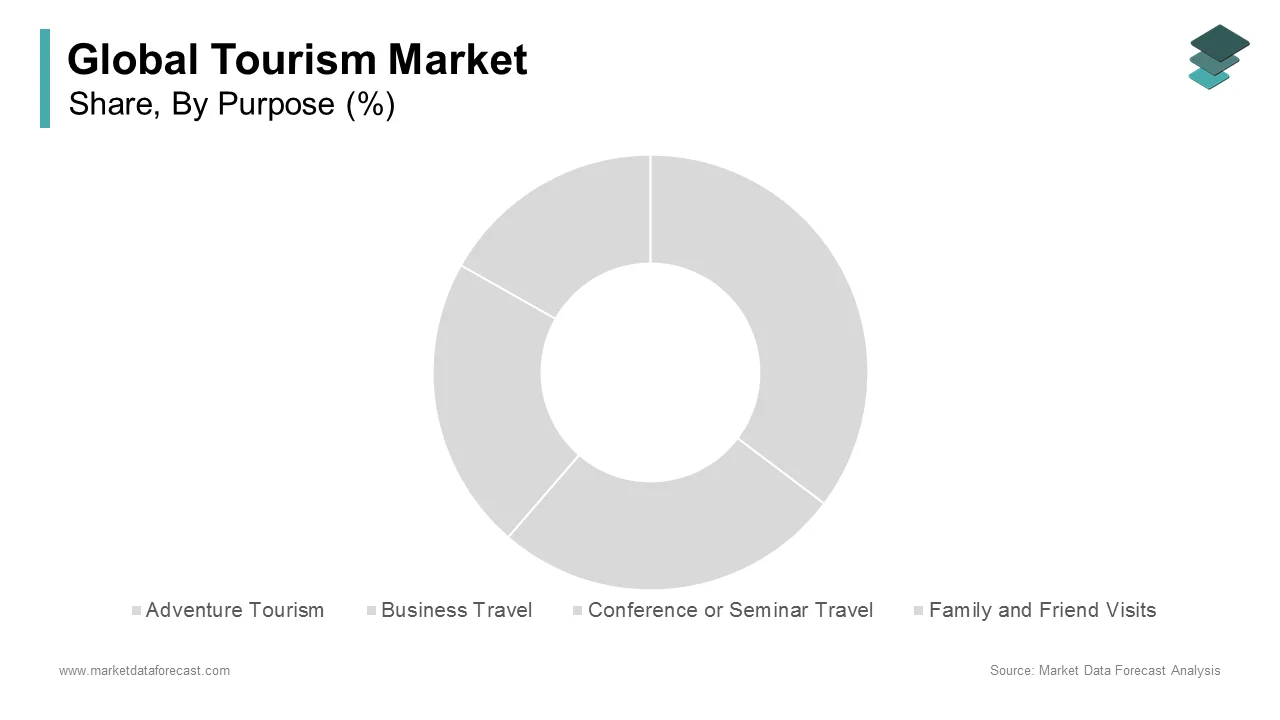
The family and friend segment was the largest and held 58.3% of the Tourism Market share in 2024, with the enduring social and emotional motivations behind travel, which remain resilient despite economic or geopolitical fluctuations. As per the U.S. Census Bureau, over 35 million Americans traveled abroad in 202,3, primarily to visit relatives, particularly in countries with large diasporas such as Mexico, India, and the Philippines. The demographic structure of global migration and remittance economies.
Tourism service companies offer various products and services to their clients. Thus, the industry products included in the worldwide tourism industry are accommodation for travelers, travel organizations and reservations, air transport, other local transport such as car rental, food and drink establishments, recreation and entertainment, gasoline, and other activities. In addition, industrial activities considered in the worldwide tourism market include accommodation services for travelers, provision of hospitality services to international tourists, airline operations, motor vehicle leasing, travel agencies, and travel organization services.
The adventure tourism segment is growing lucratively with a CAGR of 21.3% during the forecast period, driven by a generational shift toward experiential and physically engaging travel. As per the Global Youth Travel Report, 68% of travelers aged 18–35 prefer adventure-based itineraries such as trekking, scuba diving, and wildlife safaris over conventional sightseeing. The influence of digital media and influencer culture in popularizing remote destinations is gearing up with new opportunities in the coming years. Additionally, specialized operators are offering curated expeditions with sustainability certifications, like Costa Rica’s Instituto Costarricense de Turismo, which confirms that 79% of adventure tours now include conservation fees.
REGIONAL ANALYSIS
Europe Market Analysis
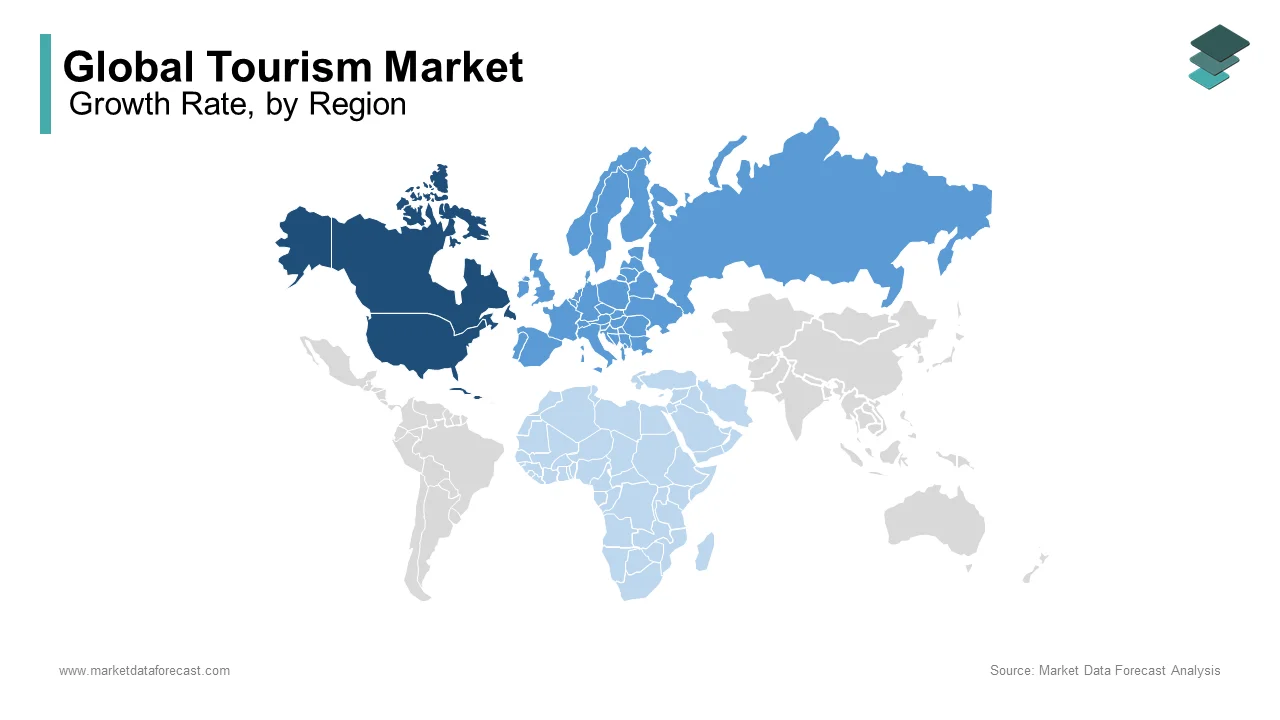
Europe was the top performer of the global tourism market by accounting for 38.3% of the market share in 2024. France, Italy, and Spain alone welcomed over 230 million international tourists in 2023, according to Eurostat, driven by iconic landmarks, culinary appeal, and well-established hospitality infrastructure. The European Travel Commission notes that intra-regional travel constitutes 70% of all trips, with weekend getaways and rail tourism gaining popularity among urban populations. According to the European Environment Agency, 29 countries now implement tourist taxation to fund conservation, with cities like Amsterdam and Barcelona regulating short-term rentals to curb overtourism. Additionally, the EU’s Green Tourism Initiative has certified over 4,000 eco-friendly accommodations.
Asia-Pacific Market Analysis
Asia-Pacific was positioned second by capturing 28.3% of the global tourism market share, with rapid growth concentrated in Southeast and East Asia. China, Thailand, and Japan are key contributors, benefiting from rising middle-class mobility and government-led tourism revitalization. Additionally, digital nomad visas in Thailand and Malaysia are attracting long-stay visitors.
North America Market Analysis
North America's tourism market growth is likely to continue, with the United States as a major contributor to the growth. Major urban centers like New York, Los Angeles, and Miami dominate arrivals, while national parks such as Yellowstone and the Grand Canyon attract millions annually.
The Canadian tourism market is likely to have significant growth opportunities during the forecast period. The region’s strength lies in its blend of business, leisure, and educational tourism, supported by world-class airports and hotel chains.
COMPETITIVE LANDSCAPE
The Tourism Market is characterized by intense competition between global online travel agencies, traditional tour operators, and emerging niche platforms specializing in experiential and sustainable travel. Dominant digital players leverage scale, data analytics, and brand recognition to control booking ecosystems, while regional operators differentiate through cultural authenticity and localized service. The rise of direct bookings via hotel chains and destination marketing organizations is challenging third-party platforms. Simultaneously, the proliferation of social media and influencer-driven travel has fragmented consumer decision-making. Innovation in immersive experiences, carbon-offset options, and digital nomad packages is redefining value propositions.
KEY MARKET PLAYERS
Some of the companies that are playing a dominating role in the global tourism market include
- Aban Offshore Ltd.
- Accor Group
- Crown Ltd.
- Balkan Holidays Ltd.
- Fred Harvey Company
- G Adventures
Top Players in the Tourism Market
- Expedia Group has its presence in the Asia-Pacific tourism sector through strategic partnerships with regional airlines, hotels, and mobility platforms. The company has localized its digital interface to support multiple languages and payment methods, including Alipay, Paytm, and GrabPay, enhancing accessibility for consumers across India, Southeast Asia, and Australia.
- com, a subsidiary of Booking Holdings, plays a transformative role in democratizing travel access across Asia-Pacific by empowering independent accommodations and small-scale operators. The platform hosts over 3 million properties in the region, including family-run guesthouses, eco-lodges, and agri-tourism farms in rural India, Indonesia, and the Philippines. The company also partnered with the Pacific Asia Travel Association to provide digital training for 50,000 small hospitality businesses, improving their online visibility.
- Airbnb has redefined travel behavior in Asia-Pacific by promoting decentralized, community-based tourism models that reduce pressure on urban centers. The company has seen exponential growth in bookings for rural and peri-urban locations, with searches for countryside stays in Japan, South Korea, and Malaysia increasing by 52% in 2023 compared to the previous year, as reported by Airbnb’s internal data. To support hosts, the company launched the “Host Academy” in India and Thailand, offering training in hospitality, safety, and sustainable practices.
Top Strategies Used by Key Market Participants
Key players in the Tourism Market are leveraging digital transformation, hyper-localization, sustainability integration, strategic partnerships, and experiential product diversification to strengthen their market positions. Companies are investing in AI-powered personalization, dynamic pricing algorithms, and mobile-first platforms to enhance user engagement. Firms are also adopting ESG frameworks, obtaining eco-certifications, and promoting low-impact travel.
GLOBAL TOURISM MARKET NEWS
- Mumbai-based Gem Tours & Travel has declared a coronavirus vaccination tour package for High Network Individual consumers who wish to travel to the United States for the shooting.
MARKET SEGMENTATION
This global tourism market research report has been segmented and sub-segmented based on type, purpose, and region.
By Type
- International Tourism
- Domestic/Local Tourism
By Purpose
- Adventure Tourism
- Business Travel
- Conference or Seminar Travel
- Family and Friend Visits
By Region
- North America
- Europe
- Asia Pacific
- Latin America
- Middle East & Africa
Frequently Asked Questions
1. What is the Tourism Market growth rate during the projection period?
The Global Tourism Market is expected to grow with a CAGR of 5% between 2025-2033.
2. What can be the total Tourism Market value?
The Global Tourism Market is expected to reach a revised size of US$ 17.97 trillion by 2033.
3. Name any three Tourism Market key players?
Accor Group, Crown Ltd., and Balkan Holidays Ltd. are the three tourism market key players.
Related Reports
Access the study in MULTIPLE FORMATS
Purchase options starting from
$ 2500
Didn’t find what you’re looking for?
TALK TO OUR ANALYST TEAM
Need something within your budget?
NO WORRIES! WE GOT YOU COVERED!
Call us on: +1 888 702 9696 (U.S Toll Free)
Write to us: sales@marketdataforecast.com