U.S. E-Commerce Market Size, Share, Trends, and Growth Analysis Report, Segmented by Business Model, Device Type, Payment Method, B2C Product Category, and Country – Industry Forecast From 2026 to 2034
U.S. E-Commerce Market Size
The U.S. e-commerce market was valued at USD 1,382.30 billion in 2025, is estimated to reach USD 1,527.80 billion in 2026, and is projected to reach USD 3,408.29 billion by 2034, growing at a CAGR of 10.55% from 2026 to 2034.
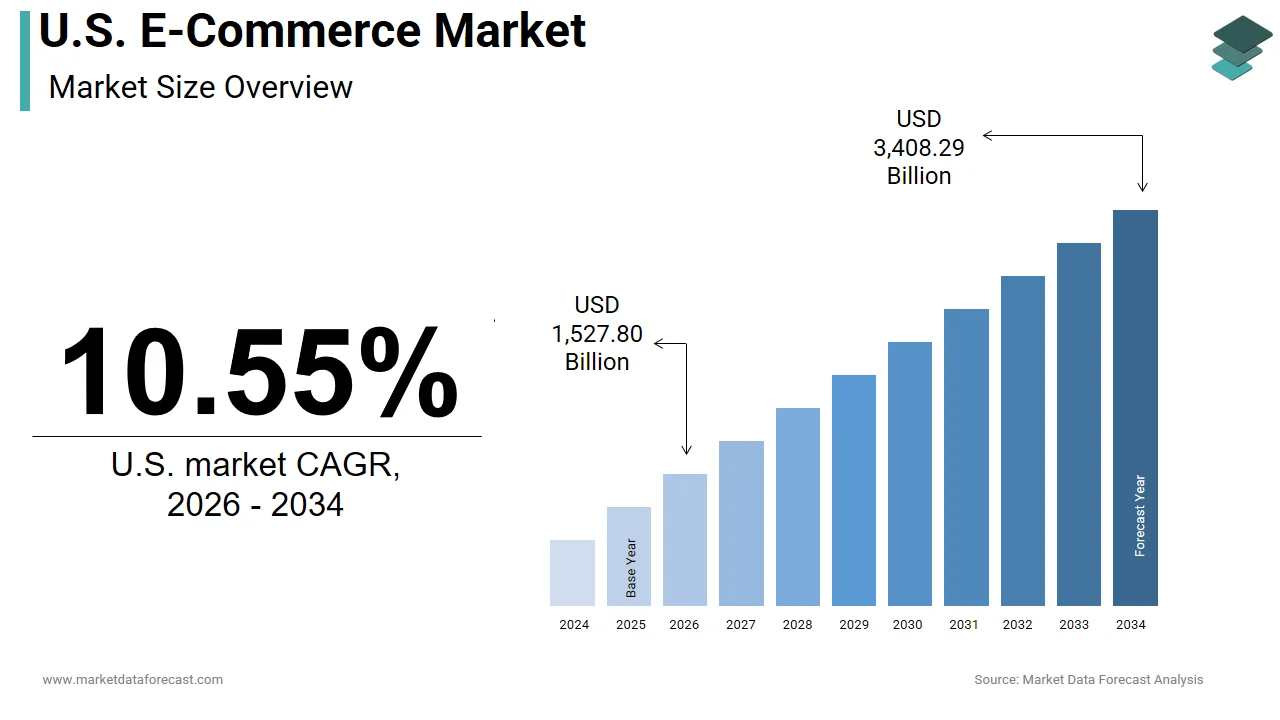
E-commerce is the buying and selling of goods and services through digital channels, including websites, mobile applications, and social media platforms. The definition, now includes omnichannel experiences, where online and offline interactions seamlessly integrate to enhance customer convenience and satisfaction. Furthermore, Americans say they have ever purchased something online, which promotes the widespread adoption of digital shopping habits across diverse demographic groups. This connectivity ensures that consumers can access a vast array of products and services with minimal friction. The integration of advanced payment systems and secure transaction protocols further facilitates trust and ease of use. The intense competition among established retailers pure play online merchants and emerging direct to consumer brands.
MARKET DRIVERS
Ubiquitous Smartphone Penetration and Mobile Commerce Adoption
The pervasive adoption of smartphones, enabling consumers to shop anytime and anywhere, is driving the growth of the United States e-commerce market. Mobile devices have become the central interface for digital interaction, allowing users to browse, compare prices, and make purchases with just a few taps. As per the research, the number of smartphone users in the United States reached 306 million in 2023, which represents a penetration rate of over 90% among the adult population. This high level of device ownership ensures that retailers have constant access to potential customers through mobile-optimized websites and dedicated applications. The convenience of mobile shopping means that consumers can engage with brands during commutes, breaks, and leisure time, which increases the frequency of transactions. The ability to utilize mobile wallets and biometric authentication simplifies the checkout process, reducing friction and cart abandonment rates. Furthermore, the integration of augmented reality features into mobile apps allows users to visualize products in their own environment, which enhances confidence in purchasing decisions. These technological synergies between hardware capability and software innovation ensure that mobile remains the dominant channel for e-commerce growth. The continuous improvement in mobile network speeds, such as 5G, further supports richer media content and faster loading times, which are critical for maintaining user engagement.
Enhanced Logistics Infrastructure and Expectation for Rapid Delivery
The development of sophisticated logistics infrastructure and the consumer expectation for rapid delivery by reducing the time between purchase and possession is escalating the growth of the United States e-commerce market. Consumers increasingly prioritize speed and reliability when choosing where to shop online, which has compelled retailers to invest heavily in supply chain optimization and last-mile delivery solutions. As per the National Retail Federation, 75% of consumers expect delivery within two days or less, which has become the standard for competitive e-commerce operations. This demand has led to the proliferation of fulfillment centers located closer to urban populations, enabling same-day or next-day delivery options. The companies with superior supply chain capabilities grow twice as fast as those with average capabilities, elevating the competitive advantage of efficient logistics. The use of advanced algorithms for inventory management and route optimization allows retailers to minimize costs while maximizing speed. Additionally, the rise of third-party logistics providers offers smaller merchants access to scalable delivery networks that were previously available only to large corporations. The ability to track packages in real time provides transparency and reduces anxiety for consumers, further enhancing the shopping experience. These logistical advancements remove traditional barriers to online shopping, such as long wait times and uncertainty, making e-commerce a more attractive option for a wider range of products and consumers.
MARKET RESTRAINTS
Cybersecurity Threats and Data Privacy Concerns
The prevalence of cybersecurity threats and growing concerns about data privacy, by eroding consumer trust and increasing operational costs for retailers, is limiting the growth of the United States e-commerce market. High-profile data breaches and identity theft incidents make consumers hesitant to share personal and financial information online, which can lead to abandoned carts and reduced conversion rates. The rise in security incidents forces e-commerce companies to invest heavily in encryption firewalls and compliance measures to protect user information. Furthermore, stringent regulations such as the California Consumer Privacy Act require businesses to implement strict data handling practices, which can be complex and costly to maintain. The fear of fraud also leads some consumers to prefer cash on delivery or in-store pickups, which limits the growth of purely digital transactions. Retailers must balance the need for seamless user experiences with robust security protocols, which can sometimes add friction to the checkout process. These security and privacy challenges necessitate ongoing vigilance and investment to maintain consumer confidence and ensure the sustainable growth of the e-commerce sector.
High Return Rates and Reverse Logistics Complexity
The high rate of product returns and the complexity of managing reverse logistics by impacting profitability and operational efficiency is additionally hampering the growth of the United States e-commerce market. Unlike physical stores, where customers can try items before buying online shoppers often order multiple sizes or colors with the intention of returning those that do not fit or meet expectations. This disparity creates substantial costs for retailers, who must handle shipping, inspection, restocking, and potential disposal of returned items. The environmental impact of returns also poses a challenge, as many returned items end up in landfills due to the high cost of refurbishment. Furthermore, the inability to resell returned goods as new inventory leads to margin erosion and inventory management difficulties. Retailers are forced to implement stricter return policies or charge for returns, which can negatively affect customer satisfaction and loyalty. The lack of standardized processes for handling returns across different platforms and carriers further complicates the issue.
MARKET OPPORTUNITIES
Integration of Artificial Intelligence for Personalized Shopping Experiences
The integration of artificial intelligence and machine learning technologies by enabling highly personalized shopping experiences that drive engagement and sales, is creating new opportunities for the growth of the United States e-commerce market. AI algorithms analyze consumer behavior, purchase history, and preferences to provide tailored product recommendations, dynamic pricing, and customized marketing messages. The e-commerce technology allows retailers to create unique storefronts for each user, thereby increasing relevance and reducing search effort. The use of chatbots and virtual assistants powered by natural language processing enhances customer service by providing instant support and guidance throughout the shopping journey. Furthermore, AI-driven inventory forecasting helps retailers optimize stock levels and reduce waste by predicting demand patterns with greater accuracy. The ability to automate routine tasks such as customer segmentation and email marketing frees up resources for strategic initiatives. These advancements enable brands to build stronger relationships with consumers and achieve superior conversion rates. The continued refinement of AI models will further enhance the precision and impact of personalization efforts, creating a competitive advantage for early adopters in the e-commerce landscape.
Expansion of Social Commerce and Shoppable Content
The rapid growth of social commerce and the integration of shoppable content, where retailers to reach consumers directly within their favorite social media platforms, is also promoting new opportunities for the growth of the United States e-commerce market. Social media networks, such as Instagram, TikTok, and Pinterest, have evolved into powerful shopping destinations where users can discover and purchase products without leaving the app. The trend is driven by the desire for seamless and immersive shopping experiences that combine entertainment with commerce. The use of influencer marketing and user-generated content builds trust and credibility, which encourages followers to make purchases based on recommendations. Furthermore, the integration of live streaming shopping events allows brands to showcase products in real time and interact with audiences, fostering a sense of community and urgency. The ability to tag products in posts and stories reduces friction in the purchase process by eliminating the need to navigate to external websites. These features make social media an effective channel for driving impulse buys and reaching younger demographics.
MARKET CHALLENGES
Intense Competition and Price Transparency
The intense competition and high level of price transparency for retailers striving to maintain profitability and brand loyalty is a challenge for the growth of the United States e-commerce market. The ease with which consumers can compare prices across multiple platforms using search engines and comparison tools forces retailers to engage in frequent price wars, which erode margins. As per a study by Profitero, 82% of online shoppers compare prices before making a purchase, indicating the high sensitivity to cost variations. This environment makes it difficult for smaller retailers to compete with large marketplaces that benefit from economies of scale and lower operational costs. The dominance of major players also creates barriers to entry for new brands seeking to gain visibility in a crowded digital landscape. Additionally, the reliance on paid advertising to drive traffic increases customer acquisition costs, which further pressures profitability. Retailers must constantly innovate in terms of product assortment, customer service, and value-added services to differentiate themselves from competitors. The pressure to offer free shipping and easy returns adds to the operational burden and cost structure. These competitive dynamics require retailers to adopt sophisticated pricing strategies and focus on building strong brand identities to retain customers in a highly transparent and competitive market.
Supply Chain Disruptions and Inventory Management Issues
The supply chain disruptions and inventory management issues, by affecting product availability and delivery reliability, are also impeding the growth of the United States e-commerce market. Global events, such as geopolitical tensions, natural disasters, and labor shortages, can interrupt the flow of goods, leading to stockouts and delayed shipments. These disruptions force e-commerce retailers to hold higher levels of safety, which ties up capital and increases storage costs. The complexity of managing inventory across multiple channels, including online marketplaces, physical stores,, and third-party distributors, further exacerbates the challenge. Inaccurate demand forecasting can lead to overstocking or understocking, which results in lost sales or excessive markdowns. Furthermore, the reliance on international suppliers exposes retailers to currency fluctuations and tariff changes, which affect pricing and profitability. The need for real-time visibility into supply chain operations requires significant investment in technology and data analytics. Retailers must develop resilient supply chain strategies, including diversification of suppliers and nearshoring, to mitigate these risks.
REPORT COVERAGE
| REPORT METRIC | DETAILS |
| Market Size Available | 2025 to 2034 |
| Base Year | 2025 |
| Forecast Period | 2026 to 2034 |
| Segments Covered | By Business Model, Device Type, Payment Method, B2C Product Category, and Country. |
| Various Analyses Covered | Global, Regional, and Country-Level Analysis, Segment-Level Analysis, Drivers, Restraints, Opportunities, Challenges; PESTLE Analysis; Porter’s Five Forces Analysis, Competitive Landscape, Analyst Overview of Investment Opportunities |
| Countries Covered | New York, Massachusetts, Pennsylvania, Illinois, Ohio, Michigan, Texas, Florida, Georgia, California, Washington, Colorado. |
| Market Leaders Profiled | Apple Inc., eBay Inc., Amazon.com, Inc., Walmart Inc., The Home Depot, Inc., and Others. |
SEGMENTAL ANALYSIS
By Business Model Insights
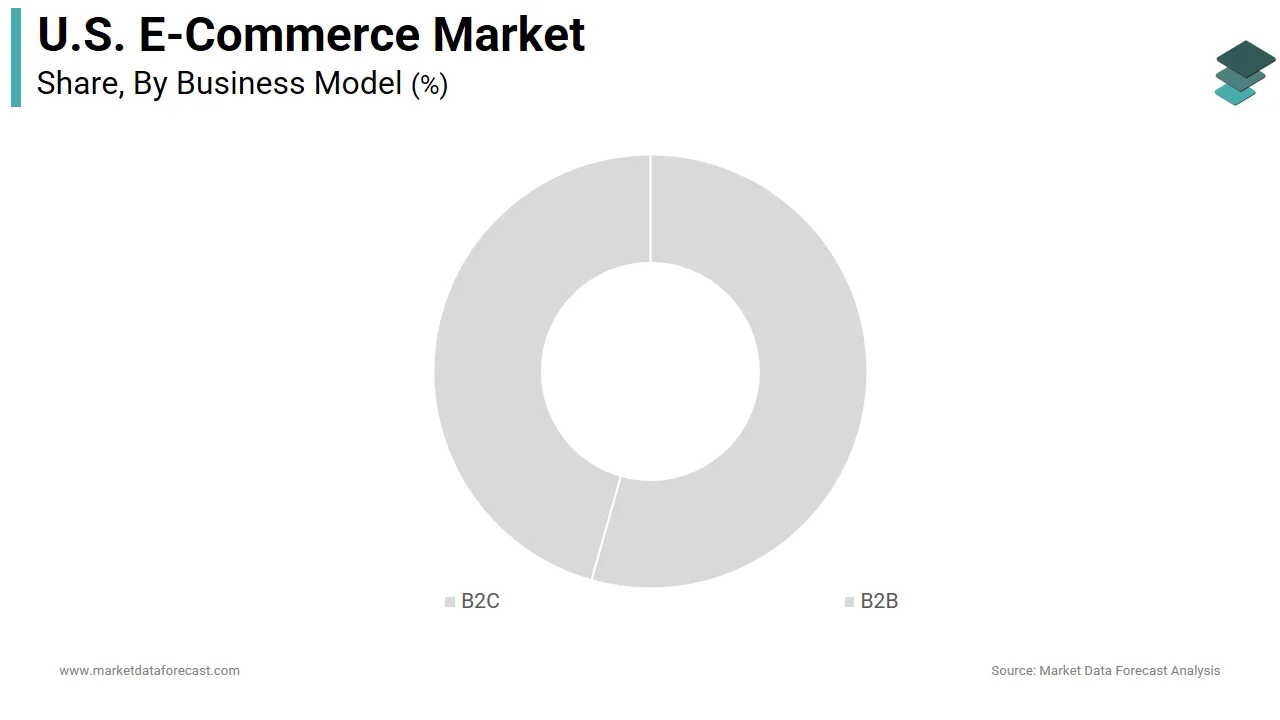
The Business to Consumer segment was the largest by holding a dominant share of the United States e-commerce market in 2025 due to the sheer volume of individual transactions and the direct engagement between retailers and end users. This model benefits from the widespread adoption of online shopping for everyday necessities, luxury goods, and discretionary items. The dominance is driven by the convenience of home delivery and the extensive product variety available on major platforms such as Amazon and Walmart. Data from the National Retail Federation indicates that over 80% of American consumers prefer shopping online for apparel and electronics due to the ease of price comparison and access to reviews. The proliferation of mobile applications has further simplified the purchasing process, allowing users to buy with a single click. Additionally, the integration of social media marketing enables brands to reach consumers directly through targeted advertisements and influencer partnerships. The ability to offer personalized recommendations based on browsing history enhances customer loyalty and increases average order values.
By Device Type Insights
The smartphone segment is likely to witness the fastest CAGR of 12.1% during the forecast period with the ubiquitous connectivity and the superior convenience of dedicated shopping applications. Mobile devices allow consumers to shop during idle moments, such as commuting or waiting in line, which increases the frequency of purchases. The introduction of progressive web apps and native mobile applications provides smoother navigation and faster loading times, which enhance the user experience. The integration of mobile wallets like Apple Pay and Google Pay simplifies the checkout process by eliminating the need to enter card details manually. Furthermore, push notifications from retail apps alert users to flash sales and personalized offers, driving impulse buys. The widespread availability of high-speed 5G networks supports high-quality image and video content, which is crucial for product evaluation on small screens.
By Payment Method Insights
The credit and debit cards segment was the largest by occupying 23.4% of the United States e-commerce market share in 2025 due to their universal acceptance and deeply ingrained consumer habits. Most online retailers prioritize card payments because they are reliable and supported by established processing networks. The familiarity of using cards for both online and offline purchases makes them the default choice for many shoppers, who value simplicity and consistency. The ability to earn rewards points, cash back, and travel miles incentivizes consumers to use cards for large purchases. Furthermore, the widespread implementation of EMV chip technology and tokenization has enhanced security, reducing the risk of fraud during online transactions. Banks and card issuers also offer zero liability policies, which protect consumers from unauthorized charges, thereby building trust. The infrastructure supporting card payments is mature and robust, ensuring minimal downtime and high success rates for transactions.
The digital wallets segment is expected to grow at the fastest CAGR of 16.4% from 2026 to 2034, with the seamless checkout experience and deep integration with mobile devices. Services like Apple Pay, Google Pay, and PayPal allow users to complete transactions with a single tap or biometric authentication, eliminating the need to enter card details repeatedly. The speed and convenience of digital wallets reduce cart abandonment rates, which is a significant issue for online retailers. The widespread adoption of smartphones has facilitated the uptake of digital wallets as they are often pre-installed or easily accessible on mobile operating systems. Furthermore, the ability to store multiple payment methods and shipping addresses in one secure location enhances user convenience. Retailers are increasingly prioritizing digital wallet integration to cater to mobile-first shoppers who demand quick and efficient payment solutions. This trend is further accelerated by the rise of contactless payments in physical stores, which familiarizes consumers with the technology.
By B2C Product Category Insights
The fashion and apparel segment accounted in holding 42.3% of the United States e-commerce market share in 2025 due to the high frequency of purchases and the constant demand for new trends. Clothing is a necessity that requires regular replacement and updating, making it a staple of online retail. The visual nature of fashion lends itself well to digital display, allowing consumers to browse extensive catalogs from the comfort of their homes. The rise of fast fashion brands has accelerated the cycle of trends, encouraging frequent purchases and repeat visits to online stores. Social media platforms play a crucial role in driving demand by showcasing new styles and influencer endorsements. The ability to filter by size, color, and style simplifies the search process for shoppers. Additionally, the integration of virtual try-on technologies is reducing hesitation and improving fit accuracy.
The beauty and personal care segment is deemed to grow at the fastest CAGR of 10.2% from 2026 to 2034. Platforms like TikTok and Instagram have become primary discovery channels for new products and trends. Influencers provide tutorials and reviews that build trust and encourage followers to purchase recommended items. The viral nature of beauty challenges and hashtags creates immediate demand for specific products. Direct-to-consumer brands leverage these platforms to launch new items and gather feedback rapidly. The visual appeal of packaging and before-and-after results translates well to digital formats. Additionally, the availability of sample sizes and subscription boxes allows consumers to try products with low commitment. These marketing dynamics create a highly engaged and responsive customer base that drives rapid sales growth. The ability of social media to democratize beauty advice and showcase diverse products ensures sustained expansion in this category.
COMPETITIVE LANDSCAPE
The competition in the United States e-commerce market is intense and characterized by the rivalry between established giants and emerging niche players. Major retailers leverage their scale and logistics networks to offer fast delivery and low prices, while smaller brands focus on specialization and unique value propositions. The barrier to entry has lowered due to accessible technology platforms allowing new competitors to launch quickly. Price transparency enables consumers to compare options instantly forcing retailers to compete on service quality and customer experience rather than just cost. Innovation in technology, such as augmented reality and voice shopping, creates new battlegrounds for engagement. Data privacy concerns and regulatory scrutiny add complexity to competitive strategies, requiring careful compliance management. The rise of social commerce introduces new channels for discovery and sales, disrupting traditional search-based models. Customer loyalty is increasingly fragile as switching costs are low, making retention a critical challenge. Companies must continuously innovate in logistics, marketing, and product offerings to maintain relevance.
KEY MARKET PLAYERS
Some of the companies that are playing a dominating role in the U.S. e-commerce market include
- Apple Inc.
- eBay Inc.
- Amazon.com, Inc.
- Walmart Inc.
- The Home Depot, Inc.
TOP PLAYERS IN THE MARKET
- Amazon.com Inc. remains the dominant force in the United States e-commerce landscape by offering an extensive product selection and unparalleled logistics capabilities. The company continues to strengthen its position through significant investments in artificial intelligence and automation within its fulfillment centers. Recent initiatives include the expansion of same-day delivery services to more metropolitan areas and the integration of generative AI tools to enhance customer search experiences. Amazon also focuses on growing its advertising business, which leverages vast consumer data to provide targeted marketing solutions for brands. The Prime membership program remains a key driver of loyalty, offering benefits such as fast shipping and exclusive content. These strategic moves ensure that the company meets evolving consumer expectations for speed and convenience while solidifying its role as the primary destination for online shopping in the United States.
- Walmart Inc has successfully transformed its traditional retail strength into a robust e-commerce powerhouse by leveraging its extensive network of physical stores. The company utilizes its stores as fulfillment centers to enable efficient same-day delivery and curbside pickup options for online orders. Recent actions include the expansion of Walmart Plus membership, which offers free delivery and fuel discounts to compete with other subscription services. Walmart has also invested heavily in its digital marketplace, attracting third-party sellers to broaden its product assortment beyond groceries and general merchandise. The integration of advanced inventory management systems allows for real-time stock visibility, which improves order accuracy and customer satisfaction. Additionally, the company is exploring autonomous delivery technologies to reduce last-mile costs. These efforts have significantly enhanced its online competitiveness and reinforced its position as a major player in the US e-commerce sector.
- eBay Inc operates as a leading global marketplace connecting buyers and sellers across various categories including collectibles electronics and automotive parts. The company contributes to the US market by facilitating peer to peer transactions and supporting small businesses through its platform. Recent strategies focus on enhancing trust and safety measures such as authentication services for high value items like sneakers and luxury handbags. eBay has also improved its search algorithms and user interface to provide more personalized recommendations and faster browsing experiences. The introduction of managed payments simplifies the transaction process for sellers and buyers alike. Furthermore, the company is expanding its certified refurbished program to appeal to environmentally conscious consumers seeking sustainable options. These initiatives help retain its loyal user base and attract new customers looking for specific or rare items. The continued emphasis on community and specialized categories ensures eBay remains a vital component of the diverse US e-commerce ecosystem.
TOP STRATEGIES USED BY KEY MARKET PARTICIPANTS
Key players in the United States e-commerce market primarily focus on enhancing supply chain efficiency through automation and artificial intelligence to reduce delivery times and operational costs. Companies are increasingly adopting omnichannel strategies that integrate physical stores with digital platforms to offer services like curbside pickup and same-day delivery. Investment in personalized shopping experiences using data analytics and machine learning helps retailers tailor recommendations and improve customer retention. Expansion of subscription-based loyalty programs provides steady revenue streams and encourages repeat purchases by offering exclusive benefits. Strategic partnerships with third-party sellers and brands broaden product assortments and attract diverse customer segments. Additionally, firms are prioritizing sustainability initiatives such as eco-friendly packaging and carbon-neutral shipping to appeal to environmentally conscious consumers. These approaches enable companies to differentiate their offerings and maintain a competitive advantage in a rapidly evolving digital retail landscape.
MARKET SEGMENTATION
This research report on the U.S. e-commerce market has been segmented and sub-segmented into the following categories.
By Business Model
- B2C
- B2B
By Device Type
- Smartphone / Mobile
- Desktop and Laptop
- Other Device Types
By Payment Method
- Credit / Debit Cards
- Digital Wallets
- BNPL
- Other Payment Methods
By B2C Product Category
- Beauty and Personal Care
- Consumer Electronics
- Fashion and Apparel
- Food and Beverages
- Furniture and Home
- Toys, DIY, and Media
- Other Product Categories
By Country
- New York
- Texas
- Florida
- Georgia
- California
- Rest of U.S.
Frequently Asked Questions
What is the U.S. e-commerce market?
The U.S. e-commerce market covers online sales of goods and services through websites, apps, and marketplaces connecting buyers with retailers nationwide.
How does the U.S. e-commerce market function?
The U.S. e-commerce market operates via platforms handling product listings, payments, shipping, and customer service for seamless online transactions.
What drives growth in the U.S. e-commerce market?
The U.S. e-commerce market grows through mobile shopping, fast delivery options, personalized recommendations, and expanding product categories.
Which segments lead the U.S. e-commerce market?
The U.S. e-commerce market features electronics, fashion, groceries, home goods, and beauty as dominant categories with strong consumer demand.
What role does mobile play in the U.S. e-commerce market?
Mobile drives the U.S. e-commerce market as shoppers use apps and browsers for quick purchases, browsing, and on-the-go transactions.
How important are marketplaces in the U.S. e-commerce market?
Marketplaces power the U.S. e-commerce market by connecting multiple sellers with buyers through trusted platforms and vast product selection.
What is B2C in the U.S. e-commerce market?
B2C dominates the U.S. e-commerce market as businesses sell directly to consumers via branded sites and third-party platforms.
How does logistics support the U.S. e-commerce market?
Logistics enables the U.S. e-commerce market through fast shipping, returns handling, and fulfillment centers that meet customer speed expectations.
What trends shape the U.S. e-commerce market?
The U.S. e-commerce market follows subscription models, social commerce, voice shopping, and AI-driven personalization strategies.
What challenges face the U.S. e-commerce market?
The U.S. e-commerce market deals with competition, logistics costs, returns management, and data privacy concerns for shoppers.
Related Reports
Access the study in MULTIPLE FORMATS
Purchase options starting from
$ 1200
Didn’t find what you’re looking for?
TALK TO OUR ANALYST TEAM
Need something within your budget?
NO WORRIES! WE GOT YOU COVERED!
Call us on: +1 888 702 9696 (U.S Toll Free)
Write to us: sales@marketdataforecast.com