U.S. Foreign Exchange Market Size, Share, Trends, and Growth Analysis Report, Segmented by Counterparty, Type, and Country – Industry Forecast From 2026 to 2034
U.S. Foreign Exchange Market Report Summary
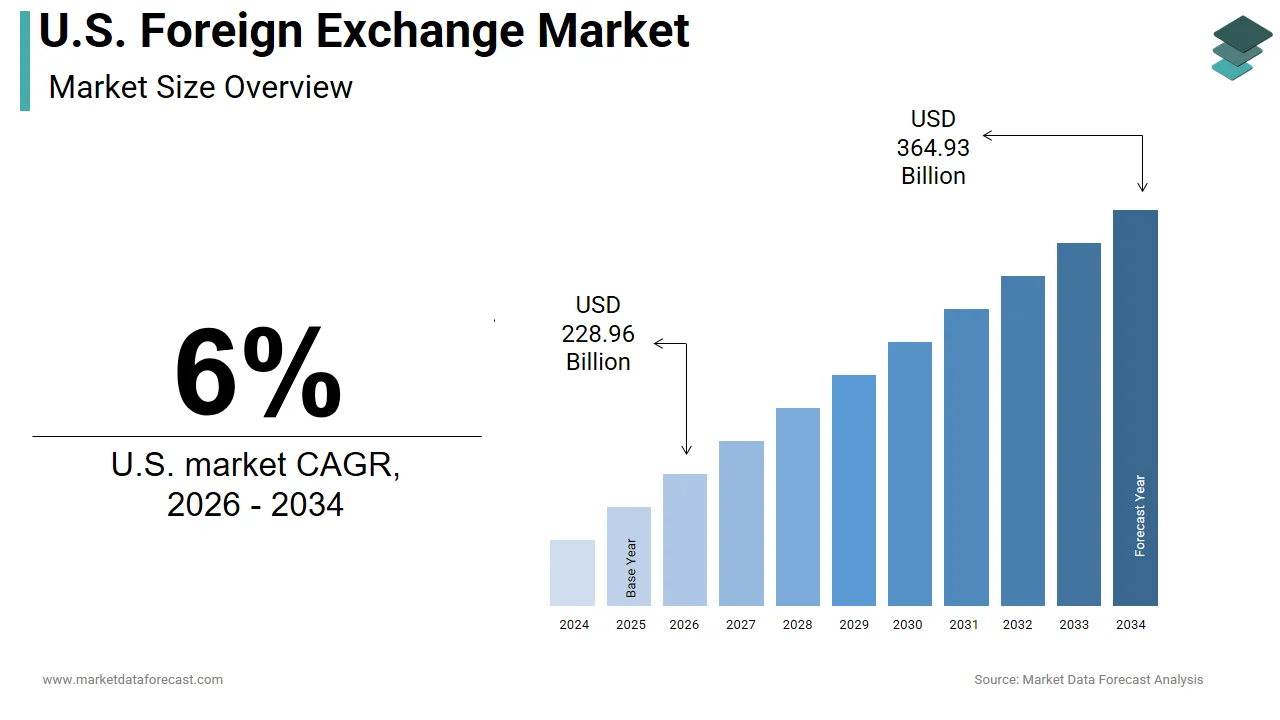
The U.S. foreign exchange market was valued at USD 216 billion in 2025, is estimated to reach USD 228.96 billion in 2026, and is projected to reach USD 364.93 billion by 2034, growing at a CAGR of 6% from 2026 to 2034. Market growth is driven by the United States’ central role in global finance, the dominance of the U.S. dollar in international trade, and increasing cross-border transactions. The market benefits from deep liquidity, advanced financial infrastructure, and continuous innovation in trading technologies. Additionally, the expansion of algorithmic trading, digital platforms, and global capital flows is further supporting steady growth.
Key Market Trends
- Continued dominance of the U.S. dollar in global trade and finance.
- Growth in cross-border transactions and international investments.
- Increasing adoption of algorithmic and high-frequency trading.
- Expansion of digital trading platforms and fintech solutions.
- Rising importance of risk management and hedging strategies.
Segmental Insights
- Based on counterparty, the reporting dealers segment dominated the U.S. foreign exchange market in 2025, driven by large financial institutions facilitating major trading volumes.
- Based on type, the outright forwards and FX swaps segment led the market in 2025, supported by strong demand for hedging and liquidity management.
Regional Analysis
- The United States is expected to maintain its leading position in the global foreign exchange landscape, supported by the continued dominance of the U.S. dollar as the primary reserve currency and medium of international trade. Strong institutional presence, regulatory stability, and technological advancements will continue to reinforce market leadership.
Competitive Landscape
The U.S. foreign exchange market is highly competitive and dominated by major global banks and financial institutions. These players focus on liquidity provision, advanced trading technologies, and global client networks to maintain their competitive edge.
Prominent companies operating in the U.S. foreign exchange market include Barclays, BNP Paribas, Citibank, Citigroup Inc., Bank of America Corporation, Deutsche Bank, Goldman Sachs, HSBC Holdings plc, JPMorgan Chase & Co., The Royal Bank of Scotland, UBS AG, Standard Chartered PLC, State Street Corporation, and XTX Markets Limited.
U.S. Foreign Exchange Market Size
The U.S. foreign exchange market was valued at USD 216 billion in 2025, is estimated to reach USD 228.96 billion in 2026, and is projected to reach USD 364.93 billion by 2034, growing at a CAGR of 6% from 2026 to 2034.
The U.S. foreign exchange market operates as the central hub for global currency trading, facilitating the conversion of the US dollar against other major currencies to support international trade, investment, and speculation. As the world’s primary reserve currency, the US dollar is involved in approximately 88% of all foreign exchange transactions globally, as per data from the Bank for International Settlements. This dominance ensures that the U.S. remains the most liquid and active jurisdiction for forex activities, attracting institutional investors, central banks, and corporate treasurers. The market functions primarily over the counter, with significant trading volumes concentrated in financial centers such as New York. As per the Federal Reserve Bank of New York, the daily turnover of US dollar related transactions reached 3.8 trillion dollars in North America in 2022, while global dollar turnover reached approximately 6.6 trillion dollars. The regulatory framework is overseen by entities such as the Commodity Futures Trading Commission and the National Futures Association, which enforce strict compliance standards to maintain market integrity. The depth of the US market allows for efficient price discovery and minimal slippage even during periods of high volatility. Furthermore, the integration of advanced electronic trading platforms has enhanced accessibility for a broader range of participants, from large hedge funds to retail traders. The structural importance of the US dollar in global finance means that monetary policy decisions by the Federal Reserve have immediate and profound impacts on exchange rates worldwide. This interconnectedness positions the U.S. foreign exchange market not merely as a domestic entity but as the pivotal anchor of the international monetary system.
MARKET DRIVERS
Dominance of the US Dollar as Global Reserve Currency
The preeminent status of the US dollar as the global reserve currency is a key driver for the U.S. foreign exchange market, which is ensuring consistent and substantial demand for dollar-denominated assets. Central banks worldwide hold significant portions of their foreign exchange reserves in US dollars to facilitate international trade and stabilize their own currencies. According to the International Monetary Fund, the US dollar accounts for approximately 58% of global allocated foreign exchange reserves. This widespread adoption creates a continuous baseline demand for dollars as nations require liquidity to manage balance of payments deficits and intervene in currency markets. The depth and liquidity of US Treasury markets further reinforce this preference, offering safe haven characteristics during times of global uncertainty. Investors flock to dollar assets during geopolitical tensions or economic crises, driving up trading volumes in the forex market. The network effect of the dollar’s usage in commodity pricing, particularly for oil and gold, also necessitates regular currency conversions for importing and exporting nations. According to industry analysis, the inertia associated with the dollar’s incumbent position makes it difficult for alternative currencies to displace it. This structural demand ensures that the market remains robust and resilient.
High Volume of International Trade and Cross-Border Investments
The extensive volume of international trade and cross-border investments involving the U.S. is further boosting the U.S. foreign exchange market growth. The U.S. is one of the largest trading nations globally, and according to the Bureau of Economic Analysis, total US international trade in goods and services was 6.9 trillion dollars in 2023. Each transaction requires the exchange of currencies, creating a steady flow of activity in the forex market as companies hedge against currency risk and settle payments. Additionally, the U.S. attracts significant foreign direct investment, and as per data from the Department of Commerce, the net position of foreign direct investment in the U.S. reached 5.3 trillion dollars at the end of 2023. These investments necessitate the conversion of foreign capital into US dollars. Multinational corporations operating in the U.S. also engage in frequent repatriation of profits, requiring complex forex strategies to optimize returns. The integration of global supply chains means that even domestic US companies are exposed to foreign exchange risks, prompting them to actively participate in the market for hedging purposes. According to financial reports, the sophistication of corporate treasury functions has led to increased use of derivatives and spot contracts to manage exposure. This commercial and investment-driven demand provides a stable foundation for market growth. The sheer scale of economic interactions between the U.S. and the rest of the world ensures that the foreign exchange market remains vibrant and essential for facilitating global commerce.
MARKET RESTRAINTS
Stringent Regulatory Compliance and Reporting Requirements
Stringent regulatory compliance and reporting requirements impose significant operational burdens on participants in the U.S. foreign exchange market, which is a significant impediment. The market is subject to rigorous oversight by multiple agencies, including the Commodity Futures Trading Commission and the Financial Crimes Enforcement Network, which enforce strict anti-money laundering and know your customer protocols. As per regulatory guidelines, financial institutions must implement comprehensive monitoring systems to detect suspicious activities. The implementation of the Dodd-Frank Wall Street Reform and Consumer Protection Act introduced additional reporting obligations for swap dealers and major swap participants. These regulations require firms to maintain detailed records and submit regular reports. Smaller players often struggle to meet these demanding standards. The threat of hefty fines for non-compliance further discourages risk-taking and innovation. According to financial industry estimates, compliance costs can account for approximately 4% to 10% of total revenue for financial firms. The fragmented nature of regulatory expectations across different jurisdictions also creates challenges for global banks operating in the U.S. This regulatory heaviness slows down transaction processing times and increases the cost of doing business.
Geopolitical Tensions and Policy Uncertainty
Geopolitical tensions and policy uncertainty create an environment of unpredictability that restrains stable growth in the U.S. foreign exchange market by inducing erratic volatility and risk aversion. Trade disputes, sanctions, and diplomatic conflicts can lead to sudden shifts in currency values, making it difficult for businesses and investors to plan long-term strategies. For instance, tensions between the U.S. and major economic partners have historically resulted in sharp fluctuations in exchange rates. As per economic analyses, geopolitical risks can increase market volatility indices significantly during peak crisis periods. Uncertainty regarding future monetary policy directions, influenced by political pressures, also contributes to market instability. Investors may withdraw capital from dollar assets if they perceive a risk of politicized monetary decisions. The imposition of economic sanctions on various nations further complicates the forex landscape, restricting transactions with certain entities and reducing overall market volume. According to financial news reports, the fear of sanctions often causes banks to de-risk their portfolios. This climate of uncertainty discourages long-term investment and encourages short-term speculative behavior. The resulting instability undermines confidence in the market’s reliability as a mechanism for efficient capital allocation.
MARKET OPPORTUNITIES
Integration of Blockchain and Distributed Ledger Technology
The integration of blockchain and distributed ledger technology presents a significant opportunity for the U.S. foreign exchange market to enhance transparency, reduce settlement times, and lower transaction costs. Traditional forex settlements can take up to two days. Blockchain solutions enable near-instantaneous settlement through smart contracts. According to industry pilots, the use of distributed ledger technology can reduce settlement times from the traditional T plus 2 cycle to real-time or T plus 0. Several major banks and fintech companies in the U.S. are exploring consortium-based blockchain platforms to streamline cross-border payments and currency exchanges. This technological shift also enhances transparency by providing an immutable record of transactions. The adoption of stablecoins pegged to the US dollar offers another avenue for innovation. According to market studies, the blockchain technology market is projected to reach approximately 469 billion dollars by 2030. By embracing these technologies, the U.S. foreign exchange market can position itself at the forefront of financial innovation. The potential for programmable money and automated compliance checks further opens up possibilities for new financial products and services.
Expansion of Digital Retail Trading Platforms
The expansion of digital retail trading platforms offers a substantial opportunity for the U.S. foreign exchange market to broaden its participant base and increase trading volumes among individual investors. Advances in mobile technology and user-friendly interfaces have democratized access to forex trading. According to industry data, global retail forex trading reached a turnover of approximately 1.07 trillion dollars daily in 2023. These platforms often provide educational resources, social trading features, and automated trading tools that empower novice traders to participate in the market. The gamification of trading experiences further attracts younger demographics who are comfortable with digital financial services. Regulatory changes that enhance investor protection while maintaining accessibility also contribute to this growth trend. As per market analysis, the retail segment now accounts for a significant portion of daily forex turnover. The ability to trade micro lots and use leverage responsibly allows individuals to manage risk effectively while seeking returns. Furthermore, the integration of artificial intelligence in trading apps provides personalized insights and risk management alerts. By catering to this growing segment, the U.S. foreign exchange market can tap into a new source of demand and foster greater financial inclusion. This expansion not only increases market depth but also drives innovation in product offerings and service delivery.
MARKET CHALLENGES
Cybersecurity Threats and Data Privacy Concerns
Cybersecurity threats and data privacy concerns pose a major challenge to the U.S. foreign exchange market. Financial institutions handling vast amounts of sensitive data and high-value transactions are constantly under threat from hacking attempts, phishing attacks, and ransomware. As per cybersecurity reports, the financial services sector experienced a 64% increase in the number of cyberattacks in 2023. A successful breach can result in significant financial losses, reputational damage, and loss of client trust. The complexity of IT infrastructure, often involving legacy systems integrated with modern APIs, creates vulnerabilities that hackers can exploit. Regulatory requirements for data protection, such as the Gramm-Leach-Bliley Act, impose strict obligations on firms to safeguard customer information. According to industry surveys, the average cost of a data breach in the financial sector reached 6.08 million dollars in 2024. The rise of sophisticated attack vectors, including state-sponsored espionage and organized crime syndicates, further complicates defense strategies. Ensuring the integrity of trading systems and protecting client funds requires continuous investment in advanced security technologies and staff training. Failure to adequately address these challenges can lead to regulatory penalties and exclusion from the market. The constant need to stay ahead of cyber threats distracts resources from innovation and growth.
Market Fragmentation and Liquidity Disparities
Market fragmentation and liquidity disparities present a significant challenge to the U.S. foreign exchange market by creating inefficiencies and increasing transaction costs for participants. The forex market is decentralized, with trading occurring across multiple venues, including interbank networks, electronic communication networks, and dark pools. This fragmentation can lead to disjointed price discovery and varying levels of liquidity depending on the time of day and currency pair. As per market studies, liquidity tends to dry up during off-peak hours or during periods of high volatility. Small and medium-sized enterprises often face difficulties in accessing competitive pricing due to their limited bargaining power compared to large institutional players. The lack of a centralized exchange means that transparency is limited. As per regulatory observations, fragmented liquidity can exacerbate market stress during crisis events. Participants must navigate multiple platforms to achieve best execution. The disparity in access to liquidity also creates an uneven playing field. Addressing these structural issues requires coordinated efforts among market participants and regulators to enhance transparency and standardize practices. Until then, fragmentation remains a persistent challenge.
REPORT COVERAGE
| REPORT METRIC | DETAILS |
| Market Size Available | 2025 to 2034 |
| Base Year | 2025 |
| Forecast Period | 2026 to 2034 |
| Segments Covered | By Counterparty, Type, and Country. |
| Various Analyses Covered | Global, Regional, and Country-Level Analysis, Segment-Level Analysis, Drivers, Restraints, Opportunities, Challenges; PESTLE Analysis; Porter’s Five Forces Analysis, Competitive Landscape, Analyst Overview of Investment Opportunities |
| Countries Covered | New York, Massachusetts, Pennsylvania, Illinois, Ohio, Michigan, Texas, Florida, Georgia, California, Washington, Colorado. |
| Market Leaders Profiled |
|
SEGMENTAL ANALYSIS
By Counterparty Insights
The reporting dealers segment occupied the major share of the U.S. foreign exchange market in 2025. The growth of the reporting dealers segment in the U.S. market is driven by their critical role as primary liquidity providers and market makers. These institutions facilitate the vast majority of trading volume by quoting bid and ask prices for currency pairs. According to data from the Bank for International Settlements, reporting dealers accounted for 44% of global foreign exchange turnover in 2022. Their dominance is reinforced by their ability to access deep pools of capital and manage large-scale risks through sophisticated hedging strategies. The concentration of trading activity among a few key players allows for tighter spreads and greater market depth. Furthermore, reporting dealers serve as the primary interface between central bank policies and the broader market. According to industry analysis, the top five banks globally control over 40% of the foreign exchange market share. This structural advantage ensures that reporting dealers remain the cornerstone of the market. Their extensive global networks also enable them to offer seamless cross-border services.
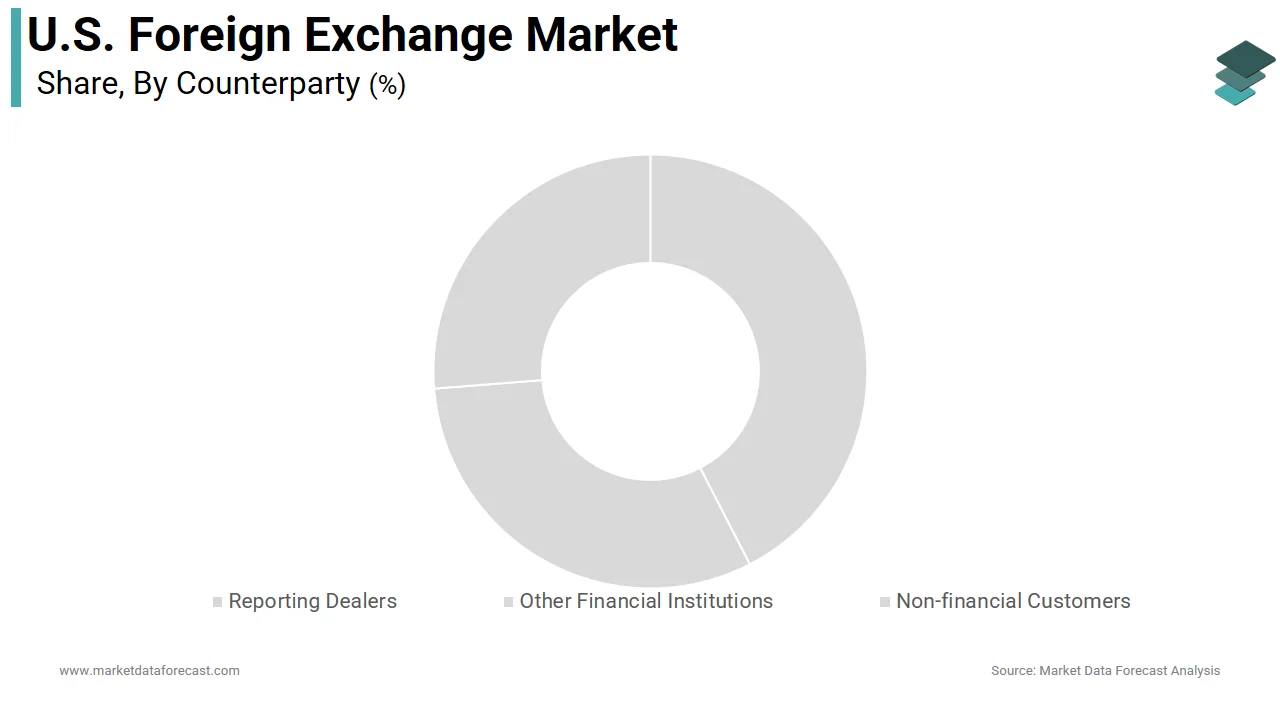
On the other hand, the non-financial customers segment is emerging as the fastest-growing segment and is predicted to witness the highest CAGR in the U.S. market during the forecast period, owing to the increasing need for corporate entities to hedge against currency volatility. Multinational corporations and small to medium-sized enterprises are increasingly exposed to foreign exchange risks due to global supply chains and international sales. As per industry surveys, approximately 70% of companies have reported that currency volatility has a significant impact on their earnings. This trend is fueled by the recognition that unhedged exposure can significantly impact earnings and cash flows. The availability of user-friendly hedging tools and digital platforms has also lowered the barrier for non-financial firms to participate in the forex market. According to market data, transactions involving non-financial customers accounted for approximately 7% of the total foreign exchange market volume. This growth is further supported by the expansion of US businesses into emerging markets. Companies are utilizing forwards and options to lock in exchange rates and protect profit margins. The shift towards just-in-time inventory management and global sourcing has also increased the frequency of cross-border payments. As corporate treasuries become more sophisticated, the demand for tailored forex solutions continues to rise.
By Type Insights
The outright forwards and FX swaps segment was the leading segment in the U.S. foreign exchange market by type in 2025. The growth of this segment in the U.S. market is driven by the widespread preference for these instruments in trade finance and short-term hedging. These products offer straightforward mechanisms for locking in exchange rates for future dates. As per market data, FX swaps alone account for 51% of total foreign exchange turnover while outright forwards account for 15%. In the U.S., importers and exporters rely heavily on these instruments to manage cash flow predictability and protect against adverse currency movements. The simplicity of forwards and swaps makes them accessible to a broad range of participants. According to banking reports, more than 90% of FX swaps have a maturity of less than seven days. This high frequency of trading contributes to the segment’s dominance. Additionally, the interbank market utilizes FX swaps extensively for funding purposes. The deep liquidity in this segment ensures tight spreads and minimal slippage. The standardization of these contracts also facilitates easy execution and settlement. As global trade volumes remain robust, the demand for outright forwards and FX swaps continues to sustain its leading position.
On the other side, the FX options segment is experiencing the fastest growth in the U.S. foreign exchange market. The increasing demand for flexible risk management solutions that protect against adverse moves while allowing participation in favorable trends is majorly propelling the growth of the FX options segment in the U.S. market. Unlike forwards, which obligate parties to exchange currencies at a set rate, options provide the right but not the obligation to do so. According to market studies, FX options turnover reached 304 billion dollars per day in 2022, representing a significant increase over previous years. This growth is fueled by the volatile nature of global currency markets. Institutional investors and hedge funds also utilize options for speculative purposes and portfolio protection. The development of exotic options and structured products has further expanded the appeal of this segment. As per derivatives reports, the market for FX derivatives continues to expand. The ability to tailor strike prices and expiration dates allows users to customize their hedging strategies precisely. This flexibility is particularly valuable in uncertain economic environments. As market participants become more sophisticated in their approach to risk, the adoption of FX options continues to accelerate.
COUNTRY LEVEL ANALYSIS
The U.S. is likely to maintain its preeminent status in the international monetary system over the next few years as the dollar remains the cornerstone of global trade. The U.S. holds the paramount position in the North American foreign exchange market, and according to data from the Bank for International Settlements, US dollar turnover reached 6.6 trillion dollars daily in April 2022. This dominant share reflects the country’s central role in the international financial system and the status of the US dollar as the world’s primary reserve currency. The market status is characterized by high liquidity, deep institutional participation, and advanced technological infrastructure. New York serves as a major global trading hub, overlapping with both European and Asian sessions, which ensures continuous market activity and efficient price discovery. The U.S. foreign exchange market is highly regulated with oversight from the Commodity Futures Trading Commission and the National Futures Association. As per Federal Reserve statistics, daily foreign exchange turnover in the U.S. alone was approximately 2.1 trillion dollars. The market is mature yet dynamic, with continuous innovation in trading technologies and product offerings. The presence of major global banks, hedge funds, and corporate treasuries creates a diverse and robust ecosystem. The U.S. also leads in the adoption of electronic trading and algorithmic strategies. This leadership is reinforced by the depth of US capital markets and the rule of law. The market’s resilience during global crises further cements its status as a safe haven for capital. As the anchor of the global monetary system, the U.S. foreign exchange market influences exchange rates and liquidity conditions worldwide.
COMPETITIVE LANDSCAPE
The competition in the U.S. foreign exchange market is intense and characterized by the presence of large global banks, specialized non bank liquidity providers, and emerging fintech firms. Major financial institutions leverage their substantial capital bases and extensive networks to dominate interbank trading and serve large corporate clients. These established players compete on pricing efficiency, execution speed, and the breadth of their product offerings. Non bank participants have gained significant traction by offering innovative electronic trading platforms that provide greater transparency and lower costs for smaller institutions and retail traders. The barrier to entry remains high due to stringent regulatory requirements and the need for sophisticated technology infrastructure. However, technological advancements have lowered some barriers, allowing agile fintech companies to capture niche segments through superior user experiences and specialized services. Price competition is fierce, particularly in major currency pairs, forcing participants to continuously optimize their operational efficiencies. Differentiation increasingly relies on value-added services such as advanced analytics, risk management advisory, and seamless integration with client treasury systems. The market dynamics are further influenced by regulatory changes that promote transparency and reduce systemic risk. As digital transformation accelerates, the competitive landscape continues to evolve, requiring constant innovation and adaptation to maintain relevance and profitability in this vital financial sector.
KEY MARKET PLAYERS
Some of the companies that are playing a dominating role in the U.S. foreign exchange market include
- Barclays
- BNP Paribas
- Citibank
- Citigroup Inc
- Bank of America Corporation
- Deutsche Bank
- Goldman Sachs
- HSBC Holdings plc
- JPMorgan Chase & Co.
- The Royal Bank of Scotland
- UBS AG
- Standard Chartered PLC
- State Street Corporation
- XTX Markets Limited
TOP PLAYERS IN THE MARKET
- JPMorgan Chase and Co maintains its position as a dominant force in the U.S. foreign exchange market through its extensive global network and robust trading infrastructure. The bank provides comprehensive currency solutions to institutional clients, corporations, and governments worldwide. Recent actions include significant investments in artificial intelligence-driven trading algorithms to enhance execution quality and reduce latency for high-frequency traders. The firm has also expanded its electronic trading platforms to offer greater transparency and accessibility for retail and institutional participants. By leveraging its strong balance sheet, JPMorgan Chase facilitates large-scale cross-border transactions and liquidity provision during volatile market conditions. The bank actively engages in regulatory compliance initiatives to ensure market integrity and trust. Its continuous innovation in digital assets and blockchain technology further strengthens its competitive edge. These strategic moves allow the institution to maintain its leadership in pricing efficiency and risk management services globally.
- Citigroup Inc serves as a critical participant in the U.S. foreign exchange market with a vast international footprint that supports global trade and investment flows. The bank specializes in providing tailored hedging solutions and cash management services to multinational corporations operating across diverse jurisdictions. Recent efforts focus on enhancing its digital capabilities through the expansion of its Citi FX Pro platform, which offers real-time analytics and automated trading tools. Citigroup has also invested heavily in sustainable finance-linked foreign exchange products to meet growing environmental, social, and governance demands. The institution strengthens its market position by optimizing its capital allocation and streamlining operational processes to improve client service efficiency. Its extensive correspondent banking network enables seamless currency conversions in emerging markets. These initiatives reinforce its reputation as a reliable partner for complex international financial transactions and risk mitigation strategies.
- Bank of America Corporation plays a pivotal role in the U.S. foreign exchange market by offering a wide array of currency trading and risk management services to diverse client segments. The bank leverages its strong domestic presence and global reach to facilitate efficient capital flows and trade settlements. Recent actions include the integration of advanced machine learning models into its trading desks to predict market movements and optimize hedging strategies for corporate clients. Bank of America has also enhanced its mobile and online banking interfaces to provide seamless foreign exchange services for small and medium-sized enterprises. The institution focuses on building long-term relationships through personalized advisory services and competitive pricing structures. Its commitment to technological innovation and customer-centric solutions helps it retain a strong competitive position. These efforts ensure that the bank remains a preferred choice for entities seeking stability and expertise in currency markets.
TOP STRATEGIES USED BY KEY MARKET PARTICIPANTS
Key players in the U.S. foreign exchange market primarily utilize technological innovation to enhance trading efficiency and client engagement. Institutions invest heavily in artificial intelligence and machine learning algorithms to automate execution and improve price discovery. Another major strategy involves expanding digital platforms to offer seamless access for retail and corporate clients. Banks focus on providing customized hedging solutions to help businesses manage currency risk effectively. Strategic partnerships with fintech companies enable traditional institutions to adopt blockchain technology for faster settlements. Regulatory compliance remains a core strategic pillar to maintain trust and avoid penalties. Participants also diversify their product offerings to include sustainable finance-linked foreign exchange instruments. These approaches help firms differentiate themselves in a highly competitive landscape while ensuring operational resilience and customer satisfaction in an evolving digital ecosystem.
MARKET SEGMENTATION
This research report on the U.S. foreign exchange market has been segmented and sub-segmented into the following categories.
By Counterparty
- Reporting Dealers
- Other Financial Institutions
- Non-financial Customers
By Type
- Currency Swap
- Outright Forward and FX Swaps
- FX Options
By Country
- New York
- Texas
- Florida
- Georgia
- California
- Rest of U.S.
Frequently Asked Questions
What is the U.S. foreign exchange market?
The U.S. foreign exchange market is where currencies are exchanged for dollars and other major currencies. It supports trade, investment, hedging, and speculative trading.
How does the U.S. foreign exchange market function?
The U.S. foreign exchange market functions through banks, dealers, corporations, funds, and trading platforms that buy and sell currencies around the clock.
What drives growth in the U.S. foreign exchange market?
The U.S. foreign exchange market grows because of global trade, hedging needs, monetary policy shifts, and rising electronic and algorithmic trading activity.
Which participants lead the U.S. foreign exchange market?
The U.S. foreign exchange market is led by banks, hedge funds, commercial companies, central banks, asset managers, and retail forex traders.
What types define the U.S. foreign exchange market?
The U.S. foreign exchange market includes spot trading, forward trading, swaps, and other currency transactions used for settlement and risk management.
How does spot trading fit the U.S. foreign exchange market?
The U.S. foreign exchange market uses spot trading for immediate currency exchange at current rates, making it the most common form of FX activity.
How do forward contracts fit the U.S. foreign exchange market?
The U.S. foreign exchange market uses forward contracts to lock in future exchange rates and reduce uncertainty in international business transactions.
What role does hedging play in the U.S. foreign exchange market?
The U.S. foreign exchange market relies on hedging so companies and investors can protect themselves from exchange rate swings and cash flow risk.
What role does the dollar play in the U.S. foreign exchange market?
The U.S. foreign exchange market centers on the dollar because it is the key reserve and settlement currency in global trade and investment flows.
How does central bank intervention affect the U.S. foreign exchange market?
The U.S. foreign exchange market can be influenced when the Federal Reserve or Treasury intervenes to reduce disorderly volatility or support market stability.
Related Reports
Access the study in MULTIPLE FORMATS
Purchase options starting from
$ 1200
Didn’t find what you’re looking for?
TALK TO OUR ANALYST TEAM
Need something within your budget?
NO WORRIES! WE GOT YOU COVERED!
Call us on: +1 888 702 9696 (U.S Toll Free)
Write to us: sales@marketdataforecast.com